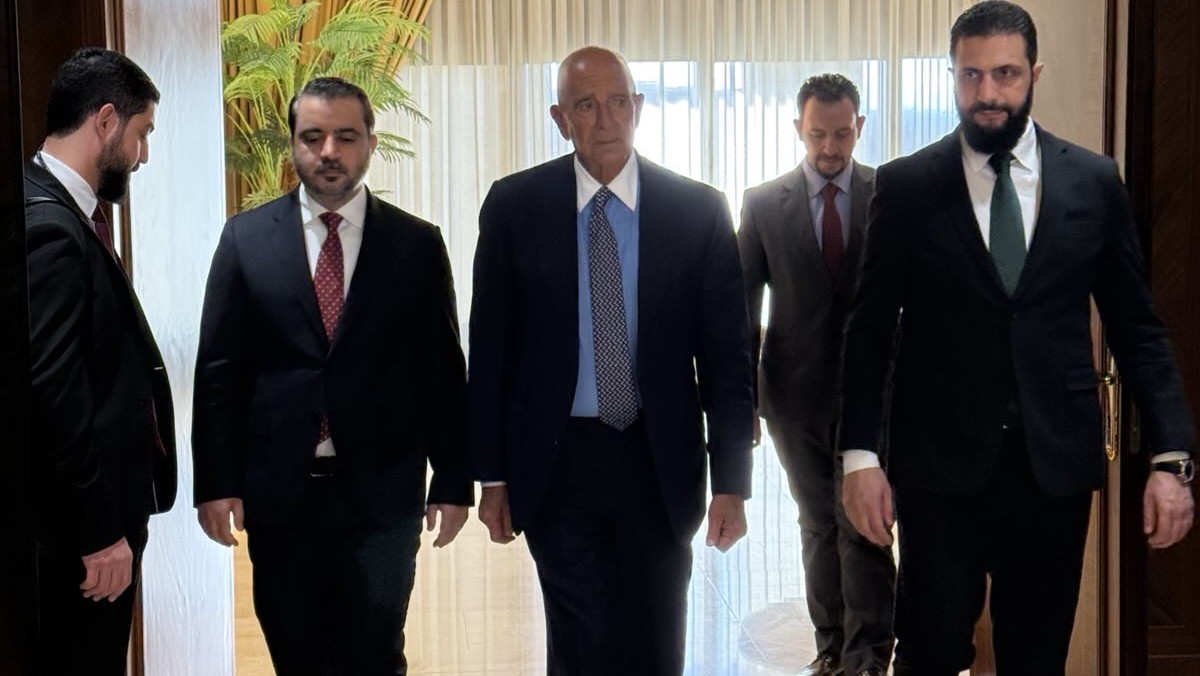
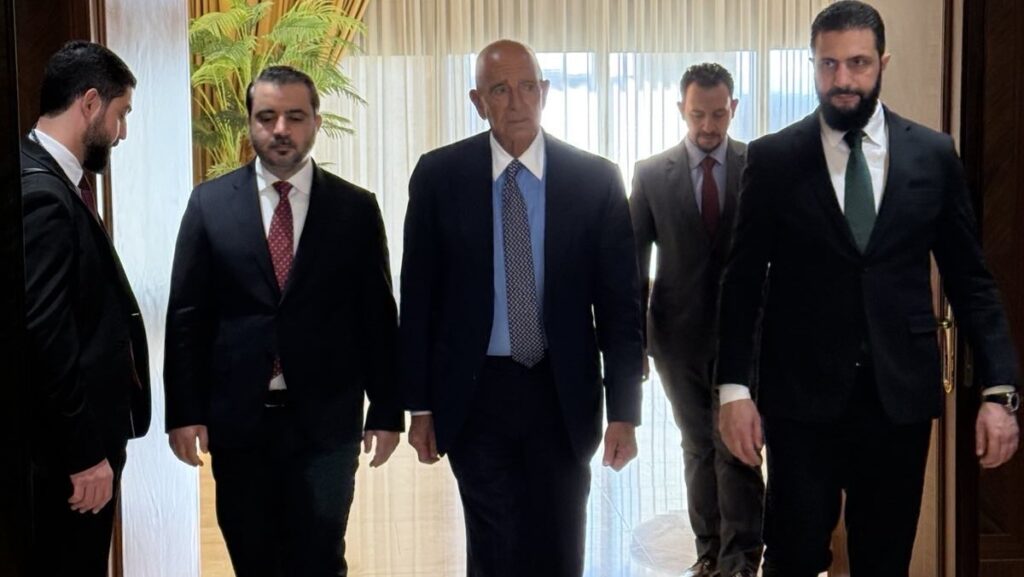
“U.S. Special Envoy to Syria Barrack was in Damascus following the drone attacks in Aleppo, which began despite the ceasefire. In the photo, he is seen between Syrian President Shara and Foreign Minister Sheybani. (Photo: X/USAMBTürkiye)
On January 10, around 15:00, Aleppo Governor Azzam El Gharib held a press conference stating that the clashes between the Syrian army and SDG/PKK militants, which had lasted four days, had ended as of 12:00, and that the militants had begun withdrawing from the Sheikh Maqsoud neighborhood. At that moment, the building was shaken by an explosion. Shortly afterward, the Syrian Ministry of Foreign Affairs reported that the SDG had attacked the city with 10 Iran-controlled suicide drones and called on the international community to stand with Syria against this terrorist attack.
The halted operations soon resumed, and the Interior Ministry announced around 02:00 that control had been reestablished in Sheikh Maqsoud.
About three hours after the drone attack, around 18:00, U.S. Special Envoy to Syria (and nominally Ambassador to Ankara) Tom Barrack met with President Ahmed Shara in Damascus. Following the meeting, he urged all parties on X to adhere to the March 10, 2025 agreement, warning that continued clashes in Syria “invite foreign interventions.” It was unclear whether he was referring to Israel, Turkey, or Iran, which was attempting to reenter the scene after internal unrest following the potential overthrow of the Assad regime.
Fidan: PKK Responds Only to Force
Another detail: Syrian Information Minister Hamza Al Mustafa, in an X post condemning the attacks, blamed both the SDG and the PKK. In Ankara, the Ministry of National Defense had announced on January 8 its support for Syria’s operation against SDG/PKK in Aleppo, stating that the Turkish Armed Forces could assist if requested. On the evening of January 9, Foreign Minister Hakan Fidan told TRT:
“As an extension of the PKK, the SDG has this characteristic: it cannot be persuaded through dialogue unless it sees force or the threat of force. It acts only when confronted with power or the threat of power.”
Another detail: On January 9, while the Syrian army launched a new attack on the SDG in Aleppo for violating the unilateral ceasefire, European Commission President Ursula von der Leyen and Council President Antonio Costa met with Ahmed Shara in Damascus. Von der Leyen’s message to the world, unlike the SDG’s expectation (“stop attacks on Kurds”), focused on participating in Syria’s reconstruction.
Why the SDG is in Aleppo
The pro-Türkiye “Terörsüz Türkiye” process’s parliamentary representative, DEM Party, claimed from the start that the clashes in Aleppo were not a battle between armies, but attacks by Shara government’s HTS militias on Kurdish civilians, urging Western “guarantors” to intervene. Tens of thousands marched in Diyarbakır and Van. While the process stalled in Syria, hope remained in Rojava; a new Kandil could emerge.
The answer to “Why Aleppo?” is strategic: Aleppo, Syria’s second-largest city, is home to Kurdish populations in Sheikh Maqsoud and Ashrafiye neighborhoods. Similar to Turkey, there is a misconception that all Kurds share the same political views.
Strategic Junction Watch
During the civil war, the Assad regime sought to limit SDG control over Aleppo’s Kurds. The neighborhoods of Sheikh Maqsoud and Ashrafiye are located along the strategic M4 highway, which runs westward from the Iraq border through Qamishli, Raqqa, Manbij, Aleppo, and Idlib, reaching the Mediterranean coast in Latakia, covering 500 km. A branch of this route, the M5, runs south from Idlib through Hama, Homs, Damascus, and Dara at the Jordanian border, spanning 450 km. Aleppo sits at the intersection of these major corridors. During the Assad regime, the SDG effectively controlled this strategic junction. When the government called for civilians to evacuate, the SDG responded by blocking the M4 route.
Was the U.S. General Asked to Leave?
On January 4, SDG leader Mazlum Abdi went to Damascus with U.S. forces. Shara had canceled a December 28 meeting due to SDG’s inflexible demands. Tensions arose during inter-delegation talks. According to journalist Amberin Zaman (Al Monitor), Syrian Foreign Minister Hasan Assad Sheybani at one point requested that U.S. Brigadier General Kevin Lambert leave the room. Lambert, responsible for SDG affairs, had previously coordinated with CENTCOM commander Admiral Bradley Cooper and accompanied President Trump to meet Shara. The meeting ended after Sheybani issued a March 10 ultimatum, and Abdi left Damascus with the Americans.
The Syrian army launched its Aleppo operation on January 5. SDG resistance led to clashes starting January 6. According to security sources cited by YetkinReport, MIT made a key observation at this stage, speaking directly with U.S. and Syrian authorities and indirectly with the SDG.
MIT Observation on Kandil Orders
Sources indicate that Mazlum Abdi and SDG foreign affairs official Ilham Ahmed initially showed a willingness to compromise. During the early stages of the army and police operation in Aleppo, the outer neighborhoods of Sheikh Maqsoud were cleared of YPG forces without major conflict. However, after Ashrafiye was evacuated and Sheikh Maqsoud surrounded, Kandil issued orders on January 6 to “strengthen and fight.” Consequently, Ankara officials claim that the PKK is responsible for the bloodshed. Mazlum Abdi and Ilham Ahmed are not directly blamed. One security source suggested that the SDG should first reach an agreement with Damascus and accept the March 10 terms. Significant developments are expected.