
Yetkin Report - Murat Yetkin

  • Türkçe
  • Politics
  • Economy
  • Life
  • Writers
  • Archive
  • Contact

The Middle East Is Being Reshaped: The Türkiye–Saudi Arabia–Pakistan Triangle

by Murat Yetkin / 09 August 2026, Sunday / Published in The Middle East Political and Economic Affairs, Turkish Foreign Relations Analysis Forecast

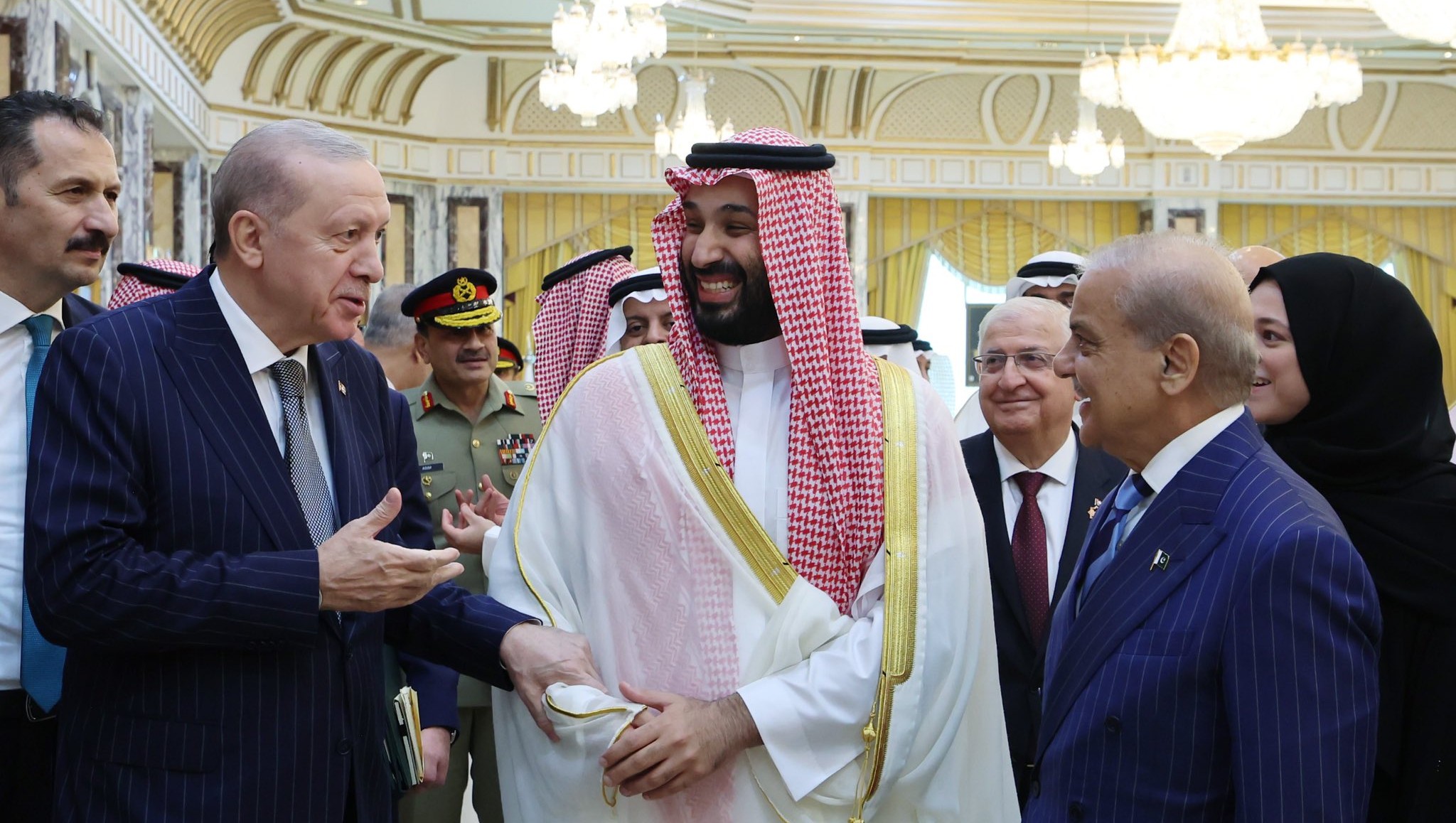
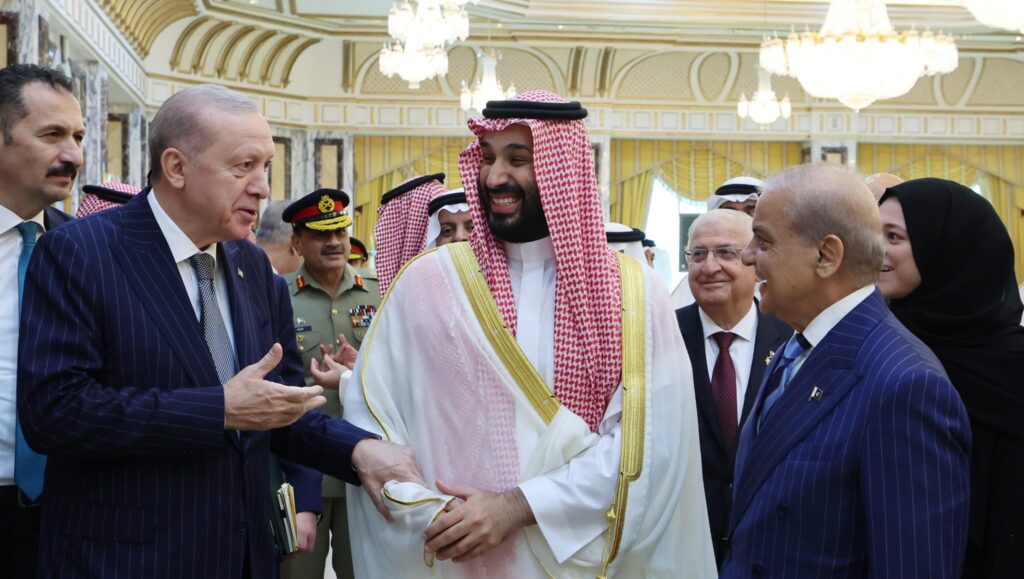
From left, President Tayyip Erdoğan, Saudi Crown Prince Mohammed bin Salman and Pakistani Prime Minister Shehbaz Sharif share a light moment during the signing ceremony of the Mecca Joint Defense Agreement, which establishes a new center of power in the reshaping of the Middle East, as Turkish Defense Minister Yaşar Güler looks on. (Photo: X/Directorate of Communications)

The Joint Defense Agreement signed today, August 7, in Mecca by the leaders of Türkiye, Saudi Arabia and Pakistan marks an important step in the reshaping of the Middle East by creating a new center of power in the region.

Although it was emphasized that the Joint Defense Agreement signed at Al Safa Palace in Mecca by President Tayyip Erdoğan, Pakistani Prime Minister Shehbaz Sharif and Saudi Crown Prince Mohammed bin Salman, the host of the meeting, is not directed against any country, it stands out as a cooperation project that will create a balance against the influence of both Israel and Iran.

The timing of the Mecca Agreement is also significant. According to diplomatic sources, the agreement, whose preparations had continued for several years, was in fact expected to be signed in the spring. However, it was delayed because of the war that began with the Israeli and U.S. attack on Iran on February 28. The agreement was signed at a time when trade routes, especially for oil and natural gas, particularly maritime trade routes, are under the threat of conflict and new transportation routes are being sought.

There is not yet any information on whether the agreement, like the Terror-Free Türkiye framework law, will be submitted to the Turkish Grand National Assembly for approval before it goes into recess.
A New Power House in the Middle East

Thus, exactly one month after hosting the NATO Leaders’ Summit in Ankara, President Erdoğan signed another agreement on the same day that will affect the geostrategic balance in the Middle East. Türkiye’s Directorate of Communications announced that the agreement “stipulates that an armed attack against any one of the three states shall be regarded as an attack against all of them.” This is a reference to Article 51 of the United Nations Charter concerning the right of self-defense.According to information obtained from official sources in Ankara, it is emphasized that this situation does not contradict Türkiye’s NATO membership, that NATO has “no alternative,” and that, on the contrary, this is a “complementary” structure that enables the sharing of the security burden. Diplomatic sources say that each country will remain within its own alliance structures and that the agreement will also be open to the participation of other countries in the region.This emphasis means that the answer to the question, “Is an Islamic NATO being established?” is “No.”The joint statement on the agreement, whose full text has not yet been published, indicates the emergence of a new political and military center of power, as cooperation among the three states will extend beyond the existing diplomatic, defense and intelligence structures to include the defense industry.Pakistan Is a Nuclear Power

Türkiye, Pakistan and Saudi Arabia all have important geographical positions and characteristics that can create a force multiplier when combined. In addition, all three countries have recently shared an important political common ground in their efforts to prevent conflicts, from the Russia-Ukraine war to Israel’s attacks on Gaza and the war with Iran. Beyond that:

  • Türkiye is a NATO member with access to the Mediterranean, Eastern Europe, the Black Sea and the Caucasus. It is the industrial center of its region and has made significant advances in defense industry technologies in recent years.
  • Saudi Arabia is one of the world’s leading oil and natural gas producers and has the potential to provide financial support for joint energy, transportation, trade and defense projects.
  • Pakistan borders Iran and Afghanistan, as well as India and the Indian Ocean, has access to Central Asia, and possesses nuclear weapons.

If these capabilities can be mobilized jointly, as envisaged in the Mecca Agreement, it is clear that they will limit the freedom of action of some countries in the region.

Israel, which has already reacted openly, is at the top of that list. It can be seen that the agreement will create a balancing weight against both Israel and Iran in the broader Middle East, and against India in South Asia.

The Terror-Free Türkiye Dimension

By its scope, the agreement has the potential to bring Iraq, which is under the impact of the U.S. occupation, and Syria, which is trying to recover from civil war, and perhaps Lebanon as well, under its umbrella.

The Terror-Free Türkiye framework law, submitted to the Turkish Grand National Assembly two days before the agreement and expected to be voted on in the coming days, occupies an important place in the process of reshaping the Middle East. The PKK’s gradual transformation from an armed threat in Türkiye, Iraq and Syria into an actor participating in open politics could accelerate energy, transportation and industrial investments throughout the region.

Within this framework, projects such as the Development Road, which is planned between Iraq and Türkiye and will provide a secure highway and pipeline route between the Persian Gulf and Europe and Central Asia; the Iraq-Syria oil pipeline; and the New Hejaz Railway extending through Türkiye, Syria, Jordan, Saudi Arabia and Oman could become a reality.

In addition, the Mecca Agreement has the characteristic of being an attempt by the countries of the region to redefine their relations with the United States and Western Europe at the level of strategic autonomy and to give priority to their own interests provided that it can be implemented and does not fall apart almost immediately.

Yeni yazılardan haberdar olun! Lütfen aboneliğinizi güncelleyin.

İstenmeyen posta göndermiyoruz! Daha fazla bilgi için gizlilik politikamızı okuyun.

Aboneliğinizi onaylamak için gelen veya istenmeyen posta kutunuzu kontrol edin.

Tagged under: Mecca Joint Defense Agreement, NATO, Turkey-Saudi Arabia-Pakistan, Türkiye-Saudi Arabia-Pakistan

What you can read next

Is Greece an ally of Türkiye or of Israel?
“NATO’s Outreach to the Middle East via Turkey and Trump’s Two Key Meetings”
Erdoğan couldn’t say “One minute!” to the Saudi Crown Prince
  • The Middle East Is Being Reshaped: The Türkiye–Saudi Arabia–Pakistan Triangle9 August 2026
  • Thanks to Israel, the U.S. is no longer the Arab monarchies’ insurance policy against Iran5 August 2026
  • Özgür Özel Leaves CHP to Form a New Party21 July 2026
  • Russia-China Meeting in Ankara and Fidan’s Visit to Ukraine15 July 2026
  • Erdoğan Expects Trump to Keep His Word, Trump Expects Europe to Keep Theirs8 July 2026
  • Ankara Summit Marks the Birth of NATO’s New Cold War Era7 July 2026
  • “NATO’s Outreach to the Middle East via Turkey and Trump’s Two Key Meetings”6 July 2026
  • Russia’s Ambassador to Ankara: We Respect Türkiye’s Choice of NATO Membership17 June 2026
  • Can the NATO Summit Open Europe’s Doors to Türkiye?17 June 2026
  • Armenia: Pashinyan Chose Peace with Türkiye and Azerbaijan—and Won8 June 2026
Search the news archive...

Politics

Economy

Life

Writers

Archive

Türkçe

About

Impressum

FAQ

Advertising

Contact

Made with ♥ by tbtcreative.com © 2022 yetkinreport.com All rights reserved.

Yetkin Report     ·      Help     ·      User Agreement     ·      Legal

TOP