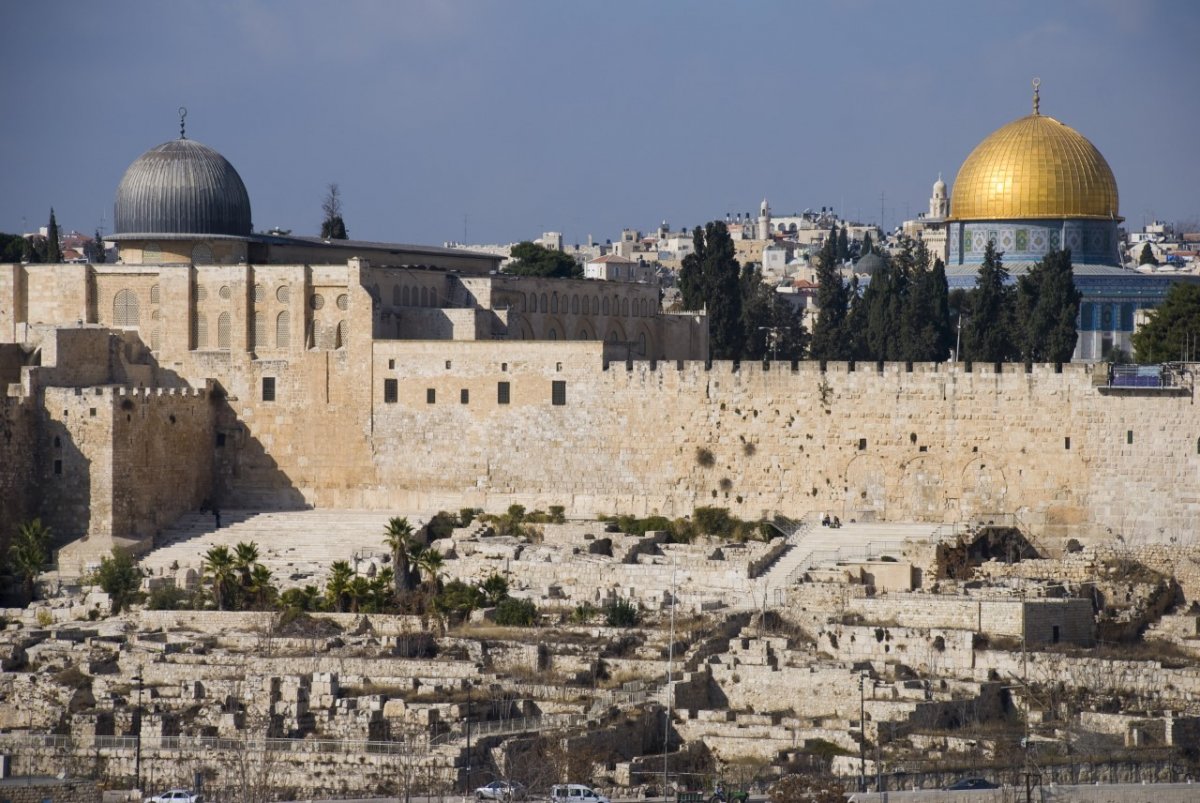
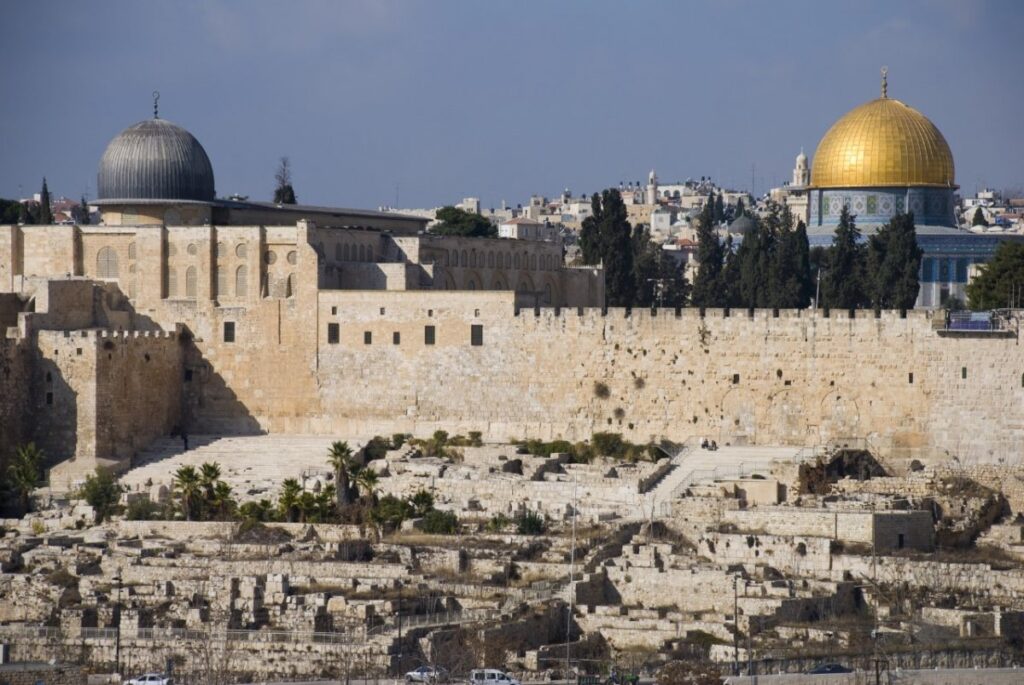
Jerusalem: Masjid al-Aqsa from the east, together with the Dome of the Rock. (Photo: TDF Encyclopedia for Islamic Studies)
The Erdoğan–Netanyahu confrontation is no longer just a war of words. It reflects a deeper struggle shaped by the contested status of Jerusalem, energy rivalries in the Eastern Mediterranean, and U.S. unwavering support for Israel. The only way out lies in a hard-nosed approach to deterrence, balanced by sober diplomacy.
From words to weapons
For weeks, the two leaders have traded blows from the podium. After the Doha summit, Benjamin Netanyahu stood under American and Israeli flags, declaring: “Jerusalem is ours, it will remain ours, and it will never be divided. Mr Erdoğan.” This was not just a message to his domestic base; it was aimed at Washington and Ankara, too.
President Erdoğan’s sharp ripostes are equally calculated. They shore up his domestic standing while reminding allies and rivals alike that Türkiye remains a regional heavyweight with historical responsibilities. However, if left unchecked, these escalating exchanges could push the Eastern Mediterranean into its gravest crisis in decades — imperiling the future of two peoples who, historically, have not been enemies.
Personalities and structures
Both Erdoğan and Netanyahu are strong-willed leaders who use confrontation as political leverage. Different personalities might temper the rhetoric, but the underlying disputes — Jerusalem’s status, the de facto realities in Gaza and the West Bank, Israel’s reach into Syria and Lebanon, Kurdish entanglements, and offshore gas fields — would persist regardless. Leaders accelerate the fire; the fuel is already there.
Jerusalem and Al-Aqsa: the flashpoint
Every attempt to alter the delicate status quo of the Haram al-Sharif risks igniting a wider blaze. The Erdoğan–Netanyahu confrontation is no longer just a war of words. It reflects a deeper struggle shaped by the contested status of Jerusalem, energy rivalries in the Eastern Mediterranean, and U.S. unwavering support for Israel; it could ignite sectarian and religious flames across the region within days.
A pan-Islamic military mobilisation is improbable, but severed diplomatic ties, consumer boycotts, protests against passive Arab regimes, targeted financial sanctions, and selective energy disruptions are likely. For Türkiye, silence is not an option; domestic opinion and historical role dictate otherwise.
Asymmetric power, shared risks
If deterrence fails, both countries bring different strengths to the table. Türkiye commands NATO’s second-largest ground forces, with demographic depth, mobilisation capacity, and a $1 trillion economy, however fragile. Israel, by contrast, is small but lethal: a fleet of F-35s, the Iron Dome and Arrow missile shields, electronic warfare dominance, and U.S.-backed military finance.
A direct clash would be catastrophic. Neither side would emerge as a winner. Both would bleed, and the region would be dragged into worse instability.
The U.S. factor
Israel does not act alone.
• In any crisis, U.S. aircraft carriers would anchor off its coast; F-35 squadrons and missile defence systems would be activated.
• Washington was the first to recognise Jerusalem as Israel’s capital and relocate its embassy there, a move that emboldened expansionist policies.
• The U.S. frames Israel as its “forward outpost” in the Middle East, with London’s quiet backing.
• Even NATO has been a battleground: Washington pushed for Israeli membership, but Ankara blocked it.
Reading today’s tensions without factoring in Washington and London is to miss half the picture. Britain’s recent aerial refuelling support for Israeli operations is a reminder.
Encirclement fears in the Eastern Mediterranean
From Israeli air defences stationed in southern Cyprus, to expanding US bases in Cyprus, Greece, Iraq, and Syria, to the tightening Athens–Nicosia–Tel Aviv triangle, Ankara perceives a creeping encirclement.
Energy is part of this chessboard. Israel’s oil lifeline runs via Azerbaijan through the BTC …Energy is part of this chessboard. Israel’s oil lifeline runs via Azerbaijan through the BTC pipeline across Türkiye. Ankara is unlikely to shut the tap outright, given contracts and alliances, but it can signal that “flows are not guaranteed.” Dreams of a Gulf-style 1973 oil embargo are unrealistic; today’s energy markets are global, interdependent, and shaped by Gulf states’ rapprochement with Israel under the Abraham Accords.
Deterrence: from rhetoric to preparation
Erdoğan’s pledge to respond “five-fold” to any Israeli strike is no idle boast if backed by action:
•Visible but non-provocative military exercises and deployments,
•Scenario briefings to Washington, Brussels, and London clarifying red lines,
•Legal and financial measures — sanctions, insurance and credit constraints, arbitration cases,
•Flexible energy and logistics tools to raise Israel’s risk premium.
NATO, the U.S. and the risk of isolation
Article 5 of the NATO treaty is political, not automatic. With Washington firmly behind Israel and several European capitals leaning the same way, Türkiye cannot assume solidarity. Hence, Ankara must strengthen its independent deterrence even while using alliance channels. It should also expect little more than rhetorical support from the wider Islamic world.
“New Crusade” rhetoric and the clash of civilisations
Whenever holy sites are touched, the spectre of a “new Crusade” resurfaces in Western discourse, amplified by American evangelicals. Yet today’s West wages conflict not with medieval crusader armies but with finance, technology, law, and information. Huntington’s “clash of civilisations” thesis only partially applies: the sharper divides are over resources, logistics, technology, and raw power.
The people’s voice
Ultimately, politics and power are meant to serve human welfare. Yet it is ordinary people who pay the price of reckless escalation.
• The father is heading to work in Jerusalem,
• The mother in Gaza is trying to send her child to school,
• The young couple in a Tel Aviv café,
• The anxious citizen in İstanbul is watching the news.
Their common demand is not war but peace, jobs, security, and dignity. Within Israel itself, opposition to Netanyahu’s hardline policies is strong; many Israelis and Jews in the diaspora argue that true security comes only through peace, not perpetual conflict. Ignoring these voices hollows out politics, turning power into an end in itself.
A 25-year framework for peace
The region needs more than firefighting. A binding framework for at least 25 years should:
• Guarantee the status of holy sites,
• Forbid unilateral territorial changes,
• Establish crisis hotlines and joint de-escalation mechanisms,
• Create enforceable arbitration and sanctions clauses,
• Build economic, cultural, and energy interdependence,
• Undergo independent review every five years.
It may sound utopian, but without such a horizon, crisis will remain chronic.
Conclusion: confronting history, confronting politics
A single spark could engulf the region in uncontrollable violence. Denying the historical continuity of Jews or ignoring the lived reality of Palestinians leads nowhere. The gap between Israel’s legitimate birth and its expansionist present must be closed — and only the U.S. can truly enforce this. The EU, Russia, and China remain bystanders for now.
Türkiye’s role is pivotal: firm but prudent, deterrent but diplomatic, prepared yet level-headed. Because this is not about national honour alone; it is about millions of lives and the fragile peace of an entire region.