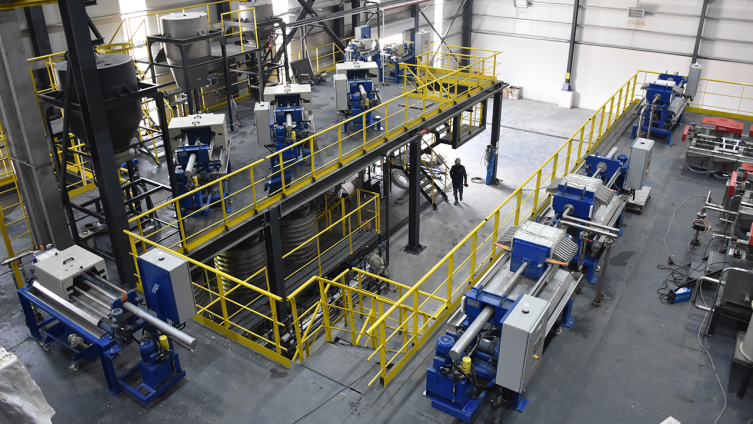
The new “Great Game” is no longer about oil and gas, but is centered around rare earth elements. With its rich deposits, Turkey finds itself caught in the middle of the US-China rivalry. A view from the Eti Maden facility in Beylikova, Eskişehir. (Photo: Ministry of Energy and Natural Resources)
Today, however, we stand on the brink of an entirely new energy era. This time, neither oil nor gas plays the leading role—critical minerals and rare earth elements do. These resources have become determinants not only of emerging industries but also of the global power struggle.
The Invisible Fuel of the Energy Transition
From electric vehicles to renewable energy, from artificial intelligence to the defense industry, from space technologies to digital infrastructures—everything depends on certain minerals.
Without elements like lithium, cobalt, nickel, graphite, copper and manganese, the modern economy comes to a halt.
But behind the scenes, there’s a quieter yet even more powerful group: rare earth elements.
Names like neodymium, praseodymium, terbium, yttrium, and lanthanum are seldom heard, yet each one is a strategic weapon of its era.
From wind turbines to missiles, radar systems to MRI machines, electric vehicle motors to smartphones—countless technologies operate thanks to their magnetic, thermal, and chemical properties.
In short, without these elements, neither a green transition nor technological sovereignty is possible.
China’s Invisible Empire
The dominant power in this critical supply chain is clear: China.
China controls 70 percent of global rare earth element production and 90 percent of refining and processing capacity.
This is no coincidence—it’s the result of strategic patience and state-level planning.
While Western nations shut down their mines due to environmental concerns, China slashed prices to capture the market, accumulated know-how, and consolidated the entire supply chain around itself.
Today, the world depends on Beijing’s refineries, export permits, and pricing policies to sustain the energy transition.
This dependency is not just an economic issue—it is a geopolitical weapon.
Washington–Beijing Mineral Wars
Last week, U.S. President Donald Trump announced a 100 percent tariff on all Chinese goods in retaliation for China’s restrictions on rare earth and graphite exports.
This decision is not merely a trade retaliation—it marks the official beginning of the 21st century’s New Great Game.
Wars are no longer fought with tanks, but through supply chains, tariffs, tech embargoes, and bans on investments. The U.S., along with Canada, Australia, and Europe, is working to form a new supply security front called the “Clean Supply Alliance.”
The goal: to break China’s absolute dominance over the mineral supply chain.
But the playing field is asymmetric. China is dominant not only in production but also in refining, battery manufacturing, and recycling technologies.
Rare Earth Elements in Erdoğan–Trump Meet
Amid this geopolitical storm, interesting claims emerged following the September 25 meeting between President Erdoğan and President Trump: That the rare earth reserves in Eskişehir, Türkiye, would be handed over to American companies—or even jointly operated. It is currently a hot debate between Erdoğan and the main opposition CHP leader Özgür Özel. Back in 2024, cooperation talks had already begun with China over what is considered one of the world’s largest rare earth deposits in Beylikova, Eskişehir.
Collaboration between Türkiye and the U.S. on rare earths was also listed among the priorities in U.S. Special Representative Tom Barrack’s Senate testimony. These developments serve as a critical warning for Türkiye. The U.S. is currently applying the same strategy in Ukraine, Iceland, Africa, and Latin America—securing access to critical mineral fields through investment promises to friendly nations, then taking effective control.
Türkiye must not fall into this trap. No country—especially in such a sharply competitive era—should be granted privileges over Türkiye’s rare earth elements. These resources, much like oil in the 20th century, are the guarantee of Türkiye’s strategic power in the 21st century.
Energy Security to Resource Sovereignty
The 20th century was the century of energy security.
The 21st century will be the century of resource sovereignty.
Rare earth elements are a prime example of this shift.
Today, it’s not just about discovering resources—it’s about processing them and controlling the value chain.
Barrels have been replaced by kilograms; oil wells by mines, and pipelines by refineries.
Energy security now means more than just production—it involves processing capacity, access to technology, and control over data.
In this new equation, power will belong not to those who merely extract resources, but to those who manage them strategically.
Strategic Roadmap of Türkiye
Türkiye holds strong cards in this transformation: it possesses significant reserves of boron, nickel, copper, lithium, and rare earth elements. Yet this potential has not been translated into a coherent vision.
Türkiye must now move beyond isolated “projects” and establish a national critical mineral strategy at the level of state policy.
- Critical Mineral Inventory: All reserves, potential sites, and geological data should be reclassified as national security assets.
- Integrated Value Chain: The extraction, processing, refining, battery production, and recycling of minerals should be carried out within Türkiye.
- Geopolitical Partnerships: Strategic investments should be made with Turkish capital in Africa, Central Asia, and Latin America.
- Green Industry Integration: Mineral strategy should be connected with renewable energy, hydrogen, and battery industry policies.
- Principle of National Sovereignty: No country or company should hold privileges over Türkiye’s rare earths—these operations should be carried out through domestic public–private partnerships.
If Türkiye manages these resources wisely, it can become not just a supplier, but a central country in the new energy era.
The New Great Game Has Begun
With Trump’s tariff decision, the New Great Game has officially begun.
This is no longer just an energy war—it is a battle over minerals, technology, and data.
Just as those who controlled oil wells shaped the world in the oil age, those who control rare earth elements and critical minerals will shape the world today.
Türkiye will either write its own destiny in this game—or be cast as a mere bystander in a script written by others.