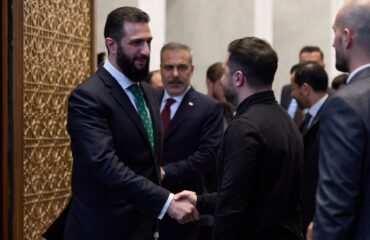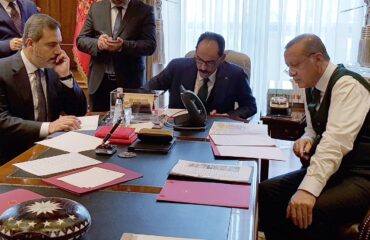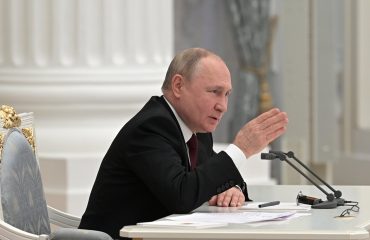


President Erdoğan displays the trajectory over the years of the Palestinian territories occupied by Israel at the UN General Assembly. Meanwhile, Israeli PM Netanyahu is escalating his anti-Türkiye politics. Despite this, a permanent rupture between the two countries does not seem possible. (Graphic: T24)
Türkiye and Israel are weathering one of the most acrimonious periods in their modern diplomatic history. The humanitarian catastrophe in Gaza, Israel’s increasingly assertive posture in Syria, its strategic alignment with Greece and the Greek Cypriot administration, and the heightened pressure from influential segments of the US Jewish lobby on Ankara have all contributed to a deep freeze.
Layered on top are Türkiye’s framing of Hamas as a “national resistance movement,” its restrictions on a bilateral trade volume once exceeding $9 billion, and rhetoric that occasionally converges with Iran’s. Taken together, the two capitals appear politically estranged, with formal ties operating at their bare minimum. Yet one fundamental truth remains unchanged: Türkiye and Israel are two states that know one another intimately and cannot, in practice, disengage for long.
Real Politik and Normalization
Türkiye was the first Muslim-majority nation to recognise Israel. For decades, the two countries cultivated an exceptional partnership spanning defence, intelligence, agriculture, science, crisis management and, more recently, energy. The historic memory of refuge offered by the Ottoman and later Turkish Republic to Jews fleeing the Spanish Inquisition and Nazi persecution still resonates in both nations’ political consciousness.
Even during the harshest crises, this architecture never fully collapsed. Operational intelligence channels, security coordination and substantial trade links were rarely severed. Of course, foreign policy is never shaped solely by structural interests.
The “chemistry” of leaders matters — sometimes decisively. The personal hostility between President Erdoğan and Prime Minister Netanyahu has undeniably deepened the current rupture. But beneath this interpersonal layer lies a deeper, more enduring dynamic: Türkiye–Israel relations possess a structural realpolitik depth that individual leaders cannot erase.
Realpolitik is blunt in its logic: when strategic interests demand it, ties are repaired and ruptures are bridged. Despite today’s hostile discourse, that logic is quietly reasserting itself. In a region where both states remain the most resilient and capable actors, the choice is binary — prolonged confrontation or renewed cooperation. The real question, then, is no longer whether normalisation will occur, but whether Ankara and Tel Aviv can start laying the groundwork for the inevitable today.
Back-Channel Diplomacy Networks
When formal channels stall or become politically toxic, the real arteries of diplomacy seek alternative pathways. Today, those pathways run through discreet networks of:
• former intelligence chiefs
• seasoned diplomats
• trusted business intermediaries
• think-tank networks
• diaspora actors
These are not official committees, nor do they operate with public mandates. They form an unspoken “back-channel taskforce” with three principal functions:
De-escalating rhetoric before it becomes policy
In fragile periods, a single phrase can crystallise long-term damage. Quiet intermediaries help recalibrate tone before it crosses that threshold.Opening apolitical, low-risk cooperation tracks
Green energy, water management, agricultural tech, AI, health and cybersecurity offer pragmatic entry points detached from political sensitivities.Using third countries as diplomatic buffers
Baku, London, Washington, Dubai — all serve as neutral venues when direct contact carries domestic political cost. Official silence, in this context, does not mean the absence of communication. It merely signals a change of format.
Regional Imperatifs
The regional landscape leaves both countries little strategic room for indefinite estrangement:
• Iran’s increasingly assertive geopolitical behaviour
• The potential expansion of the Russia–Ukraine war’s regional spillover
• The US shifting its strategic posture and recalibrating regional alliances
• Intensifying energy competition in the Eastern Mediterranean
• Fragile dynamics between Türkiye and Greece
• Rapidly evolving military and political equations in Syria
Against this backdrop — and with Washington applying growing pressure on both capitals — a long-term rupture in Türkiye-Israel relations is neither economically viable, nor strategically realistic, nor regionally sustainable.
Tangible Steps Toward Quiet Normalization
Moving forward does not require grand announcements or high-profile summits. It requires technical precision and political patience:
A small, trusted back-channel core group should be established.
Issue-specific working clusters — energy, water, agriculture, defence tech, AI, health — can create early wins.
Low-profile but regular meetings in third countries should be institutionalised.
A joint media-de-escalation protocol can reduce unnecessary crises.
A renewed 25-year strategic framework can anchor the relationship in long-term interests, not political cycles.
These are not romantic prescriptions. They are rational, implementable steps aligned with the strategic imperatives of both nations.
Unseen Bridges
Some relationships do not end with dramatic rupture; they fade into silence, regroup and await a shift in the winds. When the moment arrives, they re-emerge.
Türkiye–Israel relations fall firmly into that category:
• Not severed — merely strained.
• Not abandoned — merely dormant.
• Not weakened — merely waiting.
Our task today is not to speak louder, but to strengthen the table at which the two sides will inevitably sit again — whether under these leaders or the next. The work is to build an invisible bridge. When the time comes, realpolitik will decide who crosses it. Because some partnerships do not need noise to restart. They need only one small, well-timed step. That moment is approaching.
Those prepared for it will shape the next chapter.