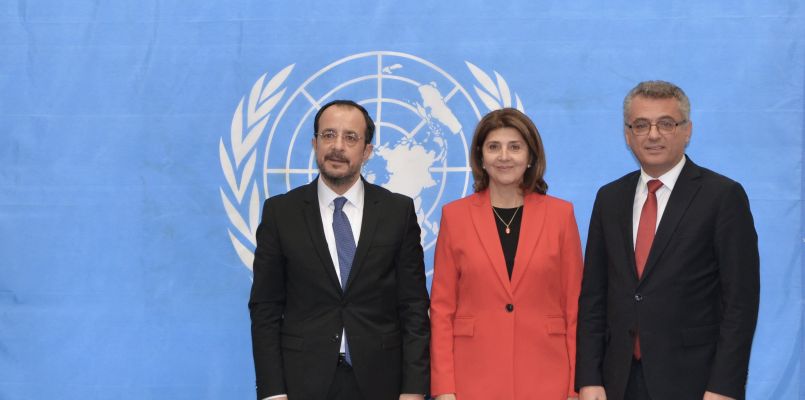
TRNC President Tufan Erhürman, Greek Cypriot Leader Nikos Christodoulides, and the UN Secretary-General’s Personal Representative Maria Angela Holguin met in Nicosia on December 11. (Photo: TRNC Presidency)”
Cyprus has seen countless diplomatic moments that promised more than they delivered. The island has lived through phases of hope, disappointment, silence and outright denial of shared political space. Yet something quietly significant happened in Nicosia last week. For the first time since the collapse of the Crans Montana negotiations in 2017, the two Cypriot leaders sat together under the guidance of a United Nations representative and issued a joint statement. In a conflict where even agreeing to meet has become an ordeal, this alone marks a shift worth examining.
Joint Statement
The meeting itself did not alter the architecture of the Cyprus issue. It did not resolve sovereignty, security, power sharing or guarantees. No one expected it to. But the mere fact that the UN once again facilitated a dialogue that produced a shared text is a reminder that the diplomatic pathways of the past eight years were not entirely abandoned. Cyprus has reopened a corridor that many considered sealed.
The heart of the joint statement lies in the reaffirmation of political equality as described in United Nations Security Council resolutions. The significance of this wording has been poorly understood by those who imagine it as a vague principle. In reality it is one of the most concrete and detailed components of the Cyprus negotiating archive. Political equality, in UN terms, includes rotating presidency on a two to one basis, effective participation of both communities in all federal organs and the requirement that every federal decision must include at least one positive Turkish Cypriot vote. These elements have evolved through decades of negotiations. They are not the creation of any single community. They have become part of the UN parameters since the Annan Plan period. They represent the only viable model that prevents numerical dominance from becoming political domination.
Emphasis on Political Equality
The joint statement did not explicitly refer to a bizonal, bicommunal federation, a fact that will comfort some and concern others. Yet the reactivation of UN Security Council language is more meaningful than the omission of any specific formula. It places both sides, after years of conceptual divergence, back under the umbrella of internationally recognised parameters. However, this should not be mistaken for full convergence. Christodoulides has not endorsed political equality in its complete form. He continues to avoid any commitment to rotating presidency, the very mechanism that gives political equality institutional meaning. His reluctance signals that the Greek Cypriot leadership is willing to speak in generalities, but not yet in the specifics required to unlock a real negotiation.
Uncertainty over Rotating Presidency
This is where Erhürman’s contribution becomes clear. The Turkish Cypriot leader has reintroduced method to a process that for years suffered under unstructured gestures and political theatre. His four stage methodology demands clarity before commencement. Only part of the first stage was reflected in the joint declaration. Rotating presidency was not acknowledged. The architecture of effective participation remains unaddressed.
The requirement of a Turkish Cypriot positive vote was not mentioned. Erhürman made it clear that without full acceptance of all four stages, comprehensive negotiations are not possible. For him, this is not a matter of preconditions but of design. A negotiation that begins without structural integrity is doomed to collapse.
Christodoulides, for his part, dismissed methodology as a non-topic, insisting that the discussion focused on substance. Yet this distinction is artificial. In the Cyprus context, the method is the substance. Without rules, timelines and guarantees that neither side can walk away at will, the table becomes a place where ideas float without gravity. The history of the Cyprus talks is littered with such tables.
Progress in practical areas
Erhürman is attempting to avoid another one.progress in practical areas. Hellim or Halloumi protected designation of origin transition is finally on track for completion. The Metehan or Agios Dometios crossing has been expanded. Licensing procedures will be decentralised. Cooperation in health, population registry and education has been identified. These steps matter. They improve daily life and create habits of coordination. But they are neither a substitute for nor a precursor to political agreement. They are the groundwork upon which trust may grow, but not the architecture of a settlement.
The discussion around a possible five plus one meeting reflects the same divide. Christodoulides sees value in convening one soon. Erhürman rightly argues that without substantive alignment, such a meeting risks repeating the failure of Geneva. His caution is rooted in recent memory. A meeting that collapses on its first day harms the process more than it helps.
Cautious Optimism
The regional environment surrounding Cyprus is more fluid than it has been in years. Türkiye is seeking a recalibrated role in the Eastern Mediterranean. Greece is coordinating more closely with Nicosia. The European Union has reawakened to the Cyprus file. These conditions create a diplomatic space that did not exist in previous years. Yet such space is only meaningful if the leaders of the island are prepared to use it wisely.
This brings us to the essential question. What exactly did the trilateral meeting achieve? The answer is neither dramatic nor dismissive. It achieved a shared reference point after eight years of silence. It restored the United Nations to its rightful place as facilitator. It produced a joint statement that aligns both sides with political equality as defined by the Security Council. It delivered practical cooperation. It opened a door that has been locked for far too long.
Cyprus is not on the verge of a solution, but it is no longer trapped in diplomatic paralysis. The trilateral meeting did not produce breakthroughs. It did something more modest but more important. It created the minimum political and conceptual space in which real dialogue can exist. The island has at last stepped back into the arena of international diplomacy.
The door to a renewed process has not swung open, but it has moved. That movement is enough to justify cautious optimism, provided that no one mistakes motion for momentum. The responsibility now lies with the leaders to use this fragile opening wisely. Eight years of silence have taught us one lesson above all. Doors that remain closed tend to rust in place. Cyprus cannot afford another decade of corrosion.