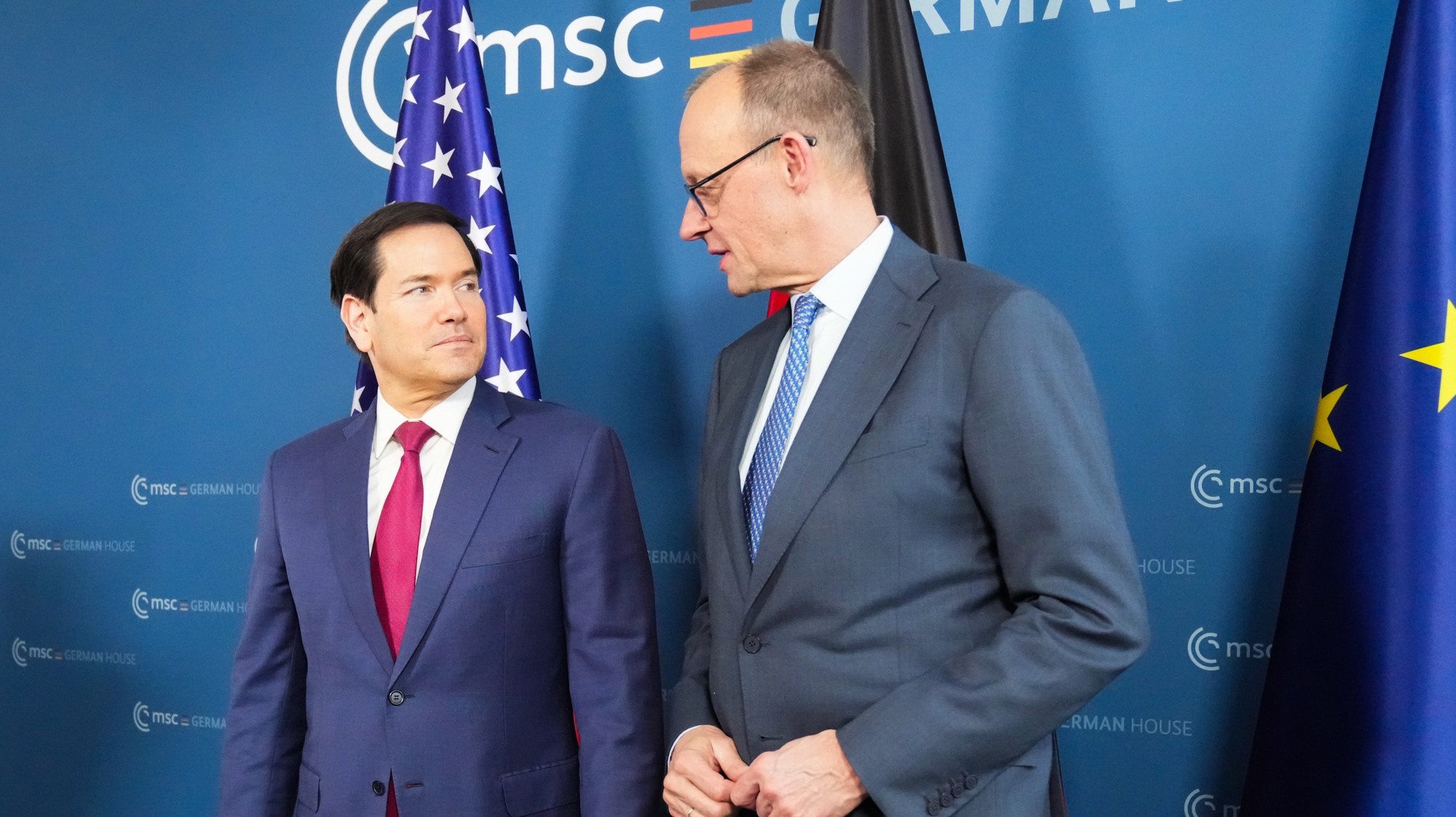
While the Munich Security Conference revealed the deepening rift between the United States and the European Union, it also became a stage where Europe acknowledged its military dependence on Washington even as it searched for ways to resist it. U.S. Secretary of State Marco Rubio is seen with German Chancellor Friedrich Merz. (Photo: X/@SecRubio)
Until Russia launched its invasion of Ukraine in 2022, the Munich Security Conference was regarded as one of the world’s most influential platforms for strategic dialogue — a political barometer for the year ahead. Not only Western countries, but also officials from China, Russia and Iran were invited. Discussions often proved more substantive than those held at UN General Assembly sessions. However, Germany’s decision to stop inviting Russia after the Ukraine war — and later Iran — coupled with Donald Trump’s return to power in the United States and his administration’s increasingly confrontational posture toward Europe, especially the European Union, diminished Munich’s inclusive glow.
China was invited to the 62nd Munich Security Conference held on February 13–15, 2026, and Foreign Minister Wang Yi delivered a forceful speech, particularly on Taiwan and tensions with the United States in the Pacific. Yet just as the 2026 Davos meeting was overshadowed by discussions about Trump rather than economics, Munich was dominated less by cooperation than by the spirit of “Under Destruction” — the conference’s defining theme — and by Trump-era policies. The gathering demonstrated both the further deepening of U.S.–EU contradictions and the EU’s submission to American pressure despite its belated push for strategic autonomy.
As the EU Remains Dependent on the U.S.
The tensions were stark. U.S. Vice President JD Vance argued that Europe’s greatest threat did not come from Russia or China but from within — accusing European governments of tolerating hostility toward Christianity and sliding into authoritarianism. German Foreign Minister Boris Pistorius sharply rebuked him, calling the remarks “unacceptable.” Yet when Secretary of State Marco Rubio followed with a speech similarly accusing European leaderships of straying from Christian values and surrendering to migration — but added, in essence, “We were born from Europe; we belong to each other” — European Commission President Ursula von der Leyen responded with what amounted to a relieved endorsement: the reassurance that the United States was not abandoning Europe.
The reason was clear. NATO Secretary General Mark Rutte bluntly stated that if Europe wanted full defense autonomy from the United States, EU governments would have to allocate up to 10 percent of their national income to NATO’s military spending.
After Trump pressured European allies by threatening to leave them “alone with Russia” unless they increased NATO contributions — pushing defense spending targets from 2 percent to 3.5 percent and eventually toward 5 percent — EU governments, already under pressure from the electoral rise of the far right, found themselves politically cornered. Rutte was simply reminding them of geopolitical realities.
The Era of Power Politics
The conference’s somber tone was set at the outset by German Chancellor Friedrich Merz. Declaring that the international order based on law and rules no longer exists, Merz argued that the era of “the law of the strong” has returned. Questioning America’s leadership of the capitalist West, he warned that great-power politics exploits the dependency of others — a clear reference to Europe’s current predicament.
At the same time, Merz announced that Germany had initiated “confidential nuclear discussions” with French President Emmanuel Macron. Given that France already possesses nuclear weapons technology, the remarks inevitably raised questions about whether Germany — historically a central actor in two world wars — might now be reconsidering its own nuclear posture. (Against this backdrop, EU capitals questioning Türkiye’s ties with nuclear-armed Pakistan and Saudi Arabia reflects another measure of double standards.)
Can Strategic Autonomy Be Achieved Within the EU?
The concept of “strategic autonomy” — which Türkiye has openly pursued since the July 15, 2016 coup attempt and for which it has often been criticized within NATO — is now being invoked by both Berlin and Paris. In his speech, Merz listed Türkiye alongside Canada, Japan, India and Brazil as potential new cooperation partners in foreign policy and defense.
The approach may be sound in theory. But can such a transformation be achieved under the EU’s unanimity principle, which treats defense policy with the same procedural rigidity as fisheries regulations? Clearly not.
For that reason, the “largest six EU economies” — Germany, France, Italy, Spain, Poland and the Netherlands — are preparing to coordinate under the EU6 framework in security, foreign policy and competitiveness without requiring unanimous consent from all 27 member states.
The European Union — arguably the most important peace and development project of the modern era — is taking steps to avoid losing its role as a political and military actor in the face of new threats from Russia and China, particularly without the protective umbrella of the United States.
Yet the unanimity principle, long considered a prerequisite for European peace, has increasingly become the greatest obstacle to European security.
Türkiye’s Position
Türkiye’s role in European defense is increasingly discussed from two contrasting angles.
On one hand:
Its battle-tested land forces securing the borders with Iran, Iraq and Syria;
Its military-industrial capacity, which has expanded significantly over the past decade despite U.S. and EU sanctions;
Its deterrent presence in the Black Sea air and maritime domains, reinforced by drone shields and missile defense capabilities;
The capability it has added to NATO through the TB-3 drone, launched from the amphibious assault ship TCG Anadolu in the Baltic Sea — thousands of kilometers north — striking its target and returning to the vessel;
Its effective intelligence apparatus and its de-confliction diplomacy demonstrated in the Russia–Ukraine war.
On the other hand, Türkiye’s participation in the emerging European security architecture (SAFE) faces obstacles from Southern Cyprus and Greece.
Şimşek Did Not Speak: The SDG Discomfort
Türkiye typically attends the Munich Conference at the level of foreign or defense minister. This time, the highest-ranking cabinet representative was Treasury and Finance Minister Mehmet Şimşek. Intelligence chief İbrahim Kalın, Presidential Security and Foreign Policy Advisor Akif Çağatay Kılıç, and members of parliament were also present. The absence of Foreign Minister Hakan Fidan and Defense Minister Yaşar Güler reflected Ankara’s limited expectations from the conference.
Şimşek was scheduled to speak at a session on Syria’s future — the only Turkish representative granted a speaking role. However, he withdrew. Deputy Foreign Minister Levent Gümrükçü was announced as his replacement but also pulled out at the last minute.
Diplomatic sources suggested two possible reasons: first, that other speakers on Syria — where Türkiye is a principal actor — were not of appropriate rank, aside from Syrian Foreign Minister Assad al-Shaybani; second, that conference organizers had invited SDG leaders Mazlum Abdi and Ilham Ahmed. The visible emphasis placed by U.S. and French leaderships on engaging the SDG was notable. When asked about the issue, NATO Secretary General Rutte responded tersely: “I did not come here to discuss the Kurds.”
“Made in Europe” and Ankara’s Calculations
Another issue directly concerning Türkiye is the “Made in Europe” and “Buy European” policy debate, which also caused divisions at the EU leaders’ summit in Belgium one day before Munich.
Some EU countries, led by France, appear inclined to adopt a protectionist turn reminiscent of Trump-era policies — particularly in public procurement — in hopes of countering Chinese competition. Such a shift would negatively affect Türkiye, whose largest trading partner is the EU and which itself ranks as the EU’s fifth-largest trade partner.
The same Southern Cyprus–Greece brake is also visible in the long-stalled modernization of the EU–Türkiye Customs Union — a move that would, in fact, strengthen Europe’s own competitiveness.
Fortunately, unanimity on protectionist measures has not yet been achieved. Meanwhile, steps by President Recep Tayyip Erdoğan’s government toward EU alignment — including reforms to the Public Procurement Law, the Anti-Terror Law and the Penal Code, implementation of Constitutional Court and European Court of Human Rights rulings, and the release of political detainees — would deprive those seeking to exclude Türkiye from Europe’s evolving security, foreign policy and competitiveness framework of key leverage.
The EU Summit and the Munich Conference demonstrate that as Europe searches for a new path, Türkiye could close significant gaps with a handful of swift and credible steps.