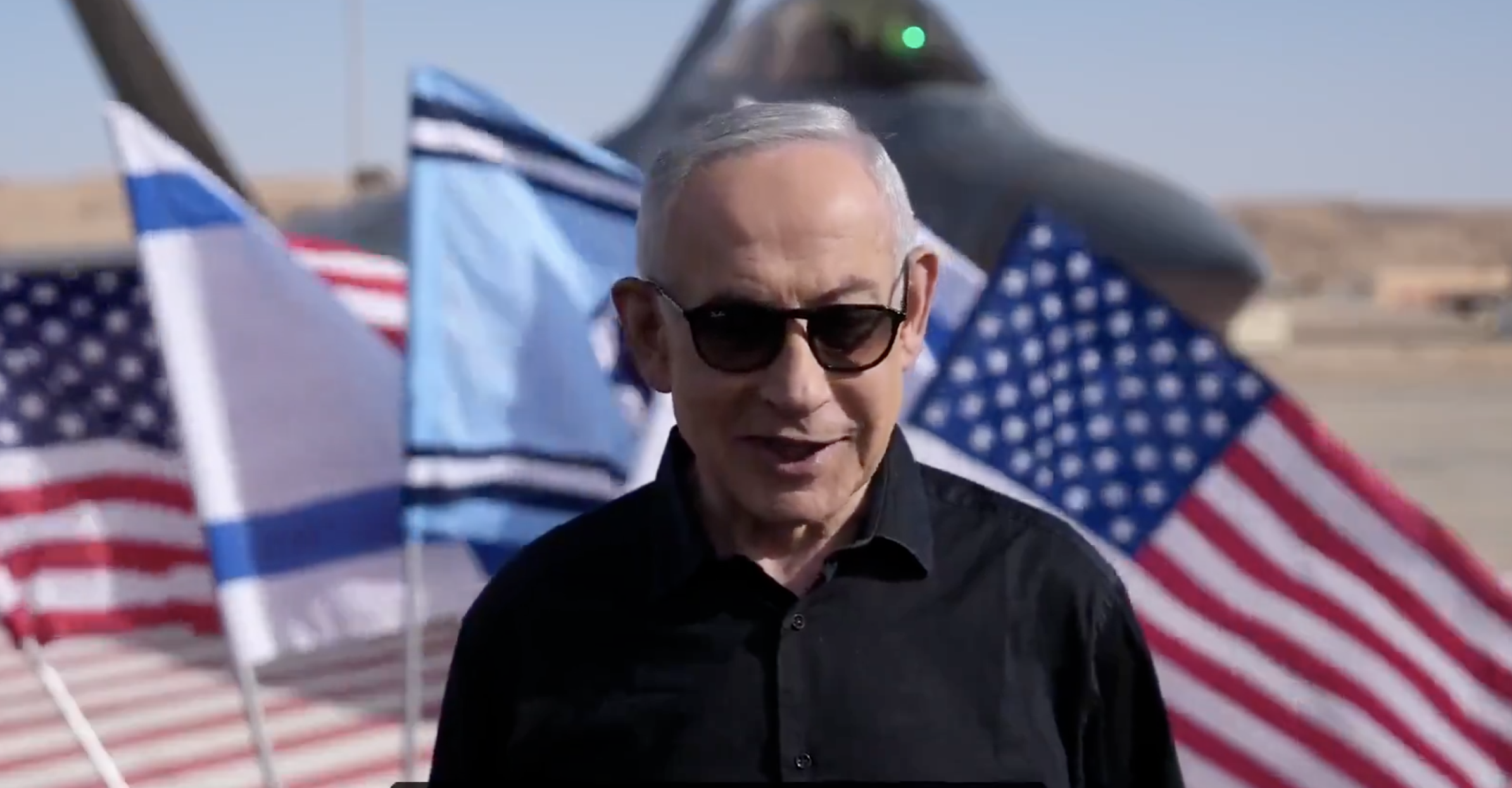
On the sixth day of Operation Roaring Lion, Netanyahu visited a U.S. air base in Israel and described the cooperation between the U.S. military and the Israel Defense Forces as ‘historic,’ saying that strikes on targets in Iran and on elements in Lebanon were continuing. (Photo: X / screenshot)”
Since taking office, U.S. President Donald Trump has been showing the world the darker face that the United States has tried to conceal for the past century. He has done so with the domestic and foreign policy backing of the Israel lobby and the reactionary religious masses connected to it who call themselves “Christian Zionists.”
This coercive mindset recognizes no rules other than the rigid Judeo-Christian religious law that they themselves invented and bent entirely to serve their own interests. One of its reflections in domestic politics was recently seen in the collective prayer ceremony held in the Oval Office, broadcast by the White House chief of staff.
Yesterday, Bradley Martin, a right-wing Zionist columnist at the Wall Street Journal—in a U.S. mainstream media environment where non-Zionist voices have largely disappeared—argued that after Iran, the U.S.–Israel alliance must ensure that “Türkiye does not take Iran’s place.”
Israeli Prime Minister Benjamin Netanyahu, while hosting Indian Prime Minister Narendra Modi recently, spoke of the “rising Sunni threat” in the region, lumping together Greece and Southern Cyprus. Shortly afterward, former Prime Minister Naftali Bennett went even further and openly referred to a “Türkiye threat.”
Could Israel Really Have Gone This Mad?
Could Israel—under Netanyahu’s leadership and emboldened by what it believes to be unlimited political, military and financial support from the United States—really have gone mad enough to dare attack Türkiye?
Despite the NATO umbrella that protects Ankara from Iranian missiles and despite Türkiye’s increased role within NATO following the Russia-Ukraine war, it is possible to say that Israel may still be prepared for a reckless move. This would be based on the belief that the Trump administration in Washington will ultimately prioritize “Israel First,” even though its official foreign-policy slogan is “America First,” and even though this approach has already begun to create tensions inside the United States itself.
How can we tell?
Erdoğan and the “Promised Lands”
From remarks made by President Recep Tayyip Erdoğan in his opening speech to the Turkish Grand National Assembly on October 1, 2024—remarks that were overshadowed at the time by the political moment when MHP leader Devlet Bahçeli shook hands with the DEM Party benches, symbolically launching the “Terror-Free Türkiye” process.
Erdoğan said the following:
– “Driven by the delirium of the ‘Promised Lands,’ the Israeli administration will, after Palestine and Lebanon, set its sights—let me say this clearly—on our homeland. All calculations are currently being made on that basis.”
– “This is precisely what some friends of Israel within Türkiye, some admirers of Zionism, and various voluntary or paid instruments of Zionist propaganda fail to understand.”
– “Even if some insist on refusing to see it, the Netanyahu government is chasing a crude fantasy that includes Anatolia. It is pursuing a utopia and revealing these intentions on various occasions.”
It appears that at the time Erdoğan did not foresee that the United States under the Trump administration would attack Iran under Israel’s insistence and encouragement. Otherwise, he might not have suggested that Israel—after Palestine and Lebanon—would set its sights on Türkiye out of “religious fanaticism.”
Nevertheless, it can be said that Ankara’s recent efforts to gain greater autonomy from the United States in the defense industry have partly been driven by the calculation that Israel’s leadership could attempt such a reckless move.
Israel and the Middle East 35 Years Ago
Why 35 years?
Because the reference point is the collapse of the Soviet Union.
Thirty-five years ago, in 1991 and the early 1990s, the Muslim countries of the region that were hostile—or at least adversarial—to Israel, in varying degrees from west to east, included Morocco, Algeria, Tunisia, Egypt, Jordan, Saudi Arabia, the Gulf states, Syria, Iraq and Iran.
At that time, the only country in the region that was not hostile toward Israel was Türkiye.
Thirty-five years later, with the exception of Iran, all of these countries have been brought into line—through U.S.-led occupations, supported internal unrest and uprisings, and political assassinations. In other words, through coercion.
Today, apart from Iran and Yemen, which remains under Iranian influence, the only country in the region that has neither entered Israel’s orbit nor shown willingness to do so is Türkiye.
Given this historical reality—and the information that Türkiye has factored such a scenario into its strategic calculations—the question must be asked once again:
Could Israel really have gone mad enough to attack Türkiye?