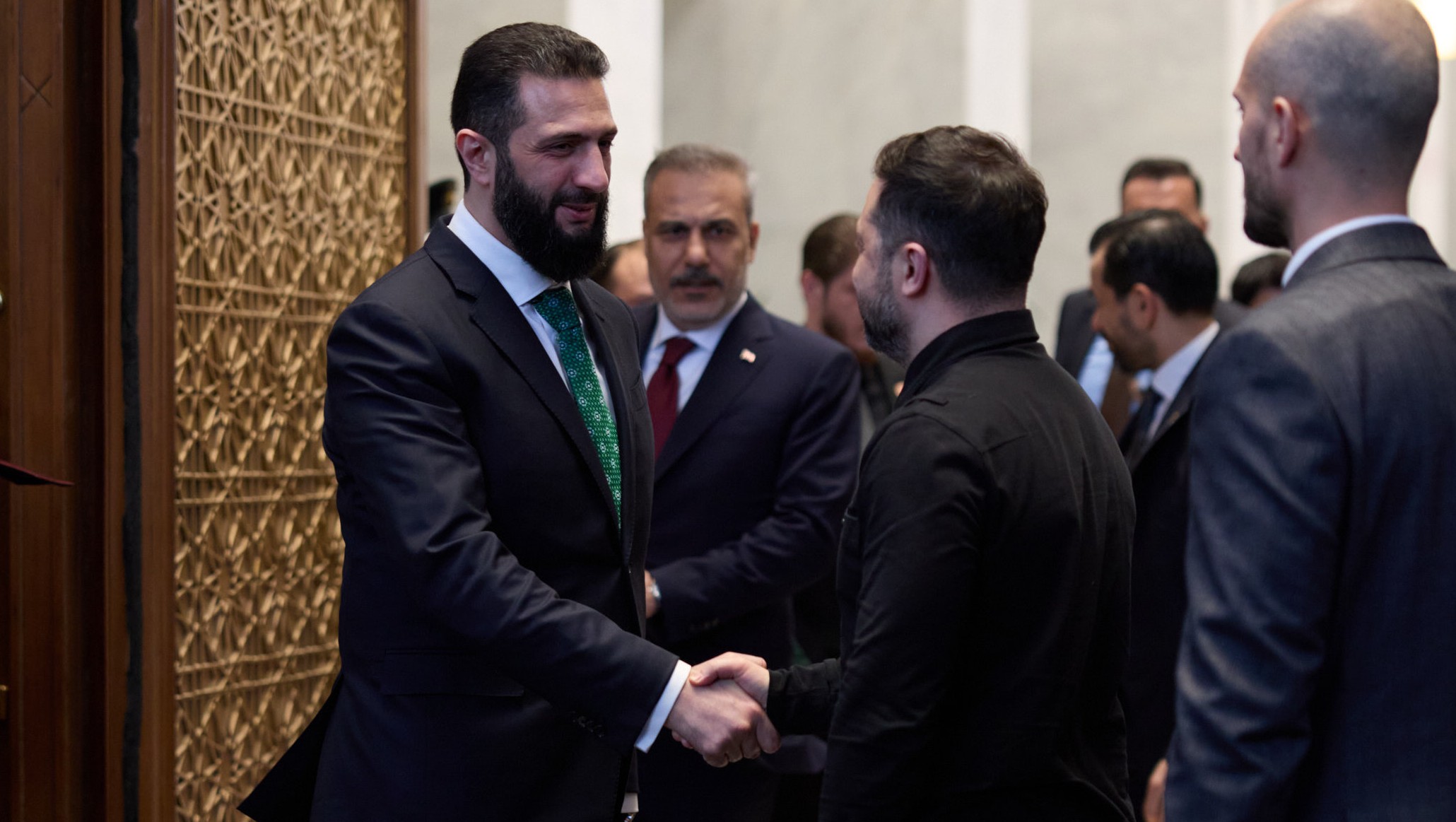
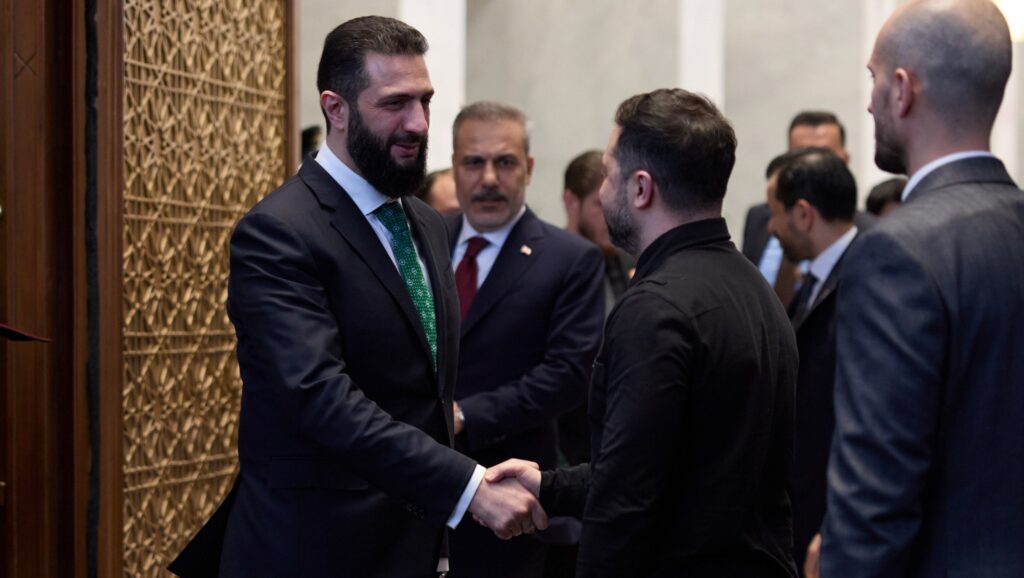
Ukrainian President Volodymyr Zelensky is received by President Ahmed al-Sharaa in Damascus after his March 4 meeting with President Erdoğan in Istanbul, while Foreign Minister Hakan Fidan stands by, appearing ready to catch Zelensky’s eye at any moment. (Photo: X/Zelensky)
Ukrainian President Volodymyr Zelensky met President Tayyip Erdoğan in Istanbul on April 4. We do not know whether the timing of the visit was deliberately arranged, but since he was already in Istanbul—and as it coincided with Easter—he also visited Patriarch Bartholomew. Later, in a move that, like his Istanbul visit, had not been announced in advance, he traveled to Damascus on April 5 to meet Syrian President Ahmed al-Sharaa. Erdoğan assigned him the official aircraft of the Republic of Türkiye. Foreign Minister Hakan Fidan, who had spoken by phone the day before with Syrian Foreign Minister Assad Hassan al-Shaibani, accompanied him and took part in the meetings. (Let us recall that Fidan had also attended the Trump–Sharaa meeting at the White House in November 2025.) Unexpected crossovers are taking place in the Middle East. The attack on Iran launched by U.S. President Donald Trump together with Israel appears set to shift the region’s imbalances onto an entirely different ground.
Note the Patriarchate Factor
Before turning to the substance of Zelensky’s meeting with Erdoğan, the Syrian dimension, and an intriguing detail absent from the Presidency’s statement, I do not want to skip the Patriarchate aspect. The Greek Orthodox Church has long had a place in the Russia–Ukraine conflict.
Four years after Russia’s occupation and annexation of Crimea in 2014, and three years before Russia launched its full-scale war on Ukraine, the Ukrainian Church declared in January 2019 that it was breaking away from the Russian Church and recognizing Bartholomew as “Ecumenical.” Russian President Vladimir Putin opposed this, but at the time NATO member Türkiye had serious problems with Russia, which was supporting the Bashar al-Assad regime in Syria; President Tayyip Erdoğan did not intervene. The Ukrainian Church’s decision to break away from Moscow was publicly announced by then Ukrainian President Petro Poroshenko at a dinner held at the Conrad Hotel in Istanbul, where Patriarch Bartholomew was the guest of honor. I was there.
Zelensky was elected President of Ukraine about four months after that meeting, replacing Poroshenko. Shortly after applying for EU and NATO membership—citing the need to stop Moscow’s pressure and with the backing of the Joe Biden administration in the U.S.—Putin ordered his armies to invade in February 2022.
From Then to Now
Erdoğan stepped in, and while Russian forces had not yet advanced too far, Türkiye was able to bring the Russian and Ukrainian sides together first in Antalya and then in Istanbul. No one says it openly, but Ankara has always known that it was Washington and London that blocked the continuation of those talks. Just as the U.S. and Israeli leaderships now seem to believe that killing Iran’s leaders would bring down the mullah regime within weeks, back then the U.S.–UK alliance had fallen under the illusion that Russia would quickly give up. As arms manufacturers profited from sales, commitments were simultaneously being secured to ensure future access to Ukraine’s underground resources.
When Trump was elected in the U.S., all balances shifted. After humiliating Zelensky—whom he had invited to the White House—he went on to line up European leaders in a row and scold them: “Time to put up the money.”
Despite its Western allies, Türkiye wants to bring together its two Black Sea neighbors, Russia and Ukraine, once again—and in an interesting way, the issues are becoming intertwined with Middle Eastern dynamics.
Zelensky, Montreux, NATO, Putin
Several significant developments took place before Zelensky’s latest visit.
On March 28, the Altura tanker, operated by a Turkish company and carrying oil loaded from Russia, was struck in the Black Sea. Suspicion fell on a Ukrainian Unmanned Surface Vehicle (USV), but no official statement has yet been made; nor was this the first such attack.
Two days earlier, Russia’s new ambassador to Ankara, Sergey Vershinin, had arrived in the capital. Since 2018, Vershinin had been Deputy Foreign Minister responsible for Middle Eastern affairs (including Syria, Iran, and others) under Russian Foreign Minister Sergey Lavrov.
On March 30, the Ministry of National Defense announced not only that a NATO rapid response corps headquarters would be established in Türkiye, but also that a multinational “Naval Element” would be created at the Black Sea exit of the Bosphorus. Russia welcomed the Ministry’s statement that this “Naval Element would not violate the 1936 Montreux Convention.”
On April 2, Russia said that a gas station of the TurkStream pipeline carrying natural gas to Türkiye had been targeted in a drone attack.
On April 3, Erdoğan spoke with Putin about both the Iran- and Hormuz-related energy crisis and Black Sea security.
On April 4, Zelensky arrived in Istanbul.
The Syria Surprise
According to a statement by the Presidency’s Directorate of Communications, Erdoğan reiterated to Zelensky that Türkiye was ready to support a return to negotiations with Russia and raised the issue of Black Sea security. He also expressed satisfaction with Ukraine’s efforts to “develop relations with Gulf countries.”
Now, a Syrian dimension has emerged. In a message posted on X after his meeting with Sharaa, Zelensky—also referring to the contribution of Foreign Minister Fidan and Türkiye—said they would cooperate on everything from food to technology and security, and that the two countries’ economies would grow together in the post-war period.
We will soon understand whether the fact that the Christian minority in Syria is largely of the Greek Orthodox faith has played a role in this.
The Security Technology Detail
A few hours earlier, Zelensky had shared details on X about his meeting with Erdoğan. His message included a detail not found in the Presidency’s statement:
• “We agreed on new steps in security cooperation. This primarily concerns areas where we can support Türkiye—expertise, technology, and experience. There is a strong political will to work together, and our teams will finalize the details in the coming days.”
Zelensky says “in the coming days” and speaks of transferring expertise, technology, and experience to Türkiye in the field of security.
Let us recall: after speaking with Putin about Iran and the Black Sea, and meeting Zelensky, Erdoğan also spoke with NATO Secretary General Mark Rutte. Do you think they only discussed, as officially stated, the NATO Summit to be held in Ankara on July 7–8? We will soon find that out as well.