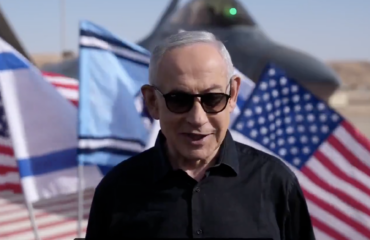
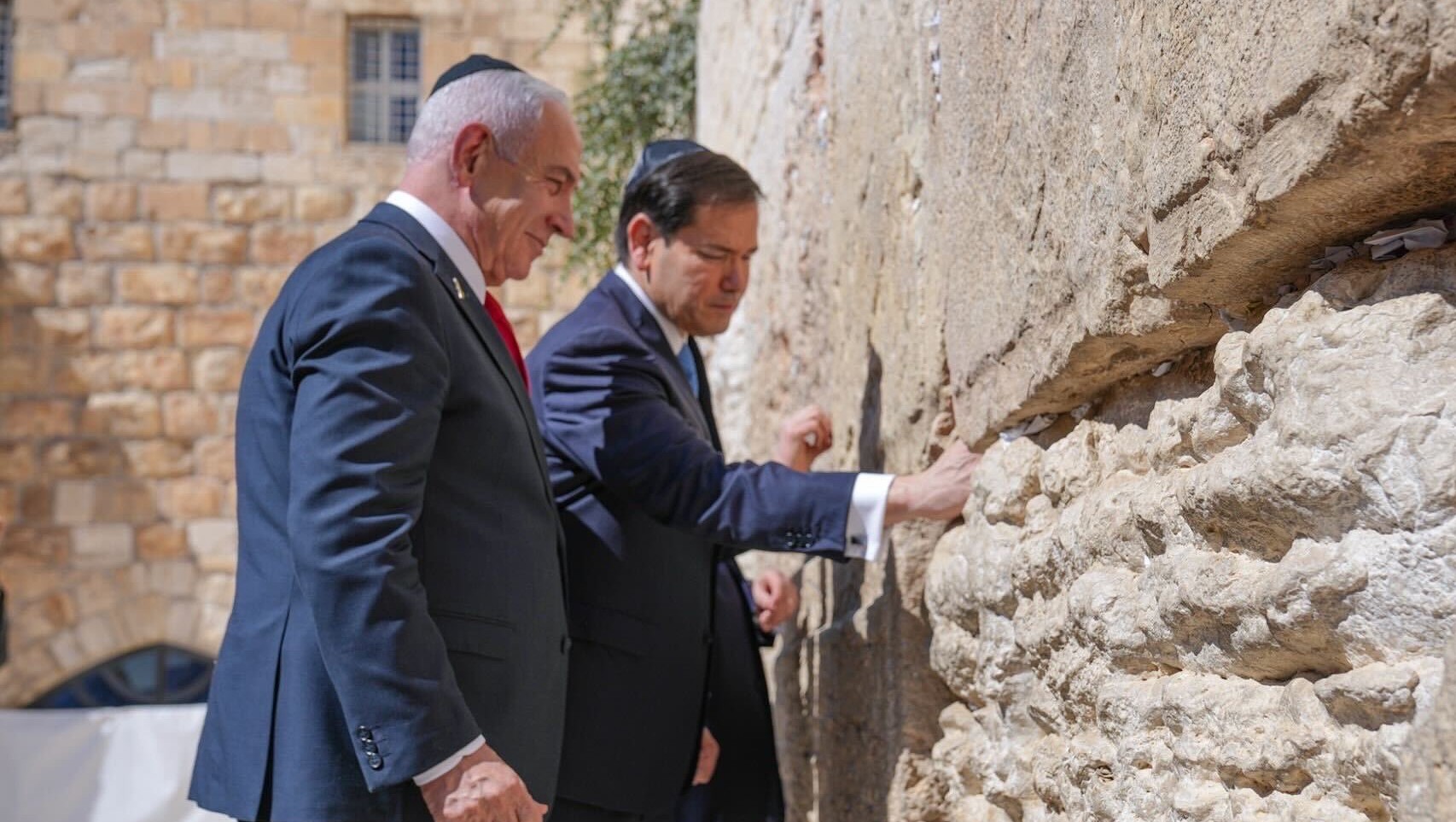
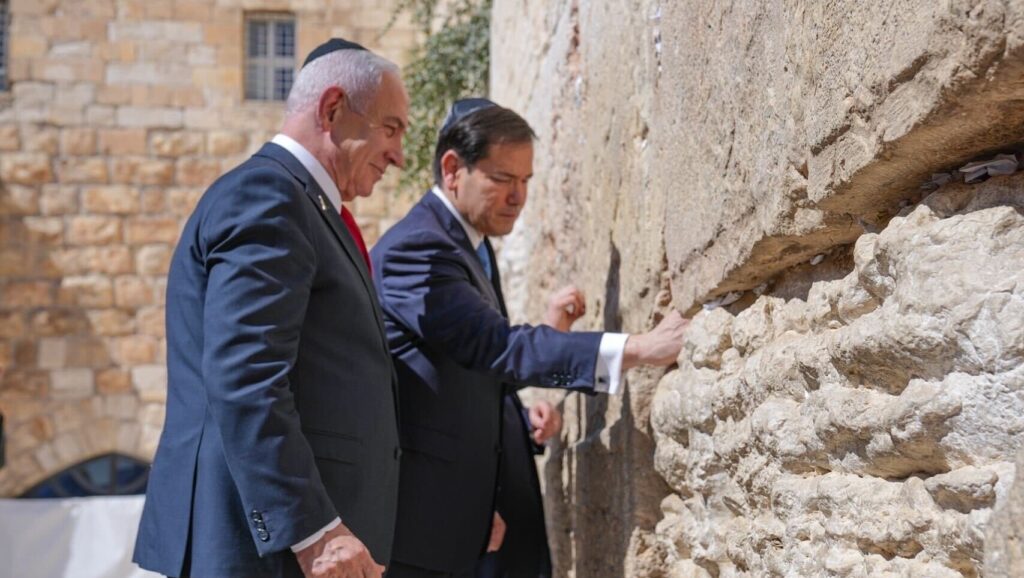
The US continues to support Israel even after the attack on Qatar, home to its largest military base in the Middle East, while Netanyahu is troubled by economic sanctions and social exclusion starting in Europe. It would be surprising if Erdoğan’s call for sanctions against Israel in the Islamic world were to resonate. The photo shows U.S. Secretary of State Rubio making a wish at the Western Wall in Jerusalem, accompanied by Netanyahu. (Photo: X/MarcoRubio)
U.S. Secretary of State Marco Rubio poured fuel on the fire with his remarks at a joint press conference with Prime Minister Binyamin Netanyahu in Israel following the Qatar operation.
According to Rubio, efforts to recognize the State of Palestine were “emboldening Hamas”. Rubio who was already emboldening Netanyahu’s expansionist aggression with this visit alone, did not mention the countries that had already recognized Palestine; this issue had already divided the European Union, for example. Rubio was trying to dissuade close allies such as the UK, France, Canada, Australia, and Belgium, which had announced their decisions to recognize Palestine at the UN General Assembly in New York on September 23-27, from their decisions.
But even while doing so, he was trying to justify Israel’s attack on Qatar on the grounds of killing Hamas leaders.
Despite the influence and manipulation of pro-Israel capital, as governments, particularly in the Western world, began to take a stand against Israel in response to public reaction, the US found itself isolated in its support for Israel, with Netanyahu seeing that only the US remained openly supportive of him. Indeed, during his meeting with Rubio, Netanyahu complained about “economic isolation” and spoke of the need for the Israeli economy to be “self-sufficient.”
Call for sanctions in Qatar
At the same time, Rubio’s next stop was Doha, where he attended a joint meeting of the Organization of Islamic Cooperation and the Arab League in support of Qatar. President Tayyip Erdoğan also addressed this very issue. In his speech, he said that “genocidal Israel” must be held accountable for its actions against Palestine and the Palestinians and that “Israel must also be squeezed economically.”
His words were directed squarely at the wealthy Arab autocracies.
Qatari Emir Sheikh Tamim bin Nasser, the target of the attack, said that Israel had deceived them and that its intention was not a ceasefire with Hamas, but to turn the Arab world into an Israeli sphere of influence. Good morning after supper.
From the Emir of Qatar to Egyptian President Abdel Fattah al-Sisi, who also mediated the Hamas-Israel talks, to Jordan’s King Abdullah II and Saudi Crown Prince Mohammed bin Salman, all Arab leaders, in fact all Islamic country leaders, say the same thing in words, but when it comes to actual implementation, fear of the US prevails.
It would be naive to think that Erdoğan’s call for concrete steps together will have any impact on Arab dictators whose power extends only to their own people.
The US, Netanyahu, and Arab dictators
Arab countries are ostensibly giving the world’s petrodollars to the US and buying weapons to curry favor with it, but in the recent attack on Qatar, it emerged that Patriot air defense missiles did not view Israeli planes and missiles as a “threat.” Israel is not considered a “threat” in their software.
Reports that a British aircraft taking off from the US base in Qatar refueled Israeli aircraft in the air as they struck targets in Qatar and then returned to their bases in Qatar have not been denied.
So, will Qatar, home to Al Udeid, the US’s largest base in the Middle East and the headquarters of CENTCOM, be able to translate its rhetoric into action against Israel’s transformation of the Arab world into its sphere of influence with US assistance?
What about Saudi Arabia, Egypt, and the United Arab Emirates? They cannot match Spain, an EU and NATO member that announced it would sever commercial ties and canceled an $820 million military equipment sale to Israel.
In his speech, Erdoğan emphasized that Türkiye severed ties with Israel a year and a half ago when Israel went far beyond responding to Hamas, which had attacked it in Gaza, and began a policy of complete destruction. But it has only been strictly enforced for a few months now, including trade through third countries, thanks to the CHP keeping the issue constantly on the agenda.
Israel’s isolation in Europe
Meanwhile, Ankara takes Netanyahu and his ministers’ reckless statements seriously, such as “We’ll strike Türkiye too,” fueled by the arrogant notion that “the US is behind us anyway.” The attack on Qatar demonstrated that being an ally of the US is not a guarantee for Israel.
On September 10, the day after Israel’s attack on Qatar on September 9, Ursula von der Leyen, the openly pro-Israel President of the European Commission, announced that the EU planned to partially suspend its “dual support” for Israel and the commercial aspects of its partnership agreement with Tel Aviv; they now also saw that Israel was killing civilians in Gaza and Yemen.
On September 13, 142 countries voted in favor of a two-state solution for Palestine in a UN vote. Only 10 countries voted against it; the US, Israel, Argentina, Hungary, Paraguay, and some Pacific Ocean island states opposed it.
As of September 14, the number of European Broadcasting Union (EBU) member countries that have announced they will not participate in the Eurovision Song Contest on May 17 if Israel participates has risen to six: Ireland, Spain, the Netherlands, Belgium, Slovenia, and Iceland.
Netanyahu’s concern that only the US remains behind him is not unfounded.