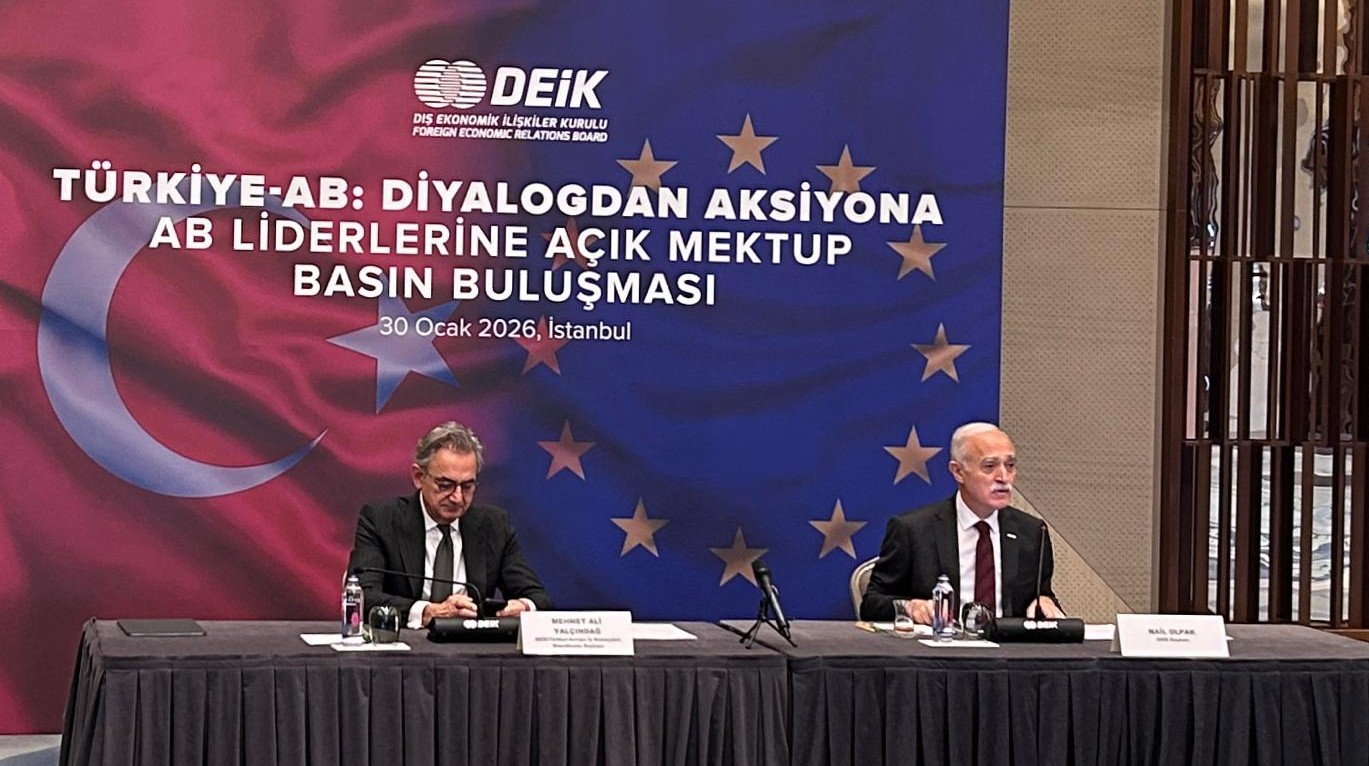
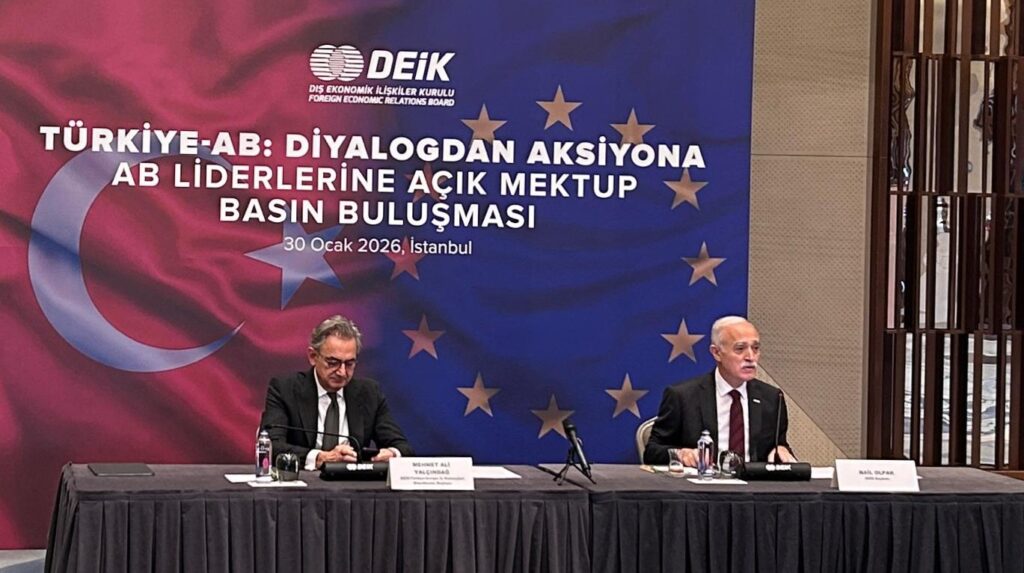
DEİK President Nail Olpak and Türkiye–Europe Business Councils Coordinator Mehmet Ali Yalçındağ are seen answering questions at a press conference they held following the open letter they sent to EU leaders.
On January 31, the Foreign Economic Relations Board (DEİK) published a full-page advertisement in the Financial Times. The ad was titled “An Open Letter from the Turkish Business Community to EU Leaders.” It was addressed to European Parliament President Roberta Metsola, European Council President Antonio Costa, and European Commission President Ursula von der Leyen. Beneath the letter are the signatures of DEİK President Nail Olpak, DEİK/Türkiye–Europe Business Councils Coordinator Mehmet Ali Yalçındağ, and the Turkish co-chairs of 25 business councils.
In short, they are trying to persuade the EU that if it wants to remain a political actor in the new world order, it needs Türkiye.
They also hope to achieve this within this year.
Türkiye–EU: The 2026 Risk
Why this year? Because in response to moves by U.S. President Donald Trump to put pressure on Europe, the EU plans to implement three major initiatives this year, all of which carry the risk of further excluding Türkiye from the EU system. These are:
The new European security architecture (SAFE),
The accelerated “Made in Europe” trade label,
Accelerated free trade agreements with Latin American (Mercosur) countries and India.
Olpak sums up the situation bluntly: “There is a risk that Türkiye will be kept outside the circle.”
Referring to the Customs Union agreement that has still not been updated, Yalçındağ says, “We cannot wait another 30 years.”
What happens if there is no response to this letter—if no concrete progress is achieved in Türkiye–EU relations? Another letter after three months, and if that fails, yet another one three months later… And then? What comes next is unclear. Yalçındağ says, “At that point, it will become clear that there are other reasons for not accepting Türkiye.”
After all, it is no secret that the problem is not commercial but deeply political.
A Commercial Solution to a Political Problem?
Business representatives do not want to delve into “political issues,” yet the two most visible obstacles in Türkiye–EU relations are profoundly political.
• The Cyprus Issue: The obstruction by Southern Cyprus and Greece. Powerful EU members such as Germany and France act as if they themselves were not responsible for the major injustice committed in 2004, when they admitted Greek Cypriots as representatives of the entire island while leaving Türkiye and Turkish Cypriots out. The failure to update the Customs Union, as well as the possibility that Türkiye could be excluded from projects such as SAFE and Made in Europe, stems from the same reason. Foreign Minister Hakan Fidan has also complained that the entire EU is being held hostage by the Greek Cypriot government. That said, there is a new scenario we will touch on in the following paragraphs—but by the time it materializes, it may already be too late.
• Rule of Law: Türkiye’s record on law, democracy, and human rights. Alongside Osman Kavala and Selahattin Demirtaş, figures such as Can Atalay and Tayfun Kahraman have now become symbolic. The government’s failure to implement Constitutional Court and European Court of Human Rights rulings has left six critical items from the 2016 agreement pending. On the surface (and in fact also necessary for the “Terror-Free Türkiye” project), amendments to the Anti-Terror Law constitute the most serious problem. From the EU’s perspective, cooperation on data protection and with Europol is also on hold.
Saying “We Are Important” Is Not Enough
Yes, the EU is Türkiye’s number one trading partner, and Türkiye is the EU’s fifth.
Yes, geopolitical developments such as Russia–Ukraine, Syria, and Azerbaijan–Armenia have highlighted Türkiye’s position, while a defense industry strengthened partly by U.S. and EU embargoes has provided additional leverage.
Yes, in Trump’s world, the EU—under pressure from both Russia and the U.S.—is undergoing its own sustainability test. Leaders must spend money not on voters to stay in power, but on rearmament, as NATO defense spending targets are gradually raised from 2 percent of GDP to 3.5 and even 5 percent.
Yes, while struggling with Muslim immigration and the rise of far-right movements against it, the fact that Türkiye is a country of 85 million with a Muslim population prevents European leaders from fully acknowledging the strategic benefits of integrating Türkiye into the system.
But will all this be enough to convince European leaders, amid today’s global turmoil, to bring Türkiye—not even as a member, but—into the EU ecosystem?
Even in relationships between two individuals, the argument “You need me more than I need you” is more likely to deter the other party than persuade them, even if they might otherwise be inclined to act. It is not a sound narrative.
The Problem Is Political—and So Is the Solution
DEİK officials say their initiative was not coordinated with the government, but that it was nevertheless welcomed.
Efforts such as the letter prepared with DEİK’s insistence on perseverance and goodwill, as well as face-to-face meetings, will surely yield some response. But ultimately, the outcome depends on the administration of President Tayyip Erdoğan.
At a time when they are also needed for the “Terror-Free Türkiye” project, the political steps Ankara takes on the Anti-Terror Law and five other issues will shift the turn to Brussels.
You are right: this will not automatically remove the veto obstacle posed by Southern Cyprus and Greece. But there are also some developments underway aimed at overcoming that hurdle.
Will the EU’s Unanimity Rule Soften?
Facing serious foreign policy and defense challenges—from Russia and now Trump’s demand for Greenland—the EU’s core countries are revisiting the shelved idea of a “Multi-Speed Europe,” at least in these areas, to overcome the syndrome of small member states holding disproportionate power.
According to a Reuters report dated January 28, filed from Berlin and jointly signed by nine correspondents from different capitals, the EU’s six largest economies are cooperating on a framework that would no longer require unanimity among all 27 countries on foreign policy, defense, and competitiveness, in order to enhance the EU’s competitive strength and defense capacity and speed up decision-making.
These six countries, already being referred to as the EU6, are Germany, France, Italy, the Netherlands, Spain, and Poland.
If Ankara is going to make a move, now is exactly the right time—because even without full membership, a window of opportunity is opening for Türkiye to be integrated into the EU system.