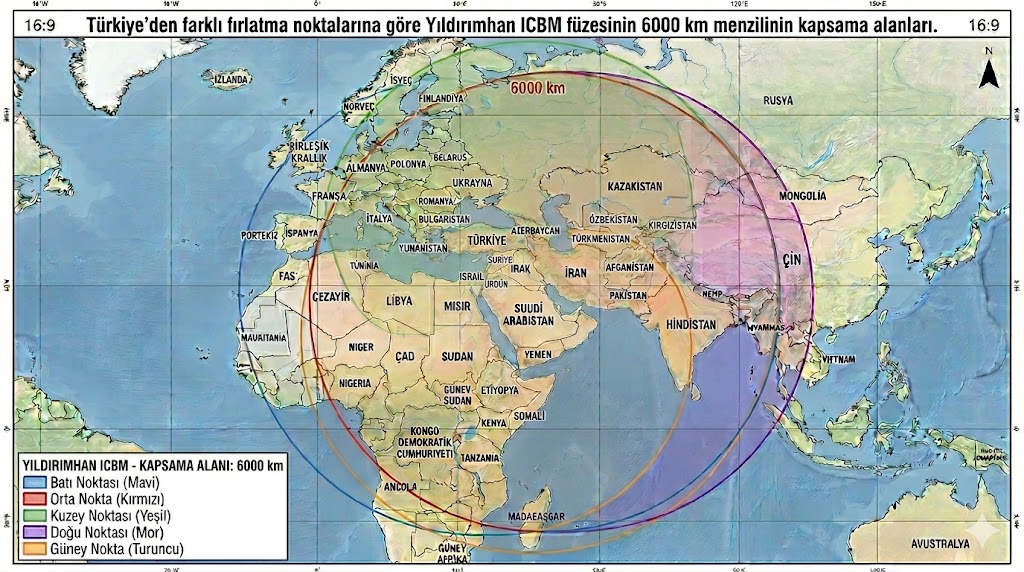
Estimated map, prepared with the assistance of the “Gemini” AI system, showing the regions that could potentially be reached if Türkiye’s newly announced 6,000-kilometer-range “Yıldırımhan” intercontinental ballistic missile (ICBM) were launched from different parts of Türkiye.
At the SAHA defense exhibition, which opened in İstanbul on May 5, the biggest surprise was the announcement that Türkiye had reached the manufacturing stage of an intercontinental ballistic missile (ICBM). A mock-up of the “Yıldırımhan” missile — said to be capable of delivering a 3-ton warhead over a distance of 6,000 kilometers — was unveiled in a ceremony attended by Minister of National Defense Yaşar Güler.
Product of a 10-Year Effort
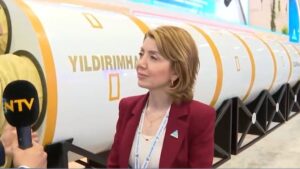
Engineer Nilüfer Kuzulu is the head of the R&D department of the Turkish Ministry of National Defense.
The missile was designed by the Research and Development (R&D) Center of the Ministry of National Defense (MSB). The Center first drew public attention during the 2025 IDEF Exhibition. It was then that the public first became familiar with the Center’s head, Nilüfer Kuzulu, as she introduced the thermobaric “Gazap– Wrath” bomb — which consumes oxygen in the impact zone through intense heat — and the bunker-busting “Hayalet-Ghost” bomb capable of penetrating deep underground shelters.
Mechanical engineer Kuzulu led the MSB R&D team that designed and enabled the production of those weapons. Gazap was significant because, at that level of capability, only the United States, Russia, and China had previously produced comparable thermobaric bombs, while Iran and India were still working on lower-capacity versions.
Kuzulu, who also heads Türkiye’s ICBM design team, says they have been conducting secret work on the project for the past ten years.
What was displayed at the SAHA exhibition is only a mock-up; officials say the first test results will soon be announced as well. At present, eight countries are known to possess ICBMs: the United States, Russia, China, France, the United Kingdom, India, Israel, and North Korea. Türkiye would become the ninth.
The Political Meaning of an ICBM
Possessing an intercontinental ballistic missile signifies that a country has political and military ambitions extending beyond its immediate neighborhood. Kuzulu emphasizes, for example, that Türkiye has demonstrated it is among the very few countries capable of producing nitrogen tetroxide rocket fuel.
Notably, the first five countries listed above are also the five permanent veto-wielding members of the United Nations Security Council.
Missiles with ranges exceeding 5,500 kilometers are classified as ICBMs. This threshold was established during the Cold War as the shortest strategically significant distance between the United States and the Soviet Union.
Therefore, possessing an ICBM means that a country perceives threats beyond its immediate region and seeks strategic reach accordingly. Pakistan, for example, possesses nuclear weapons but does not have ICBMs; instead, it fields medium-range ballistic missiles covering India, Iran, Afghanistan, and the Arab Gulf states. (Meanwhile, reports have begun emerging that Pakistan is interested in purchasing Türkiye’s Gazap bombs.)
With a 6,000-kilometer-range ICBM, Türkiye’s potential coverage area would include all of Europe and large portions of Asia and Africa. Türkiye already possesses Tayfun missiles capable of reaching targets from Greece and Iran to Russia and Israel in response to threats from neighboring regions.
The Message Behind Yıldırımhan
The message conveyed by the unveiling of an intercontinental ballistic missile is less that the missile will necessarily be used, and more that this technology can now be produced domestically by Turkish engineers in Türkiye.
Türkiye does not possess nuclear weapons, but the thermobaric Gazap bomb — classified as neither nuclear nor chemical — could render a 200–300 meter area around a target inoperable without causing mass destruction in the conventional sense; it represents a different kind of combination. This also raises the prospect of various forms of Türkiye-Pakistan defense cooperation.
This development, ahead of the NATO Summit to be held in Ankara on July 5–7, should prompt Europe — especially anti-Türkiye lobbying circles within the European Union — to reconsider Türkiye’s strategic role.
The choice of the name “Yıldırımhan” is also noteworthy. In Turkish history, there was a sultan known by the epithet “Yıldırım” (“Thunderbolt”): Bayezid I, or Yıldırım Bayezid, whose defeat by Timur’s Mongol army at the 1402 Battle of Ankara is regarded as one of the greatest military and political traumas in Turkish history.
More Appears to Be Coming
Looking back to 2016 — the year MSB R&D Director Nilüfer Kuzulu says work on the ICBM project began — we arrive at the July 15, 2016 coup attempt, one of the greatest political and military traumas in modern Turkish history.
That moment marked the turning point in Türkiye’s shift toward a policy of “strategic autonomy” in its relations with the United States and NATO. Whether that shift was the correct decision remains debated, but 2016 also marked the beginning of many major policies, from the purchase of Russian S-400 missile systems to changes in Syria/PKK policy and the diversification of defense industry projects through greater civilian-sector competition and support.
It also appears that President Tayyip Erdoğan approved the ICBM project this year alongside indigenous air defense systems such as the “Steel Dome.”
Yıldırımhan suggests that the weapon systems Türkiye has developed over the past decade are only the beginning.