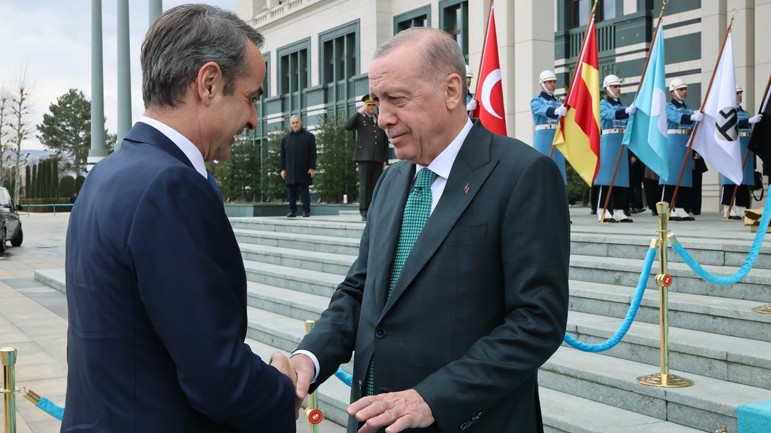
The “Blue Homeland” issue is now at the top of Greece’s agenda. In fact, Prime Minister Kyriakos Mitsotakis is also aware of the situation, but Greek domestic politics remains built around the narrative of a “threat from Türkiye.” The photograph was taken during the Ankara meeting on 11 February 2026. (Photo: Beştepe)
In recent days, significant diplomatic activity has been observed in Turkish foreign policy both on the Western front — namely NATO and the European Union — and on the Eastern front, shaped by developments surrounding Iran and Israel. In this context, President Tayyip Erdoğan’s phone call with European Commission President Ursula von der Leyen came immediately after Foreign Minister Hakan Fidan’s meetings in the United Kingdom last month and in Germany earlier this week. The timing of these contacts also provides an important framework, as they took place ahead of the NATO foreign ministers’ meeting held today (20 May) in Sweden, where the agenda for the NATO Summit to be held in Ankara on 7–8 July will be discussed. These talks are undoubtedly linked to broader global security issues currently being debated at the global level among the leaders of the United States, China, and Russia. Within this “big picture,” a new debate over the “Blue Homeland” doctrine has also emerged between Greece and Türkiye.
Blue Homeland Debate Revived
The dispute with Greece over the “Blue Homeland” concept was reignited on 12 May when Mustafa Başkara, head of Ankara University’s Maritime Law Research Center (DEHUKAM), publicly presented a proposed “Law on Maritime Jurisdiction Areas” at a press conference. The participation of Çağrı Erhan, deputy chair of the Presidential Security and Foreign Policies Council and already known for his involvement in work on this issue for the past decade, was interpreted as a sign of political backing. Although the full text of the draft law — reportedly prepared with expert contributions from the Foreign Ministry and the Ministry of National Defense — has not yet been disclosed, maps and arguments over the ownership of various islands have already sparked heated debate in both Turkish and Greek politics and media.
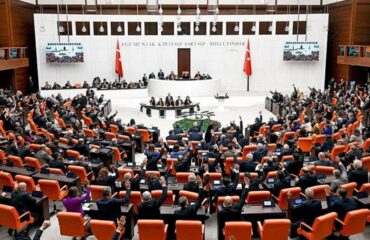
In Türkiye, the debate has largely remained confined to social media, aided by early support from the CHP. The draft law is expected to be submitted to the Turkish Grand National Assembly following the nine-day Eid al-Adha holiday recess.
The Question of “Why Now?” and Israel
When we arrived in Athens on 17 May for meetings of the Turkish-Greek Forum, of which I am a member, it became immediately clear that the Blue Homeland issue dominated the agenda. Both Greek Foreign Ministry officials and participants in our discussions over the following two days repeatedly asked the same question: “Why now?”
Another recurring question was: “Weren’t we supposed to stop surprising each other?” Athens reportedly expected Ankara to consult Greece before unveiling the Maritime Jurisdiction Areas draft law. Ankara’s response — “Did you consult us while militarizing the Aegean islands in violation of the Lausanne Treaty?” — was met with the reply: “That is a different matter.”
Athens also believes that details appearing in the press, especially in Bloomberg, were leaked by the Turkish government. Greek officials appear unwilling to acknowledge the growing movement along political fault lines in the region. Among these developments is Greece’s expanding alliance with Israel — including the participation of Greek Cyprus — at a time when Israel is accused of attempting to erase Palestinians from the map. Turkish officials, meanwhile, are trying to explain to AK Party voters that “the government is not sitting idle,” while insisting that these moves are “not directed against Türkiye.”
Misconceptions and Realities
The Israeli factor is certainly not the primary issue; the more fundamental point is that Türkiye still lacks a comprehensive legal framework defining its maritime jurisdiction areas despite numerous developments since 1982.
Legal scholar Yücel Acer, who played a significant role in preparing the draft law proposal and is himself a member of the Turkish-Greek Forum, is among those familiar with the full text. According to Acer:
- Neither the title nor the text of the draft law contains the phrase “Blue Homeland.”
- The draft law contains no maps.
- “Grey zones,” meaning disputed sovereignty areas, are not included. The proposal does not concern sovereignty claims but rather serves as a framework law.
- References such as “152 islands” or similar numerical claims do not appear in the draft. This is not a document defining sovereignty areas.
- Exclusive Economic Zones fall within the scope of the draft law.
- In reality, the proposal introduces nothing fundamentally new but instead seeks to codify and formalize the existing situation.
Another concern in Athens is that the draft law would grant the President additional authority in matters related to maritime law. However, under the current Constitution, all executive authority is already vested in the President.
Timing and NATO
Athens may seek either to block the law altogether or at least delay it long enough to pressure Ankara into revisions through US and EU influence. To that end, Greece may prefer that the Blue Homeland issue be effectively frozen until next year’s Greek elections.
Ankara’s leverage on this matter appears to be the upcoming NATO Summit. With CHP support already in place, the government may seek to pass the legislation with strong parliamentary backing before the summit, following the logic of the Turkish proverb, “Strike the iron while it is hot.” From Ankara’s perspective, this appears to be a rational course of action.
Regarding NATO, Türkiye’s policy of active neutrality first in the Russia-Ukraine war and later in the US/Israel-Iran confrontation appears to have strengthened NATO’s increasingly “more European” orientation despite attempts by the France-Greece axis to restrain it. If issues such as the Middle East, the Black Sea, and the defense industry remain high on NATO’s agenda, Türkiye’s position could become even stronger.
NATO as a Path Toward the EU?
If Erdoğan intends to use the NATO Summit as an opportunity to move beyond these disputes and pursue closer relations with the European Union — and if this is more than a tactical maneuver — it would represent a sound strategy. However, this goal cannot be achieved solely through geopolitical advantages or military-industrial strength. Two democratization steps that would also contribute to Türkiye’s domestic peace are necessary:
- Finding a political solution to the Kurdish issue under the roof of Parliament through the PKK’s disarmament, ensuring the success of the “Terror-Free Türkiye” process;
- Implementing the rulings of the Constitutional Court and the European Court of Human Rights, alongside judicial reform that would end perceptions that the judiciary is being used against the opposition.
If the Blue Homeland debate ultimately reinforces the policy of maintaining “calm waters” with Greece, then despite today’s harsh exchanges, it could benefit both countries in the long term.
Mitsotakis Understands, But…
In fact, Prime Minister Kyriakos Mitsotakis appears aware of this reality. His decision — taken amid the Blue Homeland controversy — to withdraw two Patriot missile batteries from the islands that had become the center of dispute may be seen as a signal of that awareness.
Yet Greek domestic politics remains heavily built upon the narrative of a “threat from Türkiye,” which continues to be one of the greatest obstacles to genuinely calmer relations.
One final point should be added: from what I can observe, the Greek public does not support their government’s alliance policy with Israel. Public sympathies lie with the Palestinian people under attack. The aggressive policies of the Israeli government risk poisoning not only Greece’s relations with Türkiye but potentially its broader regional relationships in the long term as well.