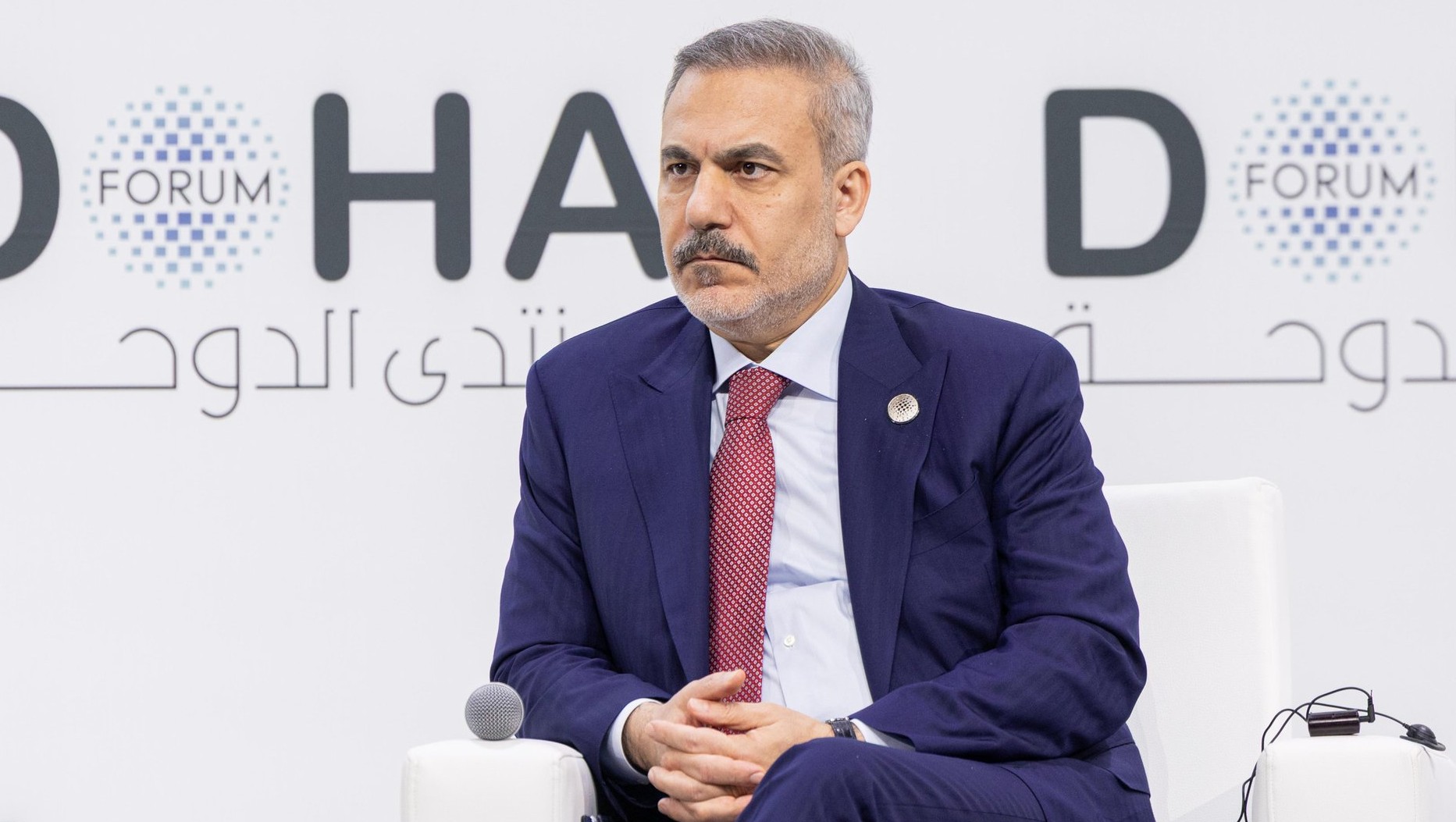
Turkish Foreign Minister in DOHA: The SDF has no intentions to honour its commitments. (Photo: X/MoF)
As Syria’s new regime completes its first year on Dec 8, Ankara has sent three warning messages—via the SDF to the PKK and to the SDF’s patron, the United States—indicating that “the wind may turn” if the current course continues:
1. Statements by Foreign Minister Hakan Fidan at the Doha Forum
2. Visits to Damascus by Chief of General Staff Gen. Selçuk Bayraktaroğlu
3. The “yellow light” flashed by the Presidential Chief Legal Advisor, Mehmet Uçum
Fidan: SDF dodges its commitments
At the Doha Forum, Fidan said:
• “The Syrian government and the SDF can reach an agreement among themselves. (…) However, when it comes to the PKK, we know there are elements inside the SDF whose sole aim is to fight Türkiye. We want non-Syrian elements removed from the SDF. Those who joined from Iraq, Iran, and Türkiye must leave immediately. That would be a good start.”
Shortly afterward, he told Reuters:
• “Signals from the SDF showed it had no intention of honouring the accord (of March 10 between Damascus and SDF) and was instead seeking to sidestep it. (…) “There can be no two armies in any given country. So there can only be one army, one command structure … But in local administration, they can reach a different settlement and different understandings.”
Is Ankara OK with an “SDF police force”?
Fidan’s words are consistent with both DEM Party MP Gülistan Kılıç Koçyiğit’s remarks after the Turkish parliamentary delegation’s Nov 24 visit to PKK leader Abdullah Öcalan in İmralı Prison and the controversial summary minutes submitted to parliament. In short, SDF armed units must integrate into the Syrian army without separate command or territorial privileges—that is what PKK leader Abdullah Öcalan refers to as integration with the Syrian Defense Ministry. But local administrations, under a “federation or by another name” structure, may retain a “police force”—what he calls “the Interior Ministry.”
Fidan added a point long discussed in Ankara circles: since the SDF claims to be Syrian, all non-Syrian fighters must be expelled, including Turkish, Iraqi, and Iranian citizens of the PKK. One may assume this has been discussed with PKK elements, too, yet the PKK’s ongoing transfer of its headquarters from Iraq to Syria contradicts this.
Turkish Chief of General Staff in Syria
One day before Fidan spoke in Doha, Chief of General Staff Gen. Selçuk Bayraktaroğlu and Second Chief Gen. Levent Ergün were in Syria. They met President Ahmed al-Shara, visited the Joint Operations Center with the Syrian Defense Minister and Chief of Staff, and conducted inspections.
This visit can be considered Ankara’s second message delivered through body language.

Turkish Chief of Staff Gen. Bayraktaroğlu (second right) and his deputy, visiting Syrian President Shara and commanders on December 5 in Damascus. (Photo: X/TSK)
Between 2016 and 2019, Türkiye conducted large-scale military operations in Syria, when the regime was the Bashar al-Assad regime. Today, there is the Shara regime, which Ankara wants to survive and grow stronger, provided it poses no threat to Türkiye’s security. Back then, Russia and Iran were factors; today, they are gone, but Israel has emerged as a factor. The biggest threat to the Shara regime comes from Israel, which wants the U.S.-protected Kurdish force (SDF) to remain strong and continue threatening both Damascus and Ankara.
These are seen as factors that would make new Turkish military operations difficult, even if the SDF/PKK disrupts the “Terror-Free Turkey Process”. On the other hand, the possibility that Syria could officially request Turkish assistance is being overlooked. Fidan was fully aware of Bayraktaroğlu’s Damascus visit when he spoke the next day.
Meanwhile in İstanbul
While Fidan was speaking at the Doha Forum, SDF foreign relations co-chair İlham Ahmed was addressing (online) the International Peace and Democratic Society Conference organized by the DEM Party—from what felt like a parallel universe:
• “We want and hope the peace process in Türkiye concludes. Those who still speak of war and conflict must fall silent. Türkiye is talking to the Damascus government and has a channel with us. (…) We want dialogue with Türkiye. Let our borders be opened.
• “The Middle East is being redesigned. If Türkiye reaches peace with Syria, it will emerge stronger.”
In other words, according to the SDF representative:
• The Terror-Free Türkiye process has nothing to do with Syria and the SDF.
• Öcalan’s February 27 call for laying down arms and dissolution does not bind the SDF.
• The real issue is peace between Türkiye and Syria; the SDF is a separate matter, and Türkiye must talk to the SDF separately.
Beştepe: “The goal, you didn’t achieve through terror.”
Which one is true? Öcalan’s claim, “They (SDF) will listen to me,” or the SDF’s “It doesn’t bind us”? Or are both saying the same thing while Ankara pretends the Terror-Free Türkiye process also covers Syria, yet in reality—under U.S. pressure—is seeking compromise with the Syrian reality?
Exactly at this point, on December 7—one day after the DEM conference—the third warning came from Presidential Chief Legal Advisor Mehmet Uçum, as the voice of the Presidential Palace in Beştepe:
• “No one should delude themselves into thinking they can reach, through law and democracy, impossible goals they failed to achieve—and will never achieve—through terror.
• “Persons obliged to complete the disarmament and dissolution process during the transition period must never give ground to saboteurs—whether from within their own ranks or from outside—who try to derail the Terror-Free Turkey process with impossible demands and provocative, destructive language.
• “It is obvious that intense efforts are required to prevent sabotage, eliminate those who engage in it, and block what they plan.”
These messages were clearly directed at the PKK leadership, and the DEM Party is also in the line of fire.
SDF Chief in the Israeli press
Despite Ankara’s “don’t derail the process” warnings, the SDF keeps pushing. In an interview with the right-wing Israeli daily Jerusalem Post, SDF commander Mazlum Abdi (real name Ferhat Abdi Şahin) claimed—without any confirmation from Damascus or Ankara—that he had agreed with the Shara administration to keep 3 divisions and 2 special battalions. Claiming the SDF has 70,000 soldiers and 30,000 police (a figure Turkish sources consider inflated), Abdi effectively demanded partnership in the government.
Under the headline “Kurdish SDF chief in Syria open to Israeli support,” Abdi also said U.S. troops must stay in Syria for stability.
Ankara at a critical juncture
Ankara sees the process being diluted by the U.S. Central Command (CENTCOM), which treats the SDF like a warlord under U.S. command, and by Israeli influence.
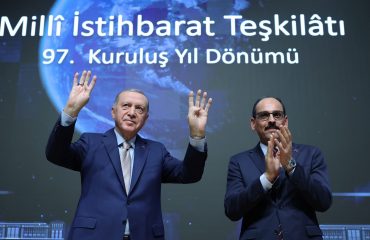
The process is coordinated by İbrahim Kalın, the Director of the Turkish Intelligence Organization (MİT). Öcalan’s communication with the PKK (also via DEM Party delegation, lawyers, and family visits) is under Turkish intelligence supervision. Or are we to believe that Öcalan, after 26 years in prison, is still trying to bypass MİT with the double-speak he mastered long ago?
Yet in Ankara—especially after the November 24 meeting—loud objections from the PKK, Barzani’s “Cizre provocation,” and the SDF spokesperson’s messages at the Istanbul conference are seen as signs that the wind may indeed turn at this critical juncture.
In Ankara, people have begun saying that if the Terror-Free Türkiye process, to end nearly half-a-century-long bloody conflict, fails—following the 2009 Oslo talks and the 2012–2015 dialogue—a fourth attempt might never happen.
Everyone would do well to take that seriously.