
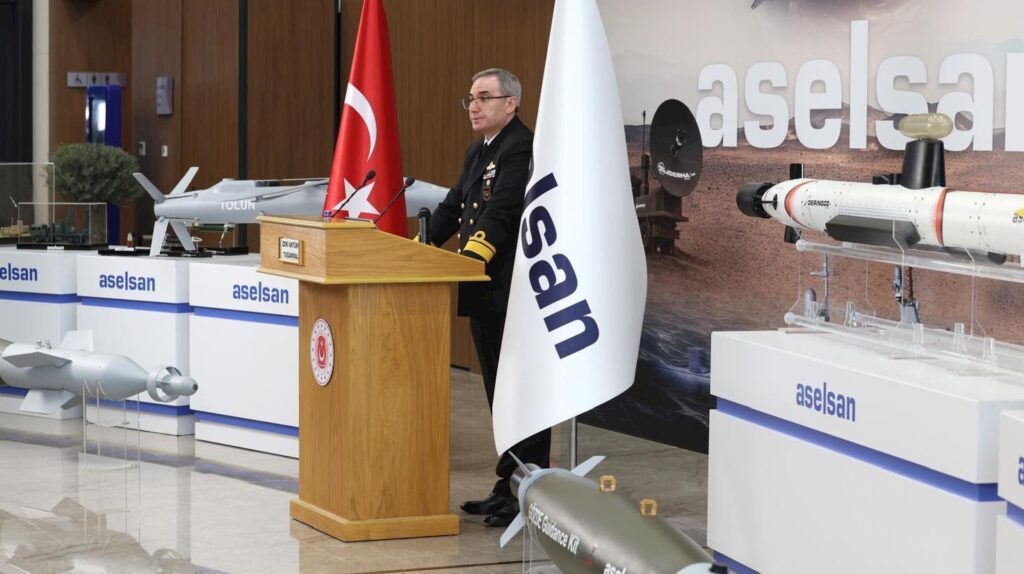
The photograph itself is the message: MSB Spokesperson Rear Admiral Aktürk held the press conference—at which he stated that the Israel–Greece–Southern Cyprus alliance would not pose a military threat to Türkiye—among domestically produced weapons at ASELSAN, one of Türkiye’s military production hubs. (Photo: MSB)
Ankara did not take seriously—did not even consider a threat—the attempt by Israel, Greece, and Southern Cyprus to form an alliance against Türkiye. On December 24, President Tayyip Erdoğan described the statements made by the three leaders in Jerusalem on December 22 as “tin clatter” and a “provocation” that Türkiye would not fall for. The following day, the Ministry of National Defense announced that this trilateral alliance attempt did not constitute a “military threat” to Türkiye.
Between the lines of these statements—which I will try to analyze in detail shortly—two strategic questions are hidden:
About a century ago, Greece, spurred on by Western financial and military support, followed Britain into a campaign against Türkiye. Is it now following Israel? A century ago, Türkiye refers to those adventures on Anatolian soil as the War of Independence, the foundation of its independence; in Greek history, however, it is called the “Great Catastrophe.”
Is Greece an ally of Türkiye, to which it is bound by the NATO agreement, or of Israel, with which it has announced cooperation—including in the military sphere—against Türkiye? For Athens, is Greece’s security and prosperity more important than a partnership with Israel, whose interests can easily change tomorrow?
Erdoğan: “Tin Clatter”
At the AK Party’s Expanded Provincial Chairs meeting, Erdoğan held Israel responsible for tensions in the region and said:
“I say this clearly and unequivocally: whether in the Eastern Mediterranean, the Aegean, or anywhere else, we will neither encroach on anyone’s rights nor allow our own rights to be violated. Nor will we permit the usurpation of the rights and interests of the Turkish Cypriots.”
“Agreements can be made, signatures can be affixed, and various messages can be sent through prearranged questions. None of these bind us. They do not change our policy.”
“Those with the blood of more than 70,000 of our Palestinian brothers and sisters on their hands—their insolence is, in our eyes, nothing more than tin clatter, and cannot be otherwise. We have not fallen for the game, and we will not. We have not succumbed to provocations, and we will not.”
With his words “agreements can be made, messages can be sent through prearranged questions,” Erdoğan was targeting remarks made by Israeli Prime Minister Benjamin Netanyahu at the joint press conference in Jerusalem on December 22, alongside Greek Prime Minister Kyriakos Mitsotakis and Greek Cypriot President Nikos Christodoulides.
Reaction in Ankara to Israel
At that press conference, Netanyahu, when asked whether the alliance was against Türkiye, said, “It is against no one.” He then claimed to be voicing the sentiments of the others as well, stating that all three countries had in the past been occupied by empires—an allusion to the Ottoman Empire—and that those who still harbored such intentions should “forget” them.
Not only President Erdoğan, but for example Speaker of the Grand National Assembly Numan Kurtulmuş also said that Türkiye would not take lessons on occupation from Israel, which is pursuing genocidal policies aimed at eliminating Palestinians in Gaza.
It should be added that the only issue on which political parties—unable to reach unanimity on almost anything else in parliament—are unanimously opposed is Israel’s actions in Palestine and against Palestinians.
By stoking fear of Türkiye within the governments of Israel, Greece, and the Greek Cypriot administration, Israel fuels dreams of a gas pipeline to Europe—despite the presence of a massive LNG terminal in Egypt. At the same time, it tries to prevent the PKK-linked SDF in Syria—what Türkiye sees as its backyard—from reaching an agreement with Damascus, and to sabotage Ankara’s politically focused “Terror-Free Türkiye” process aimed at resolving the Kurdish issue.
For this reason, the “military threat” detail in the Ministry of National Defense’s statement is significant.
MSB: Does Not Constitute a Military Threat
The MSB also stated that the Israel–Greece–(Greek Cypriot) trilateral alliance does not constitute a “military threat” to Türkiye. At the December 25 press briefing, ministry spokesperson Rear Admiral Zeki Aktürk drew attention to the NATO alliance—of which Greece, like Türkiye, is a member—saying that Ankara favors dialogue in the Aegean and the Mediterranean, but will not step back from its international guarantor rights regarding the security and rights of the Turkish Republic of Northern Cyprus.
Earlier, Defense Minister Yaşar Güler had responded to reports that Greece might deploy missile and artillery systems—likely procured from Israel—on the Aegean islands whose militarization was prohibited by the 1923 Treaty of Lausanne, saying, “They shouldn’t get too excited. It does not pose a threat to us. We are carrying out the necessary work on this matter.”
Perhaps to underscore its perspective, the MSB held this press conference not at the ministry itself but at the facilities of ASELSAN (Military Electronics Industry), one of Türkiye’s major defense industry organizations, showcasing weapons designed and produced in Türkiye.
ASELSAN was founded in 1975 after the United States imposed an arms embargo following Türkiye’s military operation in Cyprus in 1974 in response to the coup favoring union with Greece.