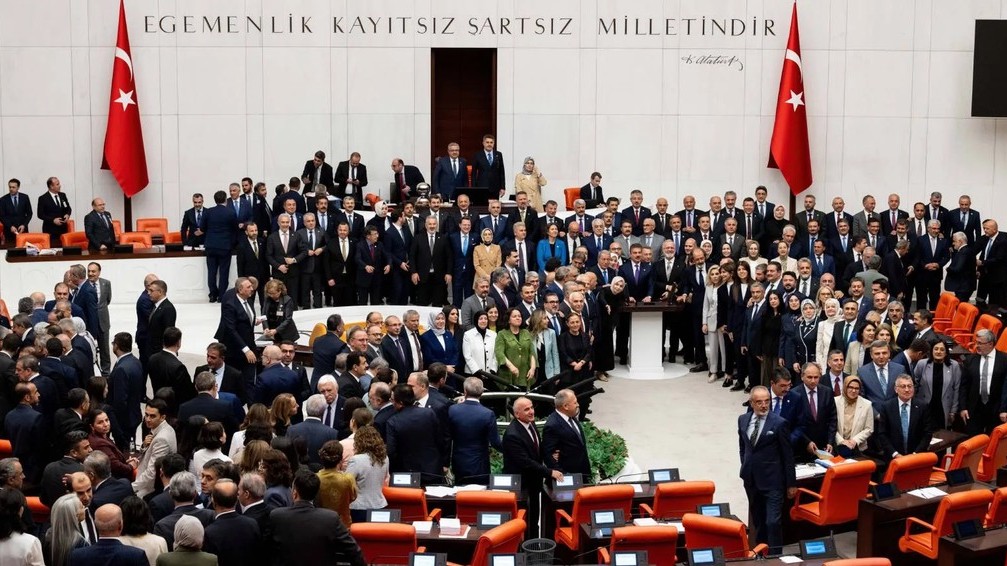
The framework law regarded as the roadmap for the Terror-Free Türkiye project was approved by a clear majority. The next step is for the PKK to lay down its arms. Following the adoption of the law, lawmakers posed for a group photo, and the TBMM went into recess.
The framework law, the key document serving as the roadmap for implementing the “Terror-Free Türkiye” process, was approved by a clear majority in a vote held in the General Assembly of the Grand National Assembly of Türkiye (TBMM) on August 10. The bill for the law, whose full name is the “Law on Strengthening National Solidarity and Social Integration,” was approved with 467 votes in favor, against 7 abstentions and 87 votes against, in a session attended by 592 lawmakers.
In the vote, the AK Party, Yeni Party, DEM Party, MHP, CHP and Yeni Party parliamentary groups, as well as HÜDA PAR, TİP and EMEP, voted “yes,” while İYİ Party, which had opposed the process from the outset and mounted fierce opposition during the negotiations, voted “no.” A lawmaker from the Yeniden Refah Party abstained. Following Özgür Özel’s statement that, apart from party officials, lawmakers were free to make their own decisions, initial assessments showed that 54 of the 91 New Party lawmakers and 2 of the 45 CHP lawmakers voted against the bill; 14 CHP lawmakers did not take part in the vote.
With the adoption of the law, regarded as one of the most important turning points in Türkiye’s recent history, the TBMM went into recess.
Implementation begins
The law, which will enter into force with the approval of President Recep Tayyip Erdoğan, consists of 12 articles.
The law will apply only to members of the PKK/KCK and affiliated organizations, excluding other illegal organizations such as FETÖ, DHKP-C or ISIS. Under the law:
• Since the organization will be deemed to have dissolved itself, the crime of membership in the organization will lapse. Investigations, prosecutions and finalized convictions concerning “establishing or leading an organization, membership, knowingly and willingly providing assistance, propaganda, crimes committed within the scope of organizational activities, and crimes related to the financing of terrorism” will be postponed.
• The law does not envisage either a personal or general amnesty, including for PKK leader Abdullah Öcalan. Likewise, senior PKK leaders, whose number is currently estimated at 232, are excluded from the scope.
• Except for crimes carrying life imprisonment or aggravated life imprisonment, including intentional homicide, a five-year postponement of sentences is envisaged for crimes carrying sentences of less than 15 years, and a 10-year postponement for crimes carrying sentences of more than 15 years. At the end of these periods, the sentence is also envisaged to be dropped if the necessary conditions have been fulfilled.
How will it work?
According to the law regarded as the roadmap for the Terror-Free Türkiye project, two bodies will be established to oversee the process of the PKK laying down its arms and dissolving all its organizational ties.
One of these will be the “Monitoring and Coordination Board,” chaired by Vice President Cevdet Yılmaz and composed of the ministers of Justice, Foreign Affairs, National Defense and Interior, along with the head of the National Intelligence Organization (MİT), and the secretaries-general of the Presidency and the National Security Council.
Its political counterpart will be an “Oversight Commission” within the TBMM, likely to consist of 17 lawmakers.
Following fieldwork to be conducted by teams from the Ministries of National Defense and Interior and the MİT, the Monitoring and Coordination Board will submit a report confirming that the process of laying down arms and dissolution has been completed to the Secretariat-General of the National Security Council, which will convene under President Erdoğan. With the President’s approval, the six-month implementation phase of the law will begin. Those who do not apply to benefit from the law within these six months will be excluded from the process and treated as terrorists, like members of other armed organizations.
The Terror-Free Türkiye process
The process followed MHP leader Devlet Bahçeli’s proposal on October 2, 2024, to PKK leader Abdullah Öcalan that he join legitimate politics in return for having the organization lay down its arms and dissolve itself.
• Öcalan responded positively on February 27, 2025. This was followed by the PKK’s decision at its 12th congress, held on May 5-7, to end its armed struggle and dissolve itself. The organization symbolically burned 30 weapons on July 11, the tenth anniversary of the end of the previous dialogue process.
• The Terror-Free Türkiye Commission, formally named the “National Solidarity, Brotherhood and Democracy Commission,” began its work on August 5, 2025, under the chairmanship of TBMM Speaker Numan Kurtulmuş. The İYİ Party did not appoint a member to the commission. A three-member delegation from the AK Party, DEM Party and MHP, representing the Commission, which heard from 140 people and representatives of organizations from most segments of society, went to İmralı Prison on November 24 and met with Öcalan.
• The Commission published its report on February 18. Article 6 of the report, concerning the laying down of arms, formed the basis of the bill submitted to Parliament on August 5. New Party leader Özgür Özel wants Article 7, concerning democratic steps, to also be implemented within six months after the National Security Council confirms that the weapons have been laid down.
The Kurdish issue and the PKK
Kurdish uprisings, which governments had sought to suppress through military measures since the founding of Türkiye, took the form of a guerrilla war, particularly from 1984 onward, following the establishment of the PKK in 1978 as a result of internal and external factors brought about by the Cold War. It was then-Chief of General Staff İsmail Hakkı Karadayı who described this as a “guerrilla war” to President Süleyman Demirel in the second half of the 1990s, saying, “We do not call it that, but…”
From then until today, according to official estimates, more than 62,000 people have been killed in attacks and clashes, including approximately 8,500 security personnel, 6,500 civilians and 47,000 PKK members. President Recep Tayyip Erdoğan said the cost of the nearly half-century-long fight against terrorism, together with lost opportunities, amounted to $2.3 trillion. This should also include the political opportunities lost because governments failed to take legal and democratic steps on security grounds, including, for example, missed opportunities in relations with the European Union.
After so many years and so much suffering, the issue of ending the Kurdish question’s most burning component—its status as an armed threat to the state—has been brought before the TBMM for the first time.
A turning point
The longest guerrilla war in modern history was fought in Vietnam for eight years against France and 19 years against the United States, lasting 27 years. In Türkiye, the conflict has continued for 48 years, nearly half a century.
The state did not allow the PKK to win the war, but neither could it eliminate the organization. The Terror-Free Türkiye process once again demonstrated that the PKK has a sociological base and that its founding leader, who has been in prison for the past 27 years, still has influence over this base.
On the other hand, the PKK was no longer in a position to sustain this war for much longer. The rapid change in international balances was one factor. Türkiye’s strategy of going to the source of the attacks, shifting the conflict to Iraq and Syria, developments in the defense industry, and intelligence operations inflicted damage on the PKK’s cadres.
The Terror-Free Türkiye process, which President Erdoğan refers to as the “Türkiye Model,” has characteristics that differ in many respects from the experiences of Ireland, Spain, Colombia, the Philippines and others.
Among the examples around the world, it may perhaps be the first that does not envisage a direct amnesty, an autonomous administrative region (or independence), or autonomous governance mechanisms, and that rejects mediation by external actors.