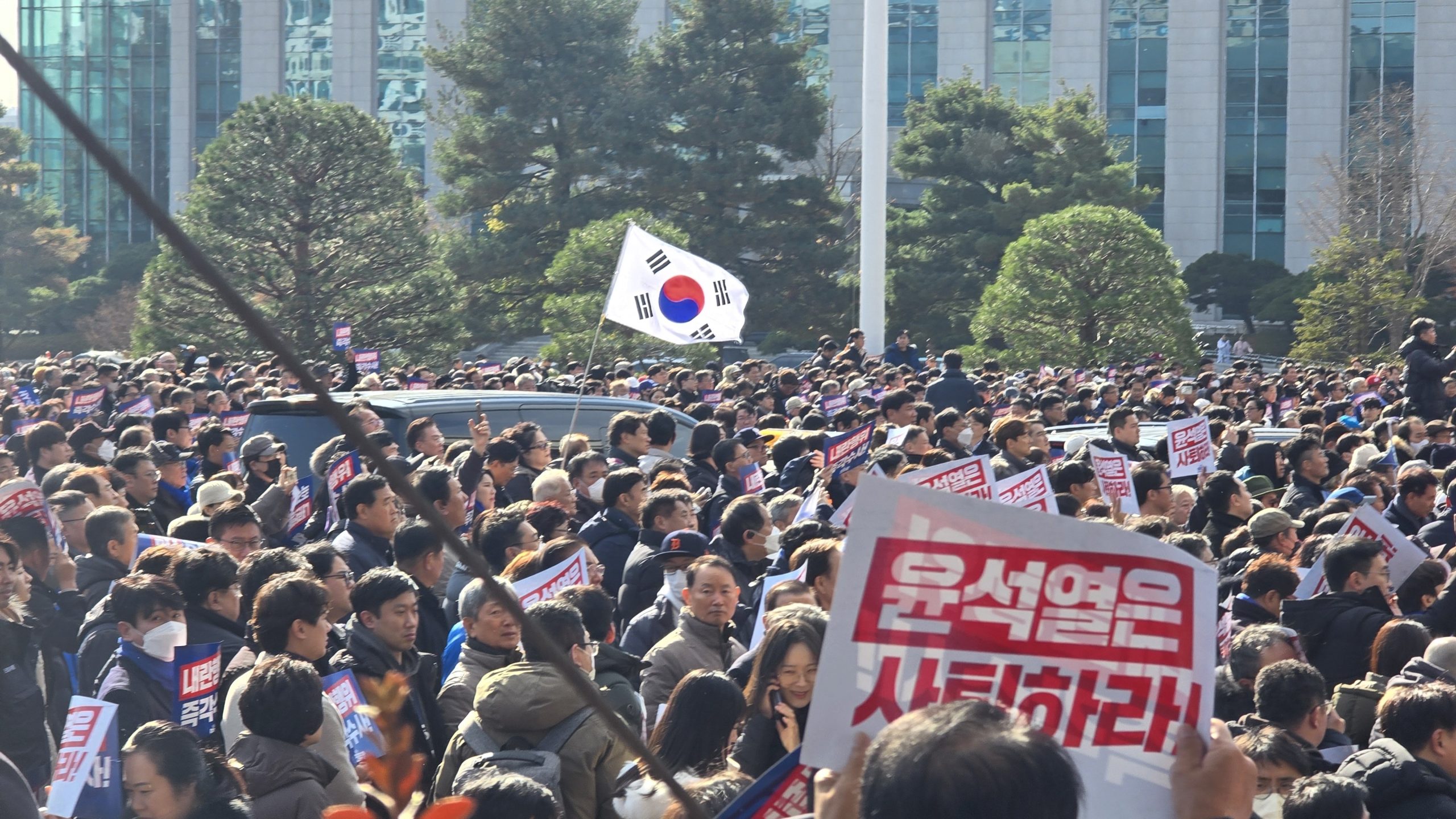
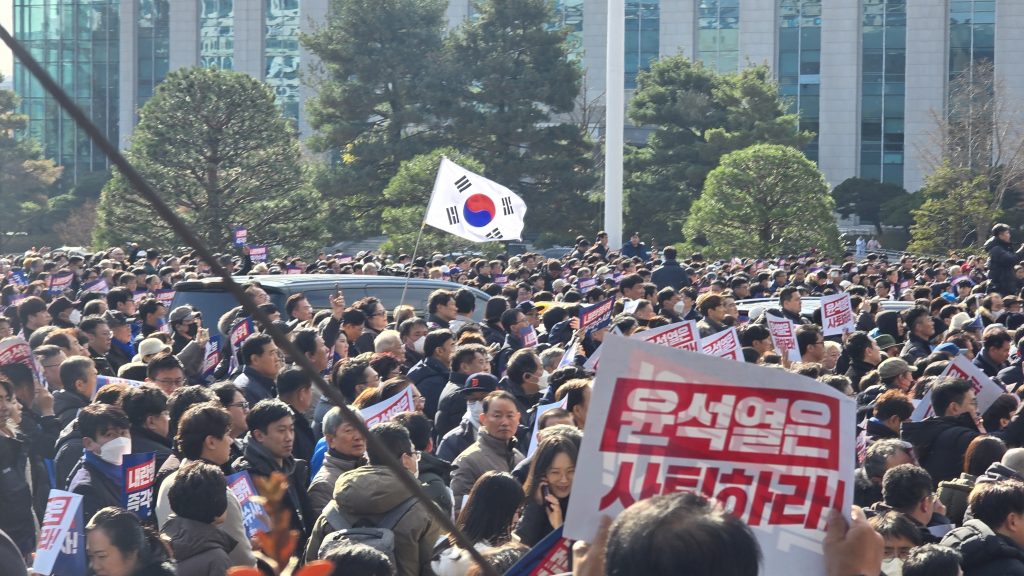
President Yoon’s attempted coup against parliament in South Korea, justified by “external threats,” collapsed due to public and bipartisan parliamentary resistance to protect democracy. Protesters gathered around parliament hold banners calling for Yoon’s resignation. (Photo: Antonio Girordano/AA)
South Korea’s situation differs markedly from Türkiye’s – they face a truly existential threat from North Korea, a heavily militarized hostile sibling state that threatens invasion and annihilation daily. As South Korean President Yoon Suk Yeol saw his public support steadily eroding, he opted to leverage this threat. Rather than risk losing power in an election he knew he couldn’t win, he attempted a post-modern coup by trying to dissolve parliament.
When the ruling People Power Party and opposition Democratic Party failed to reach an agreement on the 2025 Budget on December 3rd, he declared martial law and imposed a curfew, baselessly accusing the opposition of being agents of North Korean communists. President Yoon appointed Army Chief of Staff Parn An-su as martial law commander.
General Park issued a six-point decree banning political parties, demonstrations, and strikes. Military and police forces were mobilized, and parliament was placed under siege. The nation, he claimed, was at risk.
South Korean president’s failed gambit
However, the President’s attempt to dissolve parliament to preserve his position backfired in ways he hadn’t anticipated.
First, Seoul’s citizens spontaneously gathered around parliament as midnight approached. Then, according to South Korean media reports, parliamentarians managed to enter the building – some even scaling police barricades and fences to do so.
At 1:00 AM on December 4th, 190 lawmakers from across the political spectrum who had gained entry unanimously invalidated the President’s martial law declaration. They demanded Yoon’s immediate resignation.
His own People Power Party denounced his decision as “tragic” and called for an investigation into those involved in the conspiracy. The opposition Democratic Party went further, demanding both his resignation and prosecution for treason.
Yoon, who hours earlier had tried to intimidate the public and parliament with claims of “external threats,” now ordered troops back to their barracks and announced plans to lift martial law at the next cabinet meeting.
The United States expressed “relief” at this development.
Real threats in context
Currently, one of America’s primary concerns is understanding what North Korea received in exchange for deploying troops to support Russia’s war in Ukraine.
If North Korean leader Kim Jong Un obtained advanced weapons systems from Russian President Vladimir Putin, particularly hypersonic cruise missile technology, the implications would extend beyond South Korea. Such developments would escalate threats against both China’s target Taiwan and Japan, America’s steadfast Pacific ally.
The North Pacific currently ranks among the world’s most volatile regions. It joins two other potential flashpoints: the Russia-Ukraine conflict north of Türkiye, and the concatenation of conflicts to Türkiye’s south – Israel’s devastating campaign against Palestinians, Lebanon’s ongoing occupation despite the ceasefire, and Syria’s rekindled civil war.
While Türkiye finds itself at the crossroads of one of the world’s most intense conflict zones, South Korea faces an even more direct predicament – daily threats of invasion from its immediate neighbor. Yet remarkably, its parliament refused to yield to their President’s cynical exploitation of these “external threats” to maintain his grip on power. This, in essence, captures the significance of these events.