
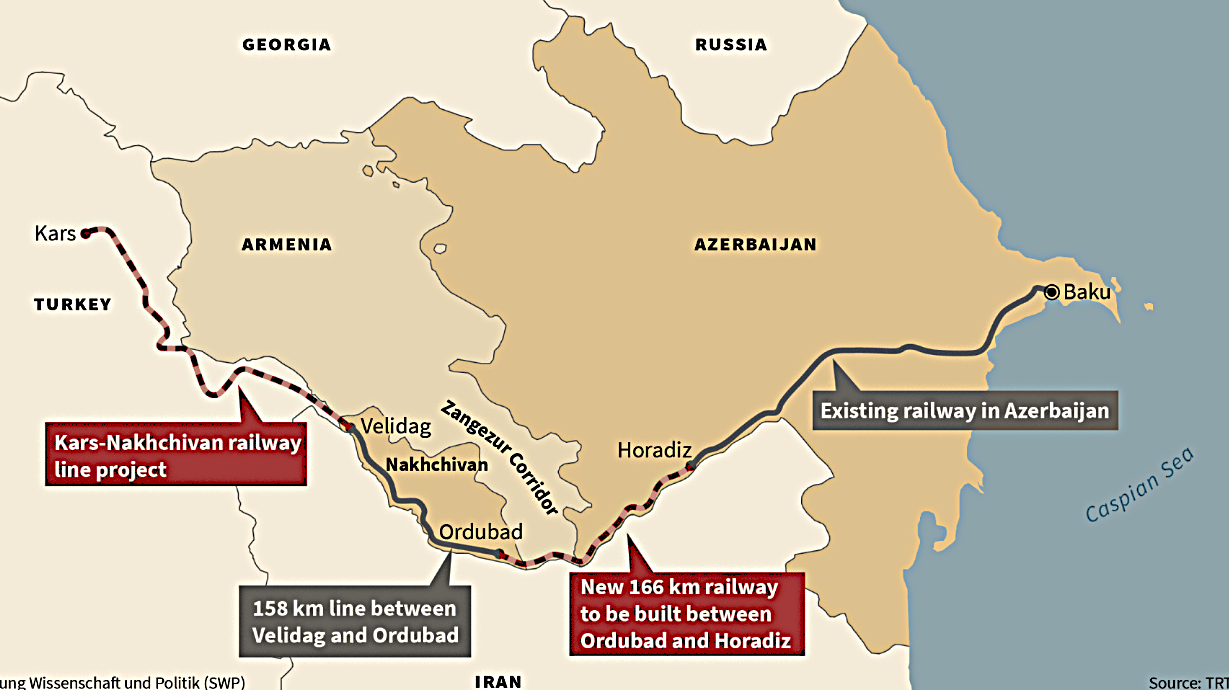
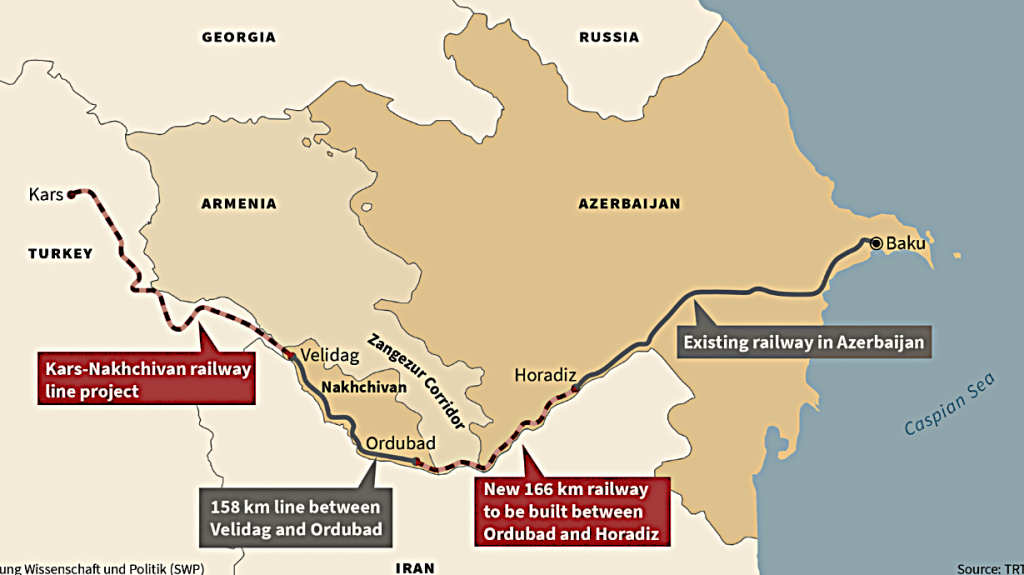
The Azerbaijan-Armenia agreement facilitated by Trump and the TRIPP road will connect Central Asia and the Caucasus with the Middle East and Europe via Türkiye. (Source: SWP/TRTWorld)
The US-brokered peace accord between Azerbaijan and Armenia, signed at the White House under President Donald Trump’s mediation, is being celebrated as a landmark in conflict resolution. However, beyond ending decades of hostility, it has created a rare geopolitical opportunity for Türkiye to advance its regional strategy and reshape the South Caucasus’ security and connectivity architecture.
At the heart of this deal lies the Trump Route for International Peace and Prosperity (TRIPP)—a corridor across Armenia’s Syunik province linking mainland Azerbaijan to its Nakhchivan exclave, and by extension, Türkiye.
For Ankara, this is more than just an infrastructure project. It is a strategic lever—an axis where trade, energy, and geopolitics converge, allowing Türkiye to deepen its influence, connect Turkic states across Eurasia, and balance against shifting Russian and Iranian postures.
Türkiye’s strategic gains
TRIPP restores an unbroken land connection from Türkiye through Nakhchivan into Azerbaijan and onward to Central Asia. This strengthens Ankara’s Middle Corridor strategy, which seeks to:
• Provide an alternative trade and transit route bypassing Russian and Iranian chokepoints.
• Integrate the South Caucasus more closely with Central Asia’s Turkic republics under the umbrella of the Organization of Turkic States.
• Boost Türkiye’s role as the western gateway of Eurasian commerce.
Energy and trade hub potential
The corridor can carry oil, gas, electricity, fiber optics, and freight—offering Türkiye:
• New energy inflows from the Caspian and beyond, reducing exposure to other supply risks.
• Expanded trade routes into both European and Asian markets.
• Increased leverage in EU–Türkiye trade negotiations, as the corridor bolsters Ankara’s importance for continental supply chains.
Diplomatic leverage through mediation
Türkiye’s support for the peace deal—and its simultaneous pursuit of normalization with Armenia—positions it as the indispensable regional mediator. By balancing solidarity with Azerbaijan and cautious engagement with Yerevan, Ankara gains:
• Soft power as a stabilizer in a historically volatile region.
• Influence over corridor governance and security arrangements.
• A platform to counterbalance US, Russian, and Iranian moves in the South Caucasus.
Changing regional and global balances
The US’s exclusive development rights over the TRIPP mark a direct encroachment on Russia’s traditional sphere of influence. For decades, Moscow controlled conflict mediation, security guarantees, and most transit negotiations in the region.
Now:
• Russia risks losing economic leverage from transit routes that bypass its territory. • Its diminished role in Armenian security after Yerevan’s pivot westward exposes Moscow’s waning regional grip.
• With the OSCE Minsk Group sidelined, Washington—not Moscow—sets the new rules.
For Türkiye, this creates a rare alignment: US interests in bypassing Russia dovetail with Ankara’s goal of opening east–west trade arteries independent of Moscow.
Shifting power geometry
The corridor’s realization alters the security-economic equation:
• Baku consolidates control over the Nakhchivan linkage.
• Ankara secures its eastward corridor.
• Yerevan gains a potential economic lifeline but risks domestic political backlash.
• Washington plants a strategic flag in the region.
• Moscow is pushed to the margins.
The Iran factor
TRIPP’s geography matters profoundly for Iran. Running through Syunik, the corridor will sit just north of the Iranian border, with the US holding development rights.
The implications for Tehran are layered:
Strategic discomfort
• US proximity to Iran’s northern frontier will heighten Tehran’s security concerns.
• The corridor potentially serves as an observation and influence platform for US regional policy.
Economic displacement
• If TRIPP becomes the preferred east–west transit route, Iran’s existing North–South and east–west transport revenues could decline.
• Azerbaijan’s fallback “Iran route” to Nakhchivan will remain relevant, but strategically secondary.
Diplomatic calculus
• Tehran may seek closer ties with Yerevan to keep a foothold in the South Caucasus.
• Alternatively, Iran could deepen its partnership with Russia to counterbalance the US–Türkiye–Azerbaijan alignment.
Russia’s position
For decades, Russia positioned itself as the sole security guarantor between Armenia and Azerbaijan. The US-led peace accord and the TRIPP corridor dismantle that exclusivity.
Military and economic setbacks
• Russian peacekeepers are now politically irrelevant in the corridor zone.
• Trade routes that circumvent Russia undercut its role as a transit monopoly between Asia and Europe.
Potential countermeasures
Moscow’s likely responses:
• Deepen military cooperation with Iran to create a counterweight to US influence.
• Use energy diplomacy to keep Armenia tethered economically.
• Leverage pro-Russian constituencies in Yerevan to slow or complicate TRIPP’s implementation.
Türkiye’s balancing challenge
While TRIPP aligns with Türkiye’s strategic interests, managing the balance will be critical:
• Avoiding a rupture with Russia, which remains an important energy supplier and trade partner.
• Containing Iranian suspicion while still benefiting from reduced Iranian transit dependency.
•Ensuring Armenian normalization stays on track despite Yerevan’s domestic resistance.
Ankara’s multi-vector diplomacy—working with Washington on corridor development while maintaining open channels with Moscow and Tehran—will define whether Türkiye can fully capitalize on the new power equation.
Türkiye as the pivot state
The TRIPP corridor and the peace accord are not just about Azerbaijan and Armenia. They are about who sets the terms for Eurasian connectivity in the 21st century.
For Türkiye:
• It is a chance to cement itself as the Western anchor of the Turkic world.
• It reinforces its role as a trade and energy hub linking Europe to Asia.
• It gives Ankara diplomatic capital with both the US and regional states.
For Iran:
• It signals a strategic squeeze near its borders.
• It forces Tehran to reconsider its South Caucasus posture.
For Russia:
• It marks a symbolic and practical retreat from a region it once dominated.
• It underscores the limits of Moscow’s reach amid competing crises elsewhere.
If Ankara plays its cards with precision—leveraging TRIPP for economic gain, using diplomacy to maintain open channels, and positioning itself as the indispensable connector—it could emerge as the primary geopolitical beneficiary of this historic realignment.