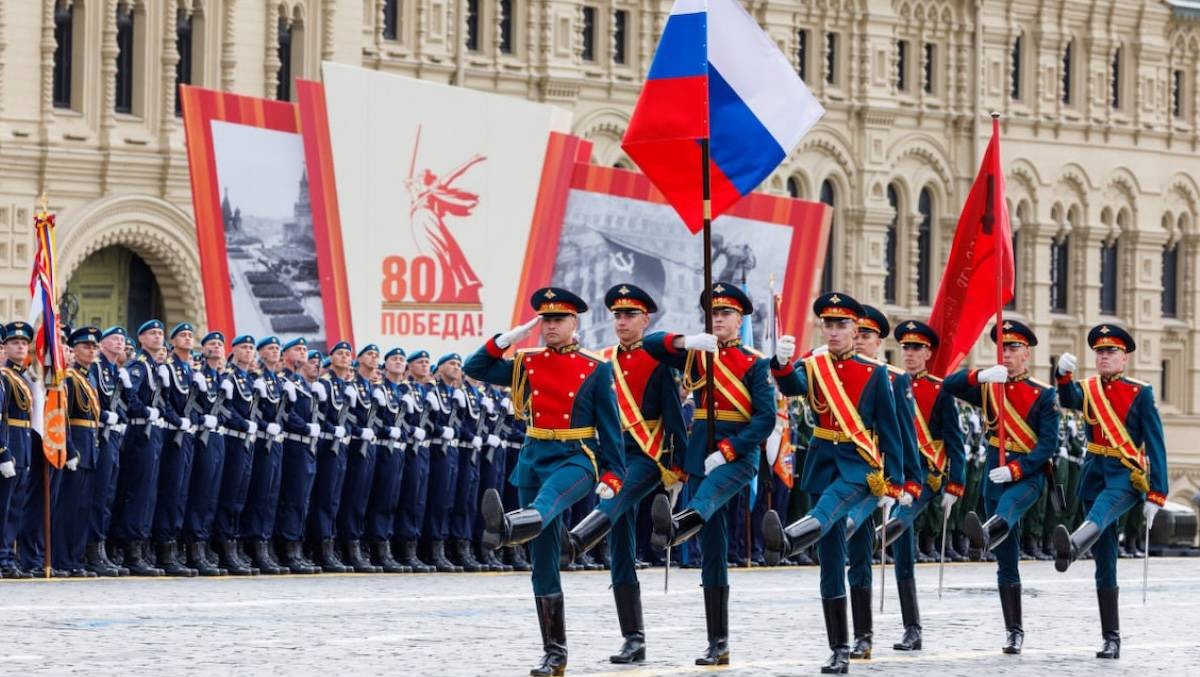
There is a real fear of Russia, especially in Eastern Europe, mainly due to its nuclear arsenal, geography, and disinformation capability. A Russian ceremonial unit during the May 9, Victory Day parade in Red Square.
Despite many efforts for a ceasefire, the war in Ukraine continues unabated. Russia’s war against Ukraine actually began in 2014 with the annexation of Crimea and continued through intermittent clashes. In February 2022, however, Moscow launched a full-scale invasion, escalating the war to a new level. Yet, Russia—despite its claim of being a superpower—failed to bring Ukraine under control in a short time, surprising both experts and the global public.
Moscow, and particularly President Vladimir Putin, expected to declare victory within weeks. More than three and a half years later, however, Russia has not achieved its objectives and has suffered significant losses against a Ukraine strengthened by Western support. At the same time, concerns in Europe persist. Finland and Sweden, traditionally cautious toward NATO, applied for membership shortly after the invasion, underscoring the depth of fear surrounding Russia. The question is whether this fear is justified and to what extent.
The Pattern of Russia’s Wars
Looking back at Russia’s wars from the early 20th century to today, a pattern emerges: Moscow has generally been more successful in defensive wars, but has often struggled or failed in offensive campaigns. Including the Soviet era, Russia has fought in seven major theaters of war, and in most cases incurred heavy losses:
• Russo-Japanese War (1905): Pursuing its expansionist policy in Asia, Russia confronted Japan but suffered a crushing defeat.
• World War I (1914–1917): Despite partial successes, Russia experienced major defeats. Following the 1917 Revolution and subsequent civil war, it withdrew from the conflict.
• World War II (1939–1945): Initially dividing Poland with Germany, Russia later suffered a massive invasion in 1941. Despite huge losses, it ultimately prevailed with Western support.
• Winter War (1939–1940): Russia attacked Finland but faced fierce resistance. Achieved only limited territorial gains.
• Afghanistan (1979–1989): Ten years of fighting drained the Soviet Union; eventually, Moscow was forced to withdraw in defeat.
• Georgia (2008): Under Putin, Russia engaged in a short war, effectively detaching Abkhazia and South Ossetia from Georgia.
• Ukraine (2014–present): Annexed Crimea, supported separatists in Donbas, and launched a large-scale invasion in 2022. Instead of a quick victory, the war dragged on, and Russian territory itself came under attack.
Always In The Neighborhood
The military interventions in Hungary in 1956 and in Czechoslovakia in 1968 were carried out together with most of the Warsaw Pact members at the time and did not encounter any military response. Historically, nearly all of Russia’s wars have been fought in its immediate neighborhood, primarily against neighboring states. Unlike other great powers such as the United States, the United Kingdom, or France, Russia has not fought truly global wars. Its intervention in Syria was more of a regional influence operation than a full-scale war. In Africa, it has relied largely on mercenaries.
Powerful In Defense, But…
This background raises a critical question: Are fears of Russia exaggerated? Is there truly reason to be afraid of Moscow?
Russia’s vast territory and harsh climate give it an advantage in resisting invaders. Although Napoleon’s and Hitler’s offensives were initially successful, Russia repelled these armies thanks to its environment. However, in its offensive wars (Finland, Afghanistan, Ukraine), it has consistently struggled to achieve decisive success. This suggests that Russia’s strategic capacity rests more on “defensive superiority” than on offensive strength.
As seen in Afghanistan and Ukraine, long wars take a severe toll on Russia’s economy and society. The longer the conflict drags on, the more Moscow faces legitimacy problems at home, as its people and economy bear heavy costs. President Putin has been able to withstand internal criticism so far, using every means possible.
Although Russia possesses a large nuclear arsenal, its conventional forces are less effective against modern Western militaries. In Ukraine, Russia’s technological shortcomings have been exposed, while advanced Western weapons have amplified Ukraine’s resistance.
Boosting Image With Disinformation
Beyond its military actions, Russia also seeks to manipulate public opinion abroad to weaken Western unity and bolster its own position. Through state-controlled media outlets, disinformation campaigns, and covert support for extremist or populist groups, Moscow tries to sow division within democracies. Social media platforms have been exploited, especially in neighboring countries, to spread misleading narratives, amplify polarization, and undermine trust in institutions. During the war that Russia launched against Ukraine, the possibility of using nuclear weapons has been raised several times by President Vladimir Putin and some senior Russian officials. These statements generally serve as a warning against the military support provided by the West to Ukraine and NATO’s expanding engagement eastward. These tactics are designed to erode support for Ukraine, create doubts about NATO’s cohesion, and present Russia as a misunderstood power rather than an aggressor. While less visible than tanks or missiles, such information warfare represents a key tool in Russia’s strategy to compensate for its conventional military shortcomings.
Fear of Russia in Europe
Europe’s fear of Russia has deep historical roots. In reality, however, Russia poses a more immediate military threat to its neighbors than to the global order. This could be one of the reasons the Global South has a different perspective towards Russia. It cannot challenge the United States or NATO as a whole on a global scale. Thus, while “fear of Russia” is partly exaggerated, for neighboring countries it remains a concrete and serious concern.
While Russia’s limited capabilities have become evident, reinforcing NATO’s deterrence, the protracted war in Ukraine has reshaped Europe’s security architecture: Finland and Sweden joined NATO, Europe moved to reduce energy dependence on Russia, and defense spending has increased significantly. President Trump’s pressure on NATO to increase spending will also have long-term repercussions on Europe.
The Real Challenge of Russia
To sum it up, throughout history, Russia has displayed an aggressive posture toward its neighbors but has rarely achieved lasting victories. Its strength lies less in battlefield success and more in its ability to exploit fear, instability, and disinformation. Russia should therefore be seen less as a global superpower and more as a regional risk factor that also wields influence campaigns far beyond its borders. Nevertheless, its nuclear arsenal, energy resources, and manipulative tactics make it a player that cannot be ignored. For the West, the real challenge lies in balancing Russia’s limited yet dangerous power—military, informational, and political—while turning the Ukraine conflict into the foundation for a resilient long-term security architecture in Europe.
Finally, a country is always more resilient when it is on the defensive. Russia has experienced this both when it was invaded itself and during its own offensives. Last February, US President Donald Trump argued in the Oval Office to President Volodymyr Zelensky that Ukraine had no cards to play, but Ukraine’s most important card is its people. Despite its own experiences, Russia has failed to understand this.