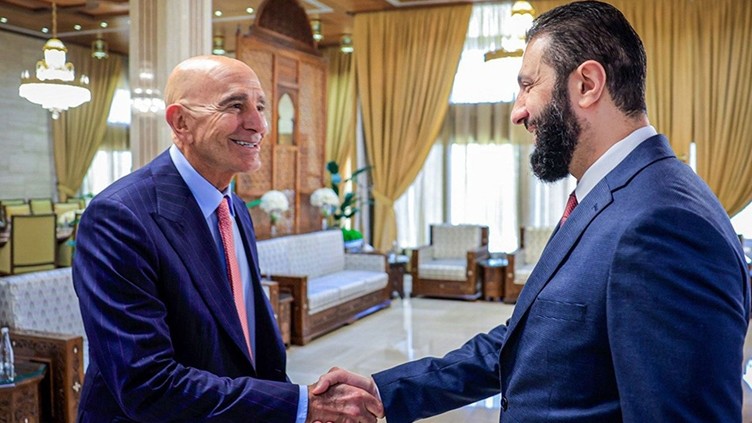
Syrian President Ahmed Shara announced the ceasefire agreement with the SDF following his meeting in Damascus with U.S. envoy Tom Barrack, who had previously held talks with government officials in Ankara and Kurdish groups in Erbil, Iraq.”
After the Syrian army pushed back SDF forces during a military operation that has been ongoing for the past two weeks, Syrian President Ahmed Shara announced on the evening of January 18 that a ceasefire had been reached with the SDF in northeastern Syria. According to the ceasefire agreement, the SDF will hand over control of all border crossings in the region, as well as oil and natural gas fields, and all military and security personnel will be integrated into the structure of the Syrian Ministries of Defense and Interior. According to Syrian authorities, under this agreement the SDF also commits to expelling non-Syrian PKK leaders and members from the country, a demand also voiced by Türkiye.
Following the agreement, President Tayyip Erdoğan called Shara by phone and stated that Türkiye’s support for Syria would continue, particularly in the fight against terrorism. The Ministry of Foreign Affairs, in a cautiously supportive statement, expressed hope that the agreement would be properly understood by all “groups and individuals” in Syria and would quickly bring stability and security.
If the ceasefire leads to reconciliation between the SDF and the Shara administration and to the transfer of command of armed forces to Damascus, it could also contribute to the “Terror-Free Türkiye” process.
According to some sources, the full text of the agreement—expected to be formalized on January 19 with a meeting and signatures by Shara and SDF leader Mazlum Abdi—can be found at the end of the article.
When the Army Crossed to the East of the Euphrates
Shara announced the ceasefire agreement following a meeting in Damascus with the U.S. Special Envoy for Syria and Ambassador to Ankara, Tom Barrack. Although it has not yet been officially confirmed, it is likely that Barrack had Abdi sign the agreement first and then went to Shara.
Prior to the ceasefire announcement, which was made around 7:00 p.m., reports emerged as Barrack was traveling from Erbil, the center of the Kurdistan Regional Government in Iraq, to Damascus. These reports said that the Syrian army—which had crossed to the eastern bank of the Euphrates two days earlier—had recaptured major cities, airports, and oil and gas fields under SDF control, with the support of Arab tribes that had risen up against the SDF.
These cities included the strategically important Raqqa and Tabqa, as well as Deir ez-Zor and Mayadin.
Established under the pretext of partnership in the fight against ISIS, the SDF—formed from the Syrian affiliates of the PKK and regarded as a significant military force since 2015 under U.S. arms, training, financial support, and protection—retreated rapidly within just a few days, even in the face of the Syrian army, which itself had been weakened by Israeli strikes following the civil war.
It became clear that without U.S. military support, especially air support, and without Israel’s political backing, the SDF—until recently described as a “100,000-strong army”—was unable to demonstrate any serious military capability.
Fidan, Barrack, and the Ceasefire
In the process that led back to the agreement signed by SDF leader Mazlum Abdi on March 10, 2025—after which he requested changes—the shuttle diplomacy of U.S. representative Barrack played a role, along with the Syrian army’s operation and Türkiye’s decision, ultimately, to keep the option of a military operation against PKK-affiliated groups in Syria on the table.
Foreign Minister Hakan Fidan had stated that, like the PKK, the SDF changes its stance when it faces “force or the threat of force,” speaking at a time when clashes between the army and the SDF were continuing in Aleppo.
Before announcing the ceasefire agreement, Shara met with U.S. representative Barrack, who on January 17 had attended a long meeting in Erbil with Syrian Kurds brought together by Kurdistan Democratic Party (KDP) leader Masoud Barzani, over which Barrack presided together with U.S. military officers and diplomats.
Barrack was in Türkiye between January 13 and 15. During his meeting with Fidan on January 13, the Iran crisis was also discussed, and he played a role in the de-escalation of the crisis a day later. While in Ankara, Barrack also met with Vice President Cevdet Yılmaz, Minister of National Defense Yaşar Güler, and Minister of Trade Ömer Bolat.
This indicated that U.S. President Donald Trump wanted to move forward on the Syria file together with Shara and President Tayyip Erdoğan; discussions had begun on investment and trade opportunities, including the lifting of sanctions on Türkiye and Syria.
However, even at the Erbil meeting, there was already another sign that the SDF was losing.
The End of a PKK Propaganda Narrative
At the Erbil meeting, the table did not include only SDF leader Mazlum Abdi and the head of foreign relations, Ilham Ahmed, as representatives of Syrian Kurds. Muhammad Ismail, the leader of the Syrian Kurdish National Council (ENKS), which has opposed the PKK and the SDF from the outset, was also present at the table.
In this way, the United States was signaling that it no longer recognized the PKK’s propaganda claim of being the “sole and legitimate representative of the Kurds.”
While Barzani called for an immediate ceasefire in Syria and the granting of Kurdish rights, Barrack stated that it was understood that Kurdish rights would be protected and that the time had now come for integration under the principle of “one state, one army.”
Barrack was referring to the decree announced by Shara on January 16, which recognized Kurdish citizenship, language, culture, and education rights.
Shara had taken the right step at the right time; before the Erbil meeting, he had eliminated one of the major propaganda advantages held by both the PKK and the SDF. It was evident that coordination with the U.S. and Türkiye played a role in this decision.
Israel, which for now appears to have left the Iran issue to the U.S., seems to attach greater importance to arrangements concerning the Golan Heights and the Druze region than to Kurdish autonomy in Syria, and it did not risk the former for the sake of the SDF. This was not the first example of the U.S., Israel, and the West in general refraining from supporting Kurdish separatist movements and abandoning them at the most critical moment.
Türkiye’s Arguments, Step by Step
Another striking aspect of the matter was a statement issued by the PKK/KCK shortly before the announcement that SDF leader Abdi had reached a ceasefire agreement with President Shara and U.S. Representative Barrack.
The statement called on “all Kurds” to join a declared “mobilization” in Rojava. Indeed, agencies claimed that despite the ceasefire announcement, SDF/YPG forces continued firing around Raqqa.
Divergent voices were emerging from within PKK ranks.
Meanwhile, the statement issued after the DEM delegation’s January 17 meeting with PKK leader Abdullah Öcalan at İmralı Prison—declaring that he was “ready to contribute to dialogue”—also lagged behind developments.
So far, Türkiye has been implementing its policy step by step in Syria without needing a new military operation against the PKK there, but by using the threat of such an operation as a diplomatic lever.
With the U.S. changing its stance and providing political support, Türkiye and Syria have so far been the winning sides in the agreement reached.
With the implementation of this agreement, Türkiye must also make efforts to ensure that the rights of Alawite, Turkmen, and non-Muslim minorities in Syria are safeguarded.
What the Agreement Brings
One of the most important aspects of the ceasefire agreement is that the integration of the army and police is to be individual rather than autonomous or institutional, as the SDF had sought. This corresponds to the “one state, one army” principle desired by Syria, Türkiye, and the U.S.
This is among the top priorities for Ankara in the context of the “Terror-Free Türkiye” process.
On the other hand, it appears that a Kurd approved by Damascus will be appointed as governor of Hasakah, and that public order in the city will be maintained by vetted SDF personnel.
Another key article—also stated unequivocally in the March 10 agreement—foresees the transfer of strategic points, including border crossings and oil and natural gas fields, to Syrian state institutions. The reference to the “special status of Kurdish regions” in this article likely implies certain privileges, but nothing has yet been officially announced.
The agreement also foresees the transfer to the Syrian government of responsibility for protecting camps holding thousands of ISIS militants and their families. In addition, the Shara government commits to full cooperation with the international coalition against ISIS. This issue had also been raised during the Trump–Shara meeting attended by Fidan.
***
Full Text of the 14‑Article Ceasefire and Full Integration Agreement
Ceasefire and Full Integration Agreement
An immediate and comprehensive ceasefire on all fronts and contact lines between the Syrian government forces and the Syrian Democratic Forces (SDF), alongside the withdrawal of all SDF military formations to the area east of the Euphrates River as a preliminary step for redeployment.
The immediate and complete administrative and military handover of the governorates of Deir ez‑Zor and Raqqa to the Syrian government. This includes the handover of all civilian institutions and facilities, with the immediate issuance of decrees to confirm the employment of current staff within the relevant ministries of the Syrian state.
The integration of all civilian institutions in the Hasakah governorate into the Syrian state institutions and administrative structures.
The Syrian government shall take control of all border crossings, oil fields, and gas fields in the region, and their protection will be ensured by regular forces to return the revenues to the Syrian state.
Integrating all military and security elements of the SDF into the structures of the Syrian Ministries of Defense and Interior on an individual basis after necessary security vetting, while granting them corresponding military ranks and financial/logistical entitlements.
The SDF leadership commits to not including remnants of the former regime within its ranks and to submitting lists of former‑regime officers present in northeastern Syria.
Issuing a presidential decree appointing a candidate for the position of governor of Hasakah, guaranteeing political participation and local representation.
Removing the heavy military presence from the city of Ayn al‑Arab (Kobani), forming a security force from the city’s residents, and maintaining a local police force administratively subordinate to the Syrian Ministry of Interior.
Integrating the administration responsible for ISIS prisoners and camps, and the forces securing these facilities, into the Syrian government so that the Syrian state assumes full legal and security responsibility.
Adopting the list of nominated leaders proposed by the SDF leadership to fill senior military, security, and civilian positions in the central state structure to ensure national partnership.
Welcoming Presidential Decree No. 13 of 2026, which recognizes Kurdish cultural and linguistic rights and addresses unresolved legal/civil issues including undocumented persons and property rights claims.
The SDF commits to expelling all non‑Syrian PKK leaders and members from beyond the borders of the Syrian Arab Republic to ensure sovereignty and regional stability.
The Syrian state commits to continuing the fight against terrorism (ISIS) as an active member of the international coalition, in coordination with the United States, to ensure regional security and stability.
Efforts will be made to reach understandings for the safe and dignified return of residents of the Afrin and Sheikh Maqsoud areas to their homes.
Signatories:
President of the Syrian Arab Republic: Ahmed al‑Sharaa
Commander of the Syrian Democratic Forces: Mazloum Abdi