
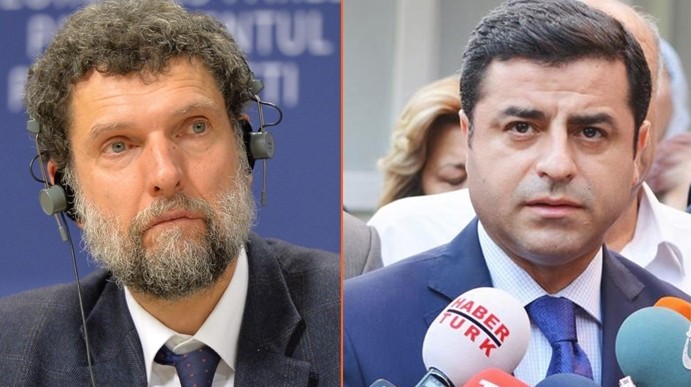
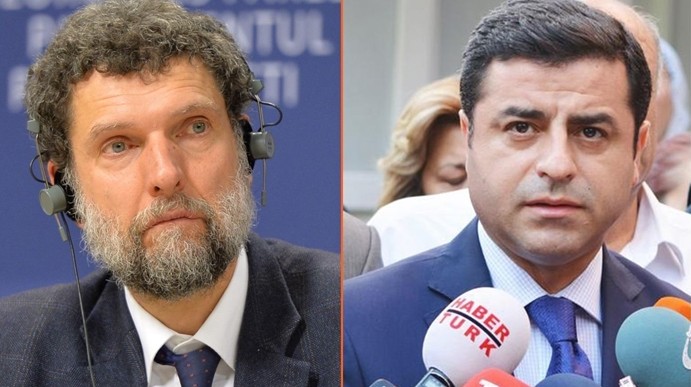
The picture in Ankara is becoming increasingly clear: if PKK leader Abdullah Öcalan is granted the so-called “right to hope” within the framework of the “Terror-Free Türkiye” process, the same principle will apply to Osman Kavala, Selahattin Demirtaş, and all others in comparable legal circumstances.
Should the Grand National Assembly of Türkiye extend the “right to hope” to PKK leader Abdullah Öcalan, this practice would also cover Selahattin Demirtaş, Osman Kavala, and all prisoners in similar situations. On the evening of 5 February, after confirming this information in Ankara’s political circles, I was granted permission to report it on the condition that it be attributed to “sources familiar with the matter.”
The points conveyed can be summarised as follows:
If such a legal arrangement is enacted, anyone serving a finalized life sentence or aggravated life sentence would become eligible after serving 36 years for crimes involving organised activity, and 30 years for crimes committed outside that scope.
If Kavala and Demirtaş were to receive finalized life or aggravated life sentences, then yes, the provision would apply to them as well. If, however, their sentences are finalized as fixed-term prison terms, they already benefit from existing legal possibilities.
The assessment is unequivocal.
Following the temporary alignment of the Syria–SDG issue, this is the point reached in recent days in the debate over the “right to hope” within the “Terror-Free Türkiye” process. Developments that brought the discussion to this stage have accelerated over the past three days.
It was Bahçeli who set the process in motion — once again
On 3 February, MHP leader Devlet Bahçeli, addressing his party’s parliamentary group, called for “peace for Anatolia, hope for Öcalan, positions for the Ahmets, and a home for Demirtaş.” The addressee of this call was the AK Party government. When I asked Bahçeli what response he expected from the government, he replied: “From here on, it is for the government to decide.”
It was, in fact, Bahçeli who first raised the issue of the right to hope on 22 October 2024, when he called on Öcalan to urge his organisation to disband and lay down arms. At the time, the proposal did not gain traction, as the AK Party showed little enthusiasm. Although Bahçeli has denied any direct link, he reintroduced the issue—unexpectedly even for the MHP parliamentary group—following the Syria–SDG agreement.
What Is the “Right to Hope”?
Under Article 3 of the European Convention on Human Rights, to which Türkiye is a signatory, and according to the case law of the European Court of Human Rights, the “right to hope” refers to the entitlement of a person sentenced to life imprisonment—regardless of the gravity of the crime—to have their sentence reviewed after a certain period (commonly accepted as 25 years), thereby retaining the possibility and the hope of eventual release.
After Öcalan was captured in a joint MİT–CIA operation in 1999 and brought to Türkiye, he was initially sentenced to death. Following the abolition of the death penalty and the commutation of his sentence to aggravated life imprisonment, his lawyers applied to the European Court of Human Rights in 2003. In 2014, the Court ruled in favour of the right to hope, and Türkiye was subsequently penalised for failing to comply with the judgment. Türkiye had not applied ECHR jurisprudence in cases involving constitutional order or crimes against the state.
The “Consensus” Debate in the Committee
Shortly after Bahçeli’s remarks, Speaker of Parliament Numan Kurtulmuş convened the report-drafting committee of the “National Solidarity, Brotherhood and Democracy” commission on 4 February. A day earlier, DEM Party Deputy Group Chair Gülistan Kılıç Koçyiğit had publicly called for the committee to meet in order to accelerate the process.
Following the meeting, MHP Deputy Chair Feti Yıldız appeared alongside CHP Deputy Group Chair Murat Emir and declared that “a consensus has been reached on the right to hope.” Emir, however, stated that no such consensus existed and that there was not even a draft on the table. Later that same evening, at a reception hosted by the Japanese Ambassador where we spoke, Emir said that Yıldız’s premature claim of consensus had placed them in a difficult position vis-à-vis CHP voters.
The following day, 5 February, AK Party Deputy Chair Mustafa Elitaş also stated that no full consensus had yet been achieved—a remark largely overshadowed by his separate comments on the possibility of early elections in November 2027. DEM Party’s Koçyiğit likewise told YetkinReport: “There is a positive approach toward agreement, but we cannot say there is full consensus.”
Feti Yıldız and Mehmet Uçum
Subsequently, Yıldız took to X, citing provisions of the Turkish Penal Code, the Anti-Terror Law, and ECHR jurisprudence, arguing that the refusal to recognise the right to hope—Türkiye’s long-standing practice—constitutes a “human rights violation.” He also emphasised that the right to hope does not equate to immediate release.
That same morning, Nefes ran an interview with DEM Co-Chair Tuncer Bakırhan by Memduh Bayraktaroğlu. Bakırhan stated that their current demand was not so much release as the provision of “free living and working conditions that would allow [Öcalan] to personally conduct negotiations.”
A few hours after Yıldız’s post, President Erdoğan’s Chief Legal Adviser, Mehmet Uçum, shared a notable statement quoting Yıldız. He agreed with him: the right to hope does not mean direct release, but rather the recognition of the possibility of conditional release at some point in the future. It was not a privilege tailored to a single individual or to Öcalan alone.
I was able to further confirm, through questions posed to “relevant sources,” that if this possibility is not exclusive to Öcalan—and given that Bahçeli himself has raised the issue—it would also apply to Demirtaş and to Kavala, whom Bahçeli had notably avoided mentioning in connection with the Gezi case.
If the right to hope is granted to Öcalan, it must also be extended to Demirtaş, Kavala, and all others in similar circumstances.