
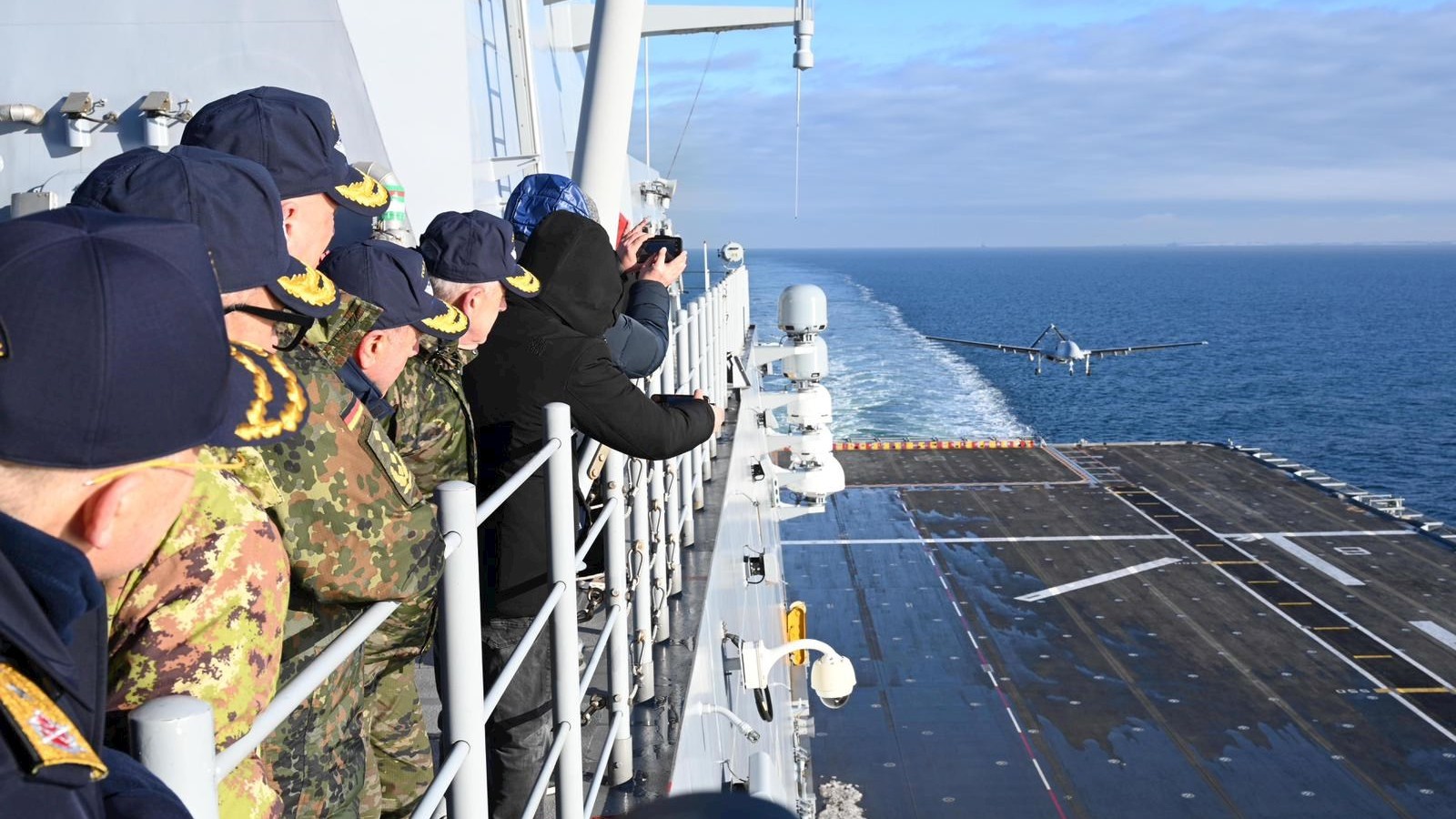
The Russia–Ukraine war, which began four years ago, ushered in Türkiye’s return to realpolitik and an expanded role within NATO. Commander of the Turkish Naval Forces Admiral Ercüment Tatlıoğlu and NATO commanders are seen observing the landing of a Bayraktar TB-3 on the deck of TCG Anadolu during an exercise in the Baltic Sea. (Photo: Ministry of National Defense)
Russian forces entered Ukrainian territory four years ago today, on 24 February 2022. NATO had anticipated the attack. Just as the world was beginning to recover from the trauma of the Covid-19 pandemic, it was perhaps stepping into what could become a simmering, low-intensity world war.
On 27 February 2022, Türkiye formally designated the situation as a war. Upon Ukraine’s request and pursuant to the 1936 Montreux Convention Regarding the Regime of the Straits, it suspended the transit of warships through the Straits. Russia was permitted to pass only those warships registered to its Black Sea ports; owing to the ongoing war in Syria, it was unable to redeploy vessels assigned to its Mediterranean bases into the Black Sea for use against Ukraine.
Ankara’s move proved decisive for the course of the war. Ukraine might have suffered far heavier losses at a much earlier stage than it has to date.
The EU Turns to NATO; NATO Recalls the Black Sea
This step had several further consequences:
-
European Union member states turned toward the United States for NATO protection against Russia—despite having assumed in the 1990s, after the dissolution of the Soviet Union, that large-scale military spending was no longer necessary and NATO was dying.
-
The United States, which had already complained that European NATO members were not contributing sufficiently to collective defense, intensified pressure—particularly after Donald Trump took office—urging Europeans to “allocate more funds to weapons, and buy those weapons from me.”
-
NATO rediscovered the strategic importance of the Black Sea. Türkiye, located at the eastern edge of NATO’s southern flank—at a time when some Europeans were questioning their role within the Alliance—was guarding not only the Syrian-Iraqi-Iranian borders but also the Black Sea. Accused by its Western allies since the beginning of the “Arab Spring” of pursuing an ideology-driven foreign policy and undergoing an “axis shift,” Türkiye nonetheless maintained relations with both Ukraine and Russia within the framework of Black Sea neighborhood ties, and was able to bring them together on its own soil.
A new reality had emerged in international relations.
For Turkish foreign policy as well, Russia’s entry into Ukrainian territory four years ago marked the beginning of a new phase.
Türkiye’s Return to Realpolitik
Recently, Ankara hosted the Global Relations Forum’s workshop titled “Risks and Opportunities for Türkiye Amid Global Fractures.” Under the meeting’s rules, I cannot attribute specific remarks. However, one of the key observations was that the shift in Turkish foreign policy from an ideology-centered approach to realpolitik began with Russia’s 2022 invasion of Ukraine.
With each passing day, the decision taken four years ago today—closing the Bosporus to warships under the 1936 Montreux Convention—appears increasingly well-judged.
The paradox of that period was that 103 retired admirals were prosecuted on charges of coup-plotting for issuing a joint statement emphasizing the importance of the Montreux Convention. The retired officers, who faced prison sentences of up to 12 years, were acquitted of all charges in December of that year.
Shortly thereafter, Türkiye brought Russian and Ukrainian delegations together. While Ukrainian soldiers composed songs about Bayraktar TB-2 drones, Russia continued exporting sanctioned grain via Türkiye.
Realpolitik and Strategic Autonomy
The return to realpolitik proceeded in parallel with the concept of “strategic autonomy,” which had been implemented with sharper contours following the failed coup attempt of 15 July 2016—albeit in a form distinct from that of the Cold War era.
After concluding that the coup attempt by the Fethullah Gülen organization had received backing from the United States, Türkiye purchased S-400 missile systems from Russia. While this move fueled further claims of an “axis shift,” it simultaneously conveyed the message: “I will fulfill my NATO responsibilities, but I will safeguard my own national interests separately.” (This is not an assessment of whether the S-400 purchase served national interests; it is referenced here solely as an example of strategic positioning.) The cost of this decision was the United States’ removal of Türkiye from the F-35 program, in which it had been a co-producer, a step widely viewed in Ankara as retaliatory. Another example of this policy was Türkiye’s insistence that Sweden and Finland, which applied for NATO membership due to fears of Russia, revise their policies regarding the PKK.
Despite criticisms, Türkiye’s policy of avoiding direct involvement in the Russia-Ukraine war has been significant. This approach is also evident in its efforts to prevent a U.S. attack on Iran. Whether successful or not, the attempt itself matters; Türkiye has not opened its airspace to U.S. military deployments aimed at Iran.
NATO Exercise in the Baltic
This positioning has not diminished Türkiye’s role within NATO; on the contrary, it has enhanced it.
Beyond the fact that the 2026 NATO Leaders’ Summit will be held in Ankara on 7–8 July, attention should also be paid to its presence in the Alliance’s largest military exercise of 2026, namely Steadfast Dart.
In the exercise held in the Baltic Sea, Türkiye made the largest contribution, deploying 2,000 troops—nearly one-fifth of all participants. The Turkish Armed Forces demonstrated that they could transport, within a short timeframe, a mechanized brigade reinforced with artillery and commando units thousands of kilometers northward by land, sea, and air. A review of NATO’s official communications shows that Türkiye’s contribution is recognized not only in terms of military strength but also in the capabilities it brings to the Western military alliance.
For example, NATO sources have described the combination of TCG Anadolu, the Bayraktar TB-3 drone, and FNSS’s ZAHA unmanned amphibious vehicle as the successful testing of the world’s first amphibious assault ship transformed into a drone (UAV/UCAV) carrier platform. Likewise, the first mission of the Turkish design and built İstanbul-class frigate, as well as the integration into NATO capabilities of ASELSAN’s Aslan unmanned ground vehicle and ROKETSAN-developed rockets, have been noted.
As the World Becomes Less Secure
Russia’s invasion of Ukraine four years ago today may in time be seen as the onset of what could prove to be a simmering, low-intensity world war. The gravest scenario would be one in which it escalates to the use of nuclear weapons.
The erosion by both the United States and Russia of the arms control agreements established after the Second World War—ended by the United States’ use of the first nuclear weapon against Japan—has made the world increasingly insecure. Developments surrounding nuclear armament, cited by the United States as grounds for a possible strike on Iran, have gained further dimensions through nuclear discussions between Germany and France.
In this environment, Türkiye’s dual-track approach—remaining within the NATO alliance while strengthening its defense capabilities as much as possible through national means, and at the same time prioritizing policies aimed at avoiding and preventing conflicts—carries importance both for our country and for our region.