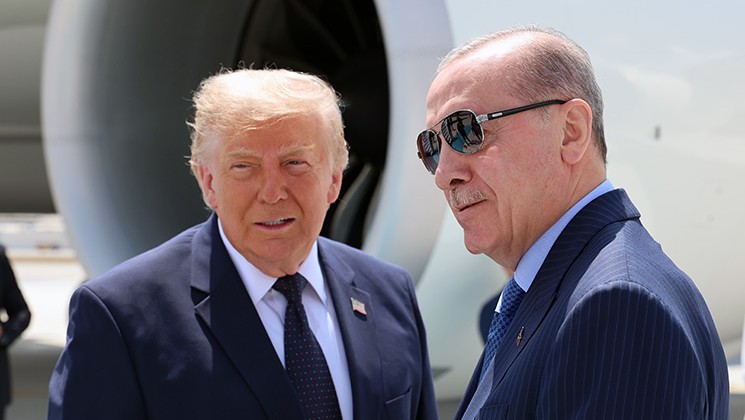
Ahead of President Erdoğan’s meeting with U.S. President Trump, Ankara imposed two economic sanctions on Iran. Erdoğan welcomes Trump, who arrived in Ankara for the NATO Summit on July 7. (Photo: Turkish Presidency)
Ahead of President Recep Tayyip Erdoğan’s visit to the United States to attend the UN General Assembly on September 22, Ankara announced two economic sanctions against Iran, shortly before his expected meeting with President Donald Trump.
The first came on September 16, when the Civil Aviation Directorate General of the Ministry of Transport announced that flights to Türkiye by Iran’s Mahan Air would be suspended as of September 21. Mahan Air was on the blacklist in the “Economic Exclusion Operation” against Iran announced on September 8 by the U.S. Treasury Department’s Office of Foreign Assets Control (OFAC).
A day after U.S. Ambassador to Ankara Tom Barrack announced on September 17 that Trump would meet with Erdoğan, the Banking Regulation and Supervision Agency (BDDK) convened and announced an economic sanctions decision against Iran in the early hours of September 19. Under the decision, the operating license of Iran’s second-largest bank, Bank Mellat, which had been operating in Türkiye since 1982, was revoked.
Erdoğan is expected to leave for the United States on Sunday, September 20.
Iran and Russia together
Trump, meanwhile, was reported on September 19 to have signed a new sanctions decision targeting Russia, alongside sanctions on Iran, aimed at putting pressure on Moscow over the war in Ukraine, particularly in the energy sector. The decision is reportedly named after Senator “Lindsey O. Graham 2026 Russia and Iran Sanctions,” who traveled from Ankara, where he had attended the NATO summit on July 7-8, to Kyiv and died on his return.
The measure, which has also passed the House of Representatives, gives Trump the authority to raise trade tariffs by up to 100 percent on countries that violate the sanctions. The measure primarily targets the largest buyers of Russian crude oil, with China understood to be the largest and India the second-largest. However, Türkiye’s reliance on Russia for nearly 60 percent of its crude oil imports in 2025, according to figures from the Energy Market Regulatory Authority (EPDK), constitutes a risk factor.
Greenland deal with Denmark
Another example of the U.S. president increasing pressure ahead of the UN General Assembly, which will convene in New York with the participation of 190 countries, is the Greenland deal he announced with Denmark.
From the moment he began his second term, Trump had said that Greenland, which belongs to NATO ally Denmark, should be under U.S. control. According to what Trump announced on Truth Social, under the deal the United States and Denmark will jointly provide for Greenland’s security; U.S. “adversaries” will not be allowed to establish military bases on Greenland or make investments in “sensitive” areas without U.S. approval.
Among the United States’ intentions regarding Greenland is the opening of a new trade route across the Arctic, which is melting due to climate change, connecting the Atlantic and Pacific oceans while passing almost entirely through Russian territorial waters.
In other words, this move is also not entirely independent of Trump’s sanctions against Iran and Russia.
Another step concerning the meetings Trump will hold at the White House on the sidelines of the UN General Assembly involved media restrictions. Trump barred CNN, MSNOW (formerly MSNBC), and Politico from access to the White House press pool, accusing them of publishing “fake news” about him.