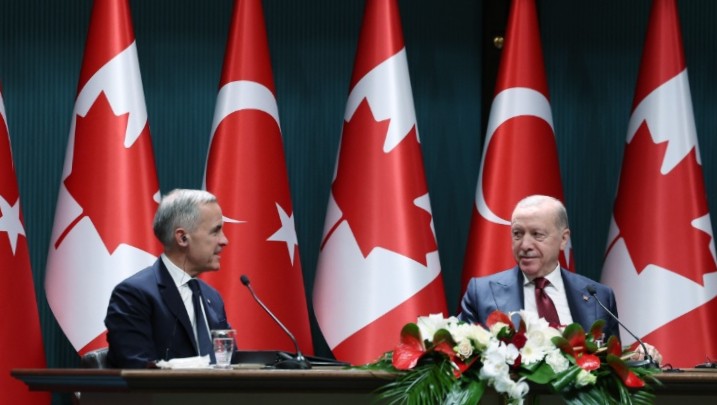
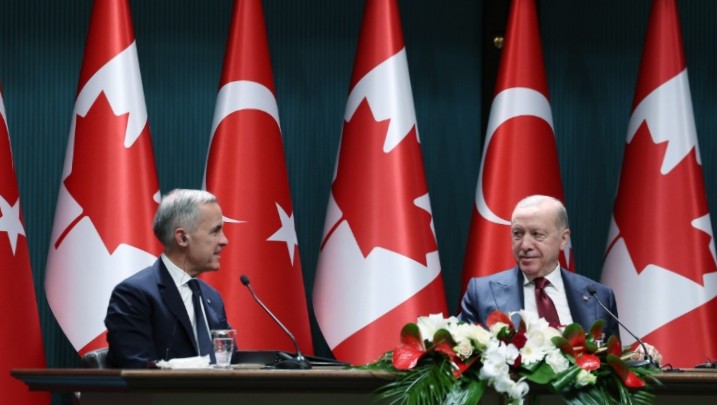
As the EU drifts further away from Türkiye, Ankara is seeking new avenues for cooperation. On October 22, Canadian Prime Minister Mark Carney signed a strategic partnership document with President Tayyip Erdoğan in Ankara. On October 23, foreign ministers from Europe and the Middle East are meeting in Istanbul. (Photo: Turkish Presidency)
As I left the press conference held on October 22 by Avio Orav, the European Union’s Ambassador to Türkiye, one sentence came to mind: “Neither does the EU have any expectations of Türkiye anymore, nor does Türkiye have any of the EU.” Yet the seasoned diplomat, who had previously served as Estonia’s ambassador, had opened the meeting by saying, “Türkiye needs the EU, and the EU needs Türkiye.” But neither the ambassador’s command of the subject nor his goodwill seems likely to break the cycle in which “neither Ankara nor Brussels want to be the first to say no.”
EU-Türkiye: Where to?
It all comes back to the Cyprus issue, which, as a result of the EU’s strategic myopia, led it to take in a territorial dispute when it admitted Cyprus in 2004. For example, journalists ask about Türkiye’s exclusion from Made in Europe, a move that has infuriated Turkish industrialists. The answer is that Türkiye needs to open its Public Procurement Law to EU businesses, a demand also voiced in Brussels at meetings of the Foreign Economic Relations Board (DEİK) attended last week by Trade Minister Ömer Bolat. But if Türkiye complies, will it be included in Made in Europe? Will the Greek Cypriot and Greek vetoes be lifted when the Customs Union is updated? Well, we are hopeful about the UN! Let’s hope for the best!
Asked about European Commission President Ursula von der Leyen’s reaction to the Türkiye-Libya agreement—which amounted to little more than a statement with no meaningful impact—the ambassador invokes the EU’s foreign policy chief, Kaja Kallas, who is also his compatriot, and offers a response along the lines of: “Our position is clear, and so are our principles.”
Indeed, Kallas, who met Foreign Minister Hakan Fidan in Brussels the day before, had also sought to convey the EU’s reaction to the Türkiye-Libya agreement through her body language, wearing a sulky expression reminiscent of a child whose toy has been taken away.
And what about human rights, press freedom and operations targeting LGBT people? Wait for the country report!
Meanwhile Canada-Türkiye
It is true that Türkiye has yet to fulfil six outstanding requirements under the 2016 visa liberalisation agreement, and has not delivered on the commitments it made under that framework. It is equally true that the EU has failed to honour its promises to Türkiye, starting with the UN Cyprus plan in 2004.
It is clear that the EU has long since lost much of its potential to exert political leverage over Türkiye, despite its expectations regarding security and connectivity. Beyond trade and industrial cooperation, Türkiye no longer appears to have any political expectations of the EU.
Meanwhile, as EU Ambassador Orav was making these remarks, Canadian Prime Minister Mark Carney was meeting President Tayyip Erdoğan in Ankara. Carney had also visited Türkiye on July 7–8 for the NATO summit, but this was the Canadian prime minister’s first visit to Türkiye in his own right.
A defence industry cooperation agreement and a strategic partnership document were signed with Canada, which only a few years ago had imposed an arms embargo on NATO ally Türkiye, alongside agreements on energy and transport. Carney concluded his remarks at the joint press conference by quoting, in Turkish, the words of Mustafa Kemal Atatürk, the founding leader of the Republic: “Peace at home, peace in the world.”
Around the same time, the Istanbul meeting of the R4 and E3 foreign ministers was announced.
R4+E3: Europe’s Gain, the EU’s Loss
Here is what R4+E3 means:
- R4: The “R” stands for Regional. The group comprises Türkiye, Saudi Arabia, Pakistan and Egypt. They discuss issues ranging from the US-Israeli war against Iran and Gaza to energy chokepoints in the Strait of Hormuz and the Bab el-Mandeb Strait, as well as the Yemen conflict. Türkiye, Saudi Arabia and Pakistan are also members of the Mecca Pact and want Egypt to join them.
- E3: The “E” stands for Europe. The group consists of the United Kingdom, Germany and France. It was formed in 2003 for negotiations on Iran’s nuclear programme. Today, its focus also includes Russia’s war in Ukraine, and the group works to secure NATO’s support—and particularly that of the United States—for Ukraine. Türkiye, a NATO member and a Black Sea neighbour of both Russia and Ukraine, is trying to keep its diplomatic channels open with both countries.
The meeting, to be held in Istanbul on October 23 at Türkiye’s initiative and bringing together the seven countries, will be the first to address the wars in Ukraine and Iran—or, in other words, security challenges in the Middle East and Europe—in a single forum.
The last-minute surprise is that Italy, despite not being a member of the E3, has also expressed a desire to participate. Europe is searching for solutions that the EU’s inertia has prevented it from finding, while Türkiye is making the most of the opening.