Trump wants to annex Greenland to the United States under the pretext of “needing it against Russia” and claiming that Denmark lacks the power to defend it.
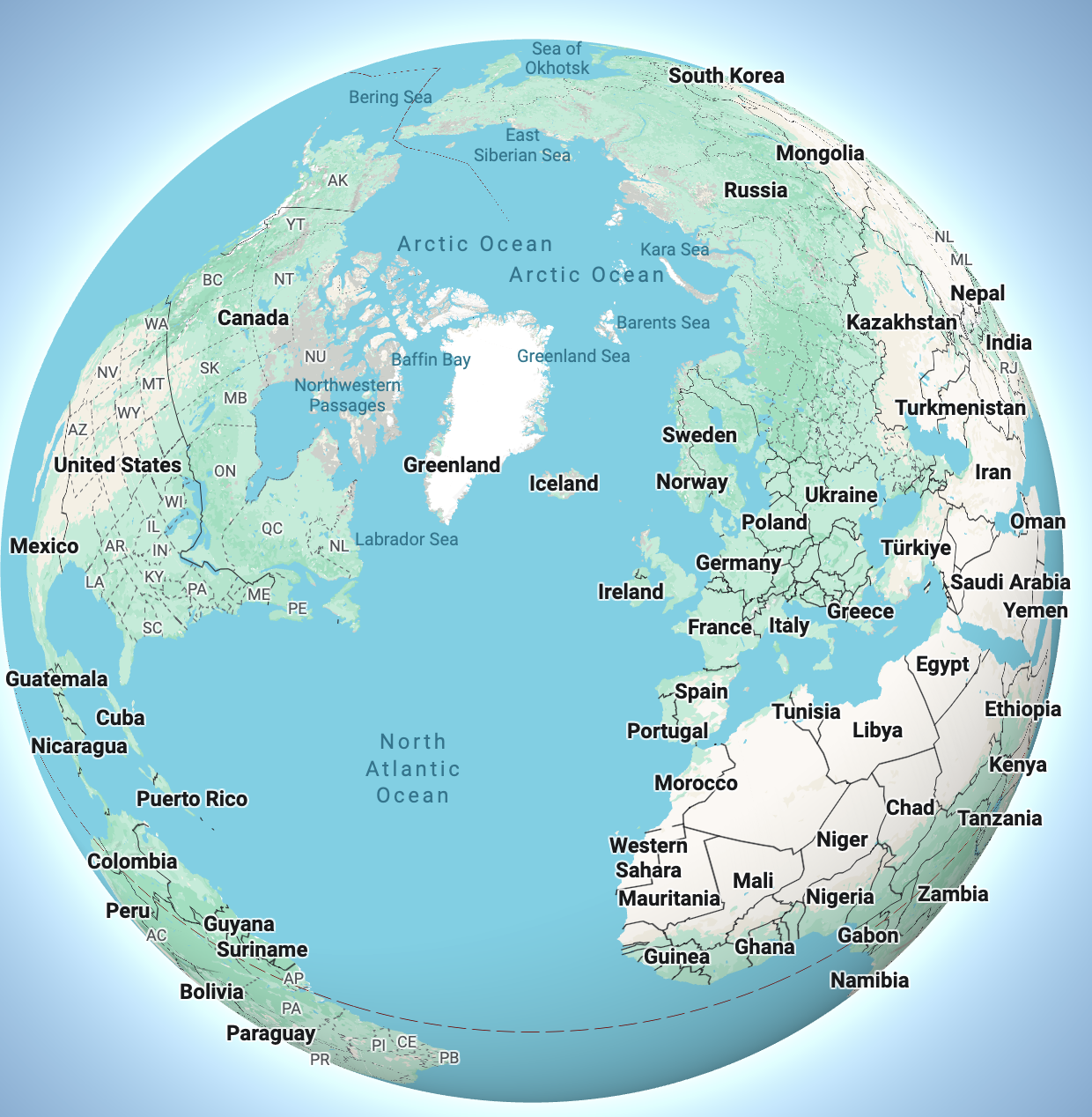
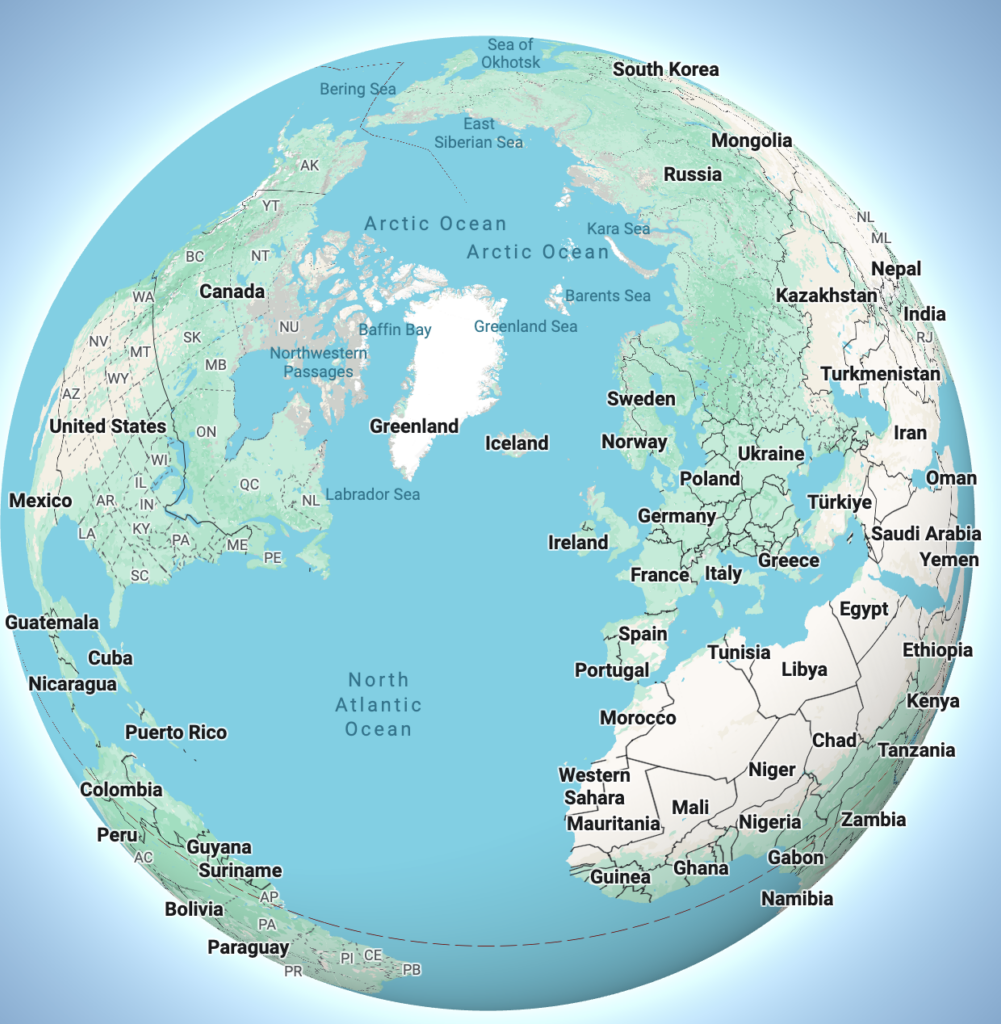
When you rotate the Google Earth application 90 degrees vertically instead of horizontally, the map above appears, clearly revealing why U.S. President Donald Trump set his sights on Greenland the very day after his military intervention in Venezuela.
The area that looks like a sea in the center is the Arctic Ocean. It is covered with ice and is suitable for air, land, and naval warfare along the Russia–Canada axis. Since the Earth is spherical rather than flat, this route is also the shortest path in terms of missile warfare.
Due to global warming, the ice is melting. For the first time in history, according to the map, a trade route is opening along the arc you see to the right of the Pole, connecting the Atlantic and Pacific Oceans via the shortest path. This route passes almost entirely through Russian territorial waters. At the Pacific end of this trade route lies the Bering Strait, located between the U.S. state of Alaska—where Trump and Russian President Vladimir Putin have met—and Russia’s Chukotka region in Eastern Siberia. At the Atlantic exit, acting like a massive plug, stands the island of Greenland.
Greenland, Denmark, NATO
Denmark, located 3,500 kilometers away from Greenland, planted its flag and claimed the island during the era when it dominated northern seas—essentially colonizing it. During World War II, in 1943, the United States landed in Greenland and established the Thule Air Base to consolidate its North Atlantic superiority against Denmark and Norway, which were under German occupation at the time. After the war, Greenland was incorporated into NATO in 1953 as Danish territory. In 1979, Denmark granted Greenland autonomy; it now has a self-governing administration responsible for internal affairs. This autonomy currently functions as a double-edged sword for Copenhagen.
The NATO Treaty guarantees sovereignty and territorial integrity within member states’ borders and operates on the principle of “one for all, all for one”—or perhaps it would be more accurate to say it used to operate that way.
Trump wants to annex Greenland to the United States under the pretext of “needing it against Russia” and claiming that Denmark lacks the power to defend it. In doing so, Trump also continues to humiliate the European Union, of which Denmark is a member.
While Danish Prime Minister Mette Frederiksen warns that such an action “could spell the end of NATO,” Greenland’s Autonomous Prime Minister Jens-Frederik Nielsen signals openness to Trump by saying, “We can make a deal.”
The U.S.: Our Hemisphere
On January 5, the White House released a visual using mafia slang: “FAFO”—“Fuck Around, Find Out,” which can be politely translated into Turkish as “If you go looking for trouble, you’ll find it.”
After Trump openly declared his interest in Greenland, Secretary of State and National Security Advisor Marco Rubio shared an image on X featuring Trump with the caption: “This Is Our Hemisphere.”
If Trump’s United States dares to covet Greenland—territory belonging to Denmark, a NATO and EU member—what would it not do to Iran, which it openly states it has unfinished business with, as it does with Israel?
This signals a return to early U.S. imperialism from two centuries ago, during the first quarter of the 19th century, when President James Monroe developed a doctrine that ostensibly opposed European colonialism while declaring the entire American continent, north and south, as the U.S. “backyard.” Some call this Monroe Doctrine 2.0; others label it the Donroe Doctrine, after Trump.
Venezuela, Russia, Ukraine
The difference is that two hundred years ago, the United States was not the world’s largest financial and military power—whereas today it is. Trump, who does not even take the EU seriously, is challenging China, a rising military and political power, and its ally Russia. Thanks to this military superiority, the Donroe Doctrine now extends influence into the Pacific via Australia, Japan, and South Korea, and into the Middle East via Israel and Saudi Arabia.
We can already predict what will happen in Greenland. Unable to secure support from NATO’s EU member states, Copenhagen is likely to bow to Washington, allowing Greenland to remain Danish territory on paper while consenting to the autonomous Greenlandic government cooperating with the United States and effectively behaving like a U.S. colony. The possibility of Greenland separating from Denmark through a plebiscite and joining the United States should not be dismissed.
It is no surprise that Putin did not react as harshly as expected to Trump’s Venezuela operation; he likely views it as confirmation that the territories Russia seized from Ukraine will not be returned. The fact that former President and current Security Council Chairman Dmitry Medvedev described Trump’s move on Venezuela as “illegal but consistent” supports this view.
China, Taiwan, Israel, Türkiye
So what would happen if China were to do to Taiwan overnight what the United States did to Venezuela? In his New Year message, Chinese President Xi Jinping explicitly stated that Taiwan will sooner or later become part of China. Would such a scenario trigger a Third World War involving nuclear weapons? I highly doubt it. In fact, the Third World War arguably began when Russia attacked Ukraine and has been continuing at a low intensity ever since. Major tensions and perhaps clashes may occur, but the Pacific will eventually settle into a new balance. Economics determines everything.
To understand the military significance of Trump’s interest in Greenland and its connection to controlling trade routes, please examine the map above once again.
In the Middle East, the most serious issue troubling the United States is the conflict between Türkiye—neighboring Russia and Ukraine and influential in the Caucasus and Balkans—and Israel, which is a regional priority of U.S. foreign policy. This conflict currently has two axes: Palestine/Gaza and Syria/SDF. The latter also has implications for a political solution to the Kurdish issue through the “Terror-Free Türkiye” project, which is expected to change the quality of governance in Türkiye. This even affects the F-35 program.
In the near future, the course of Türkiye–Israel relations may bring either positive or negative surprises.