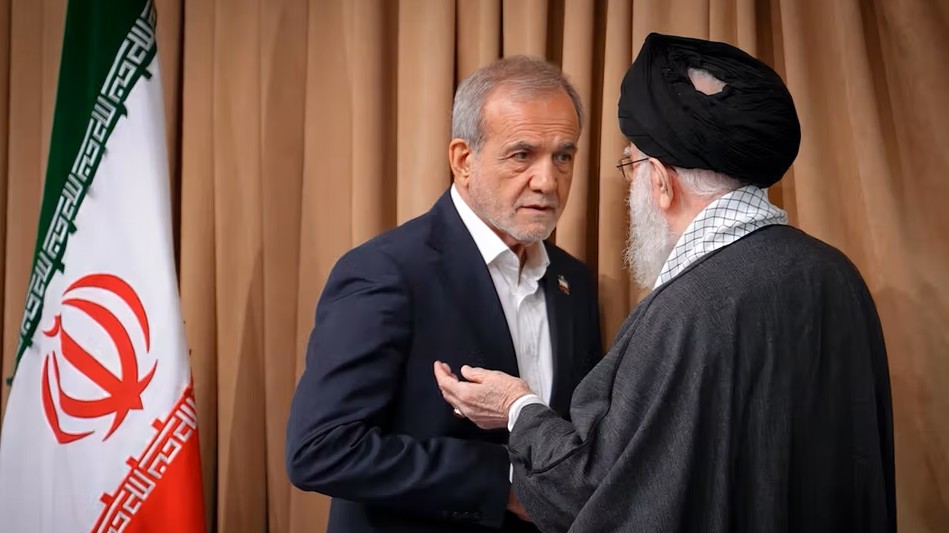
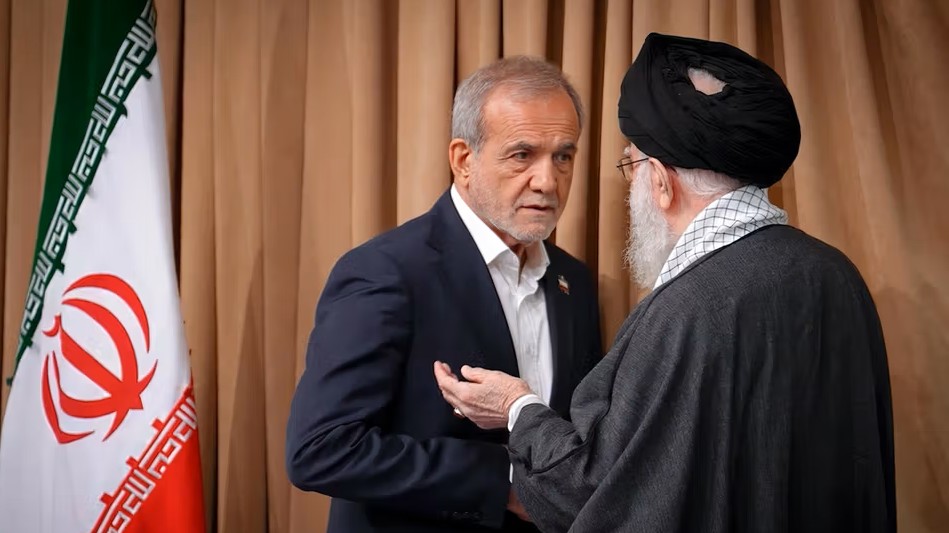
Iranian President Masoud Pezeshkian listens with concern as Supreme Leader Ali Khamenei speaks. (Archive Photo: Iran International)
Geopolitical analysis of the US–Iran crisis typically rests on cold calculations of power: air defence systems, missile ranges, sanctions packages, aircraft carriers. Yet occasionally it is more instructive to step deliberately one degree away from realism and ask: what if?
Alternative scenarios can illuminate exits from deadlocked equations.
Recall that when China brokered diplomatic normalisation between Iran and Saudi Arabia, many dismissed it as implausible. Yet it happened. In the Middle East, the improbable often emerges from the depths of the most entrenched crises.
Today we know that back-channel negotiations between Washington and Tehran continue in Muscat, relocated there at Iran’s request. The agenda reportedly ranges from which oil fields might be reopened to foreign investment, to how many Boeing aircraft could be purchased under sanctions relief. Official rhetoric remains harsh and military posturing visible, but diplomacy has not disappeared.
Let us consider a hypothetical yet strategically conceivable framework.
The Grand Bargain
The United States refrains from striking Iran — provided Tehran:
• De facto recognises Israel and agrees to a non-aggression understanding
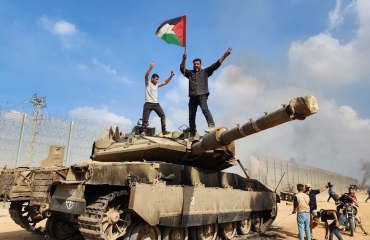
• Halts proxy military pressure across the region
• Freezes its nuclear weapons programme and subjects ballistic missile capabilities to verifiable oversight
• Opens its oil and gas sector to Western firms
• Reduces the use of energy trade with China as a geopolitical lever and returns to dollar-denominated transactions
• Abandons its confrontational Gulf security doctrine
In return, Washington provides explicit security assurances and lifts sanctions in stages tied to compliance.
Were such a bargain to materialise, it would represent the most radical paradigm shift in the Middle East since the 1979 Islamic Revolution.
What Would Iran Gain?
First and foremost: regime survival. For Tehran, that remains the primary objective.
Sanctions relief would restore access to SWIFT, unlock frozen assets and enable expanded oil exports. Inflationary pressure could ease. Structural economic suffocation would diminish.
Dependence on China and Russia would decline. Iran currently sells oil at discounted prices under constrained conditions. Normalisation would increase its bargaining leverage.
Domestic pressure could soften. Economic relief may reduce social volatility. This would not signify the end of the revolution, but rather its pragmatic evolution.
What Would the US and Israel Gain?
For Washington, strategic advantage without war. Oil prices could stabilise or decline. Inflationary pressures would ease. Gulf security would strengthen. China’s influence over Iran would be constrained. In an election year environment, avoiding a costly conflict carries domestic political value.
For Israel, the central issue is the nuclear threshold. Effective containment of Iran’s nuclear and ballistic capabilities, coupled with the scaling down of proxy warfare, could provide more durable security than direct military strikes.
However, this would require a revision of a long-standing strategic instinct: preventing the emergence of overly strong regional states, balancing through fragmentation and managing sectarian fault lines to avoid hostile blocs coalescing.
A shift would be required — from fragmentation toward controlled integration.
Alternative Pathways
The grand bargain is not the only scenario.
1. Limited Freeze Model
A partial agreement: nuclear activity frozen, missile ranges capped, proxy attacks reduced — in exchange for limited sanctions relief. A cold peace.
2. Multilateral Guarantee Model
China, or a trilateral structure, acts as guarantor. Iran positions itself within a multipolar energy equilibrium. At present, this appears the least likely path.
3. Managed Tension Model
Periodic limited crises, symbolic retaliation, continuous back-channel diplomacy. The region’s familiar equilibrium.
History suggests outcomes tend to fall between extremes: neither full war nor genuine reconciliation, but calibrated hostility constrained by mutual red lines.
Optics Matter
Any such arrangement would depend heavily on narrative management.
Iran cannot present it as revolutionary capitulation.
The United States cannot frame it as concession.
Israel cannot appear to have increased its security risk.
The messaging would need to read:
• Iran: “A dignified strategic transformation.”
• US: “We halted the nuclear threat.”
• Israel: “The existential risk has been neutralised.”
In geopolitics, legitimacy and perception are often as consequential as military capacity.
Where Does Türkiye Stand?
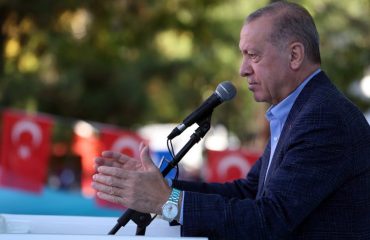
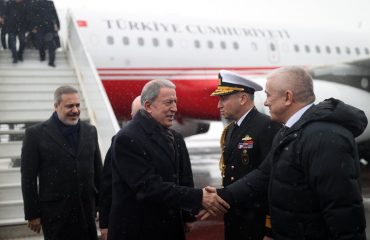
Türkiye cannot afford to be a passive observer. Ankara remains one of the few capitals capable of speaking to Washington, Tehran, the Gulf and Beijing simultaneously.
Should Iran integrate more fully into the global system, energy corridors would be reshaped. Trade and investment flows would expand. Regional security risks could decline. For Türkiye, this would generate both opportunity and competition. Reflex rivalry would be unwise; calibrated balancing would be smarter.
Türkiye’s interest lies in any framework that prevents large-scale war and stabilises energy and trade flows.
Is this scenario romantic? Hardly.
Is it impossible? No.
In the Middle East, transformative shifts occur when parties are not strong enough to win — but too exhausted to lose.
Perhaps the question is not ideology, but sustainability. Oil revenues and macroeconomic stability may ultimately prove more decisive than revolutionary rhetoric.
And perhaps one day history books will record:
“At the edge of war, the parties chose not victory — but survival.”
In geopolitics, the greatest victory is sometimes restraint — even after the sword has been drawn.