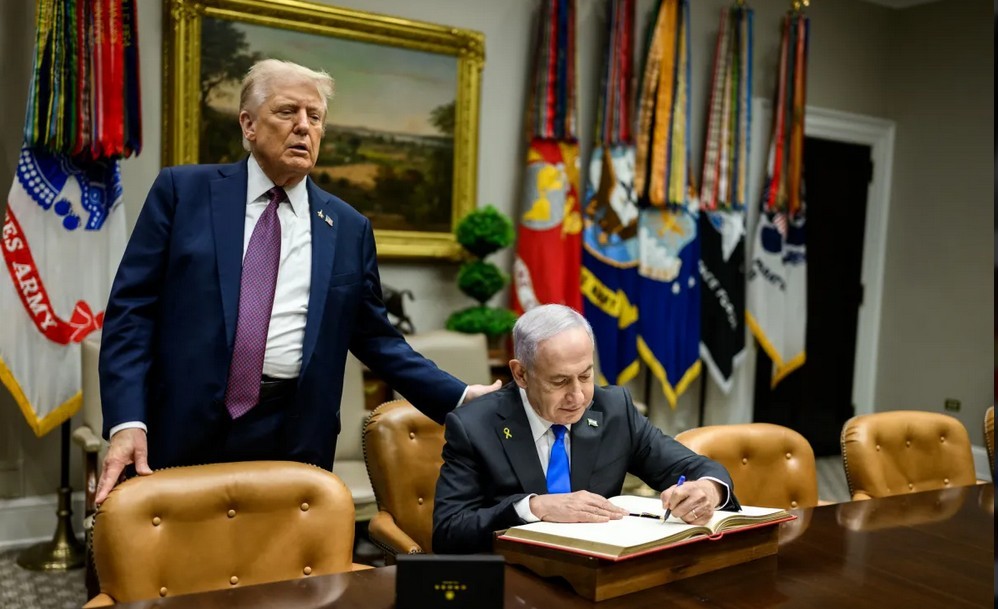
Both Trump and Netanyahu called on the Iranian people to seize the attack as an opportunity to overthrow the mullahs’ regime; the nuclear weapons issue appears to be a pretext. (Photo: White House)
When the attack began, Oman’s foreign minister — the mediator — was in Washington. Israel struck Iran while U.S. negotiations were still ongoing.
The attacker appeared to be Israel rather than the United States. It was known Iran would retaliate against Israel. Thus, ostensibly, the U.S. entered the conflict to defend Israel, its primary foreign policy priority.
The attack initiated by Israel will most likely once again be completed by the United States.
Nuclear Pretext, Regime Target
Both U.S. President Donald Trump and Israeli Prime Minister Benjamin Netanyahu state that their goal is to prevent Iran from acquiring a nuclear bomb.
However:
The attack was launched despite the announcement just one day earlier that U.S.–Iran talks would continue in Vienna at the beginning of the week.
Both Trump and Netanyahu called on the Iranian people to seize the attack as an opportunity to overthrow the Islamic Republic regime.
From the first wave of strikes, Israeli aircraft targeted regime centers in major cities such as Tehran and Tabriz. Prime Minister Masoud Pezeshkian’s son announced that his father survived an assassination attempt.
Developments indicate that beyond Israeli and U.S. airstrikes, special operations units infiltrating Iran — or armed groups inside Iran appearing to coordinate with U.S. and Israeli operations — are carrying out assassination attempts against key figures.
Previously, it was reported in the media that Hamas leader Ismail Haniyeh was killed by Israel in Tehran in 2024 following Pezeshkian’s inauguration ceremony.
The Misery of Arab Administrations
Just a week ago, out of fear of Iran, the Arab autocracies of the Persian Gulf had announced they would not allow U.S. aircraft to use their airspace — while simultaneously opening their territories to U.S. military deployments. When the first Iranian bombs began falling on them, they declared — without regard for Ramadan — that they stood alongside the United States against Muslim Iran. Saudi Arabia led the way in this regard.
But this was not surprising. Arab governments once considered the strongest supporters of the Palestinian people against Israel now seem convinced that avoiding angering the United States requires avoiding angering Israel.
The European Union appears to inhabit a different reality altogether: European Commission President Ursula von der Leyen condemned Iran for attacking U.S. bases in Arab countries, focusing solely on that aspect of the broader picture.
The Regime in Iran Is No Longer Sustainable
Iran is currently under attack through an overt U.S.–Israel conspiracy that hardly even attempts concealment.
Yet aside from limited support from Russia and China, there are few willing to be seen standing by the Iranian regime. Türkiye’s position is different — we will come to that shortly.
Following the regime change in Syria, there is no remaining capital openly supporting the mullahs’ regime in Tehran.
There are many costs to this. After the 1979 Islamic Revolution, the Revolutionary Guards effectively created a state within a state and pursued a policy of “exporting the revolution” through organizations such as Hezbollah, Hamas, and Hashd al-Shaabi, alongside propaganda aimed at eliminating Israel. Iran thus became a significant source of instability.
As the Islamic governance system in Iran weakened economically, lost external influence, and descended into internal power struggles, protests gained strength — from women’s freedom to economic hardship.
No matter how powerful it may be, there is no political force in the world that can indefinitely dictate to women how they should dress.
Strategic Risk: The Partition of Iran
The overthrow of the Iranian regime through U.S. and Israeli military action would only be possible either by eliminating the governing elite or, as in Venezuela, by sidelining the top leader and securing cooperation from others with the hegemonic power.
The U.S. and Israel are pressing with military, political, and financial instruments. But the Iranian people may say, “If we overthrow it, we will do it ourselves,” and reject cooperation with an external aggressor. If that threshold has already been crossed and cooperation has begun, then even if the Islamist regime survives this ordeal, it would no longer be viable; it would not be sustainable.
A regime change would radically alter political balances in the region but would not constitute a strategic risk for neighboring states. The strategic risk is the partition of Iran.
A fragmentation wave affecting provinces such as Azerbaijan, Kurdistan, and Baluchistan — each with significant population and dynamics — could not only alter borders but turn the region into a black hole. Neither Israel nor the United States, nor the Arab autocracies led by Saudi Arabia, could manage the consequences of dismantling a civilization-state thousands of years old.
Türkiye’s Position
Historically, Türkiye — which has shared the world’s oldest land border with Iran since the 1639 Treaty of Qasr-e Shirin — neither wants war with Iran nor conflict within Iran. Beyond oil and gas trade, there are strategic interests at stake, including trade routes to Central Asia.
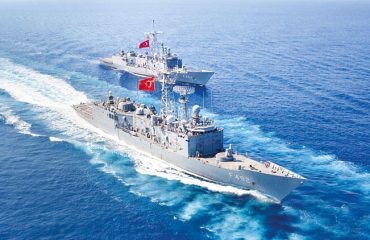
From the outset, Türkiye opposed a U.S. attack on Iran — notably as a NATO member. It limited its steps to NATO precautionary measures, from the AWACS base in Konya to Incirlik, without going further. The Presidency’s Center for Combating Disinformation stated that Türkiye was not involved in operations against Iran in any capacity and did not allow its airspace, maritime space, or territory to be used “in favor of or against any party.” For example, the air bridge established along the U.S.–Europe route reached the Middle East via Bulgaria and Greece.
Ankara worked to prevent the conflict from escalating into full-scale war — rightly so. Even after the Israeli and U.S. attacks on Iran, Foreign Minister Hakan Fidan has been in contact with Iran, Gulf Arab countries, and certain EU members in efforts to extinguish the fire.
Trump has called Erdoğan and the leaders of the UK and Kuwait on the hot issue in the late hours of February 28, but no details about the conversation were revealed on the evening of February 28.
Already under pressure from the Russia-Ukraine war to its north for four years, Türkiye has also recently been engaged in efforts to halt the Pakistan-Afghanistan conflict that erupted last week.
But the most pressing crisis now — one with the weight to affect global balances — is unfolding in another of our neighboring countries. The stakes are extremely high.