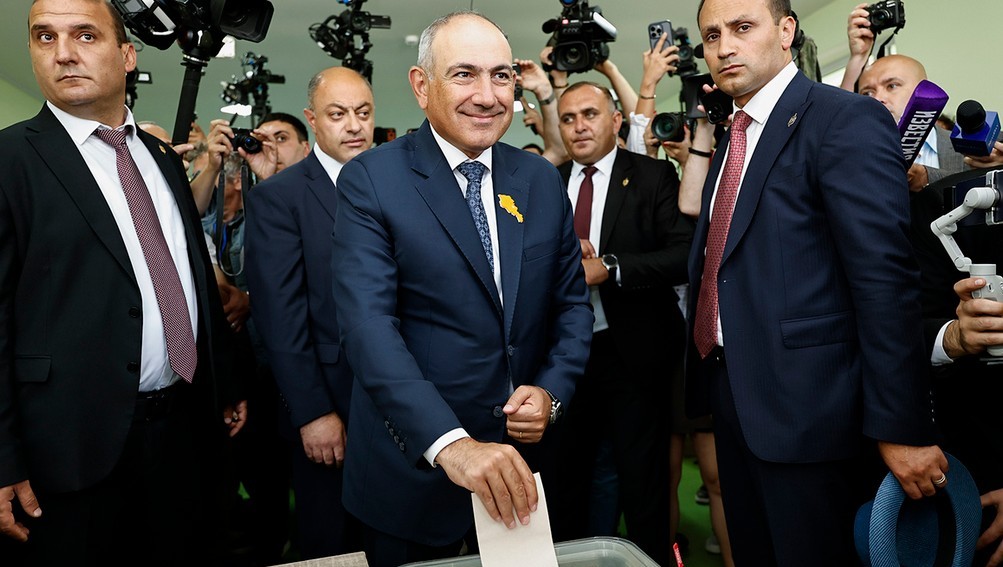
Armenian voters chose peace and prosperity with Türkiye and Azerbaijan, and Pashinyan won. The next step is the opening of the border. The badge on Pashinyan’s lapel as he casts his vote is the “Real Armenia” emblem, signaling his commitment to abandoning territorial claims as a matter of state policy. (Photo: Prime Minister’s Office of Armenia)
Armenian Prime Minister Nikol Pashinyan declared victory in the June 7 elections. Pashinyan’s Civil Contract Party, which advocates peace with Türkiye and Azerbaijan (and, it should be added, Georgia as well), won by a clear margin over its closest rival, Samvel Karapetyan’s Russian-backed, anti-compromise Strong Armenia Party. The Armenia Alliance, led by former Prime Minister Robert Kocharyan and supported by the Dashnaks, which could be described as a coalition favoring the continuation of conflict, trailed behind.
In his victory speech, Pashinyan said, “The people of Armenia voted for peace, regional prosperity, and regional cooperation,” adding, “I hope this choice will be welcomed positively in Türkiye and Azerbaijan.”
The fact that this message appears to have received a swift response is also significant. Perhaps for this reason, the foreign ministers of Türkiye, Azerbaijan, and Georgia scheduled the 10th meeting of their regular trilateral format in Istanbul for June 8, the day when Armenia’s election results were expected to become clear.
If Pashinyan can translate this electoral victory into reality through his “Real Armenia” doctrine—meaning that Armenia recognizes the borders of Türkiye, Azerbaijan, and Georgia and removes territorial claims embedded in its legislation—the political climate in the region could rapidly improve.
Pashinyan Took a Risk
Azerbaijan’s President Ilham Aliyev ended the occupation in Karabakh at the end of 2020 with the support of Türkiye and subsequently dissolved the de facto Karabakh Republic in 2023, leaving Armenia facing a difficult dilemma.
Pashinyan chose the more difficult path and began presenting his people with alternative options:
• “Real Armenia” was defined as the 26,743 square kilometers recognized by the United Nations today. Despite opposition accusations of “treason,” he handed over four border villages to Azerbaijan in accordance with the ceasefire agreement. He declared that Armenia was abandoning the “Greater Armenia” ambitions that involved territorial claims against three neighboring countries.
• Through the agreement he signed in 2025 with Aliyev and U.S. President Donald Trump, he approved the Zangezur transportation corridor (TRIPP, named after Trump), which would connect Central Asia by land to the Middle East and Europe. The agreement also aimed to reduce Russian and Iranian influence in the region.
• Shortly before the elections, Pashinyan removed the silhouette of Mount Ararat from official documents. A joint decision was also taken to restore the historic Ani Bridge over the Aras River, which forms part of the Armenia–Türkiye border.
Rather than adhering to a culture of historical revenge, Pashinyan listened to his people’s aspirations for peace and prosperity. He took a risk—and he won.
Opening the Border with Armenia
There are two border crossings between Türkiye and Armenia that have remained closed since Armenia’s 1993 attack on and occupation of Karabakh with Russian support: the Akyaka/Akhurik crossing in Kars and the Alican/Margara crossing in Iğdır.
The opening of the Türkiye–Armenia border crossings and Armenia’s genuine integration with the outside world would contribute not only to the normalization of the Caucasus but also to the rapid improvement of the political and economic climate across a vast region stretching from Central Asia to the Black Sea Basin and from the Middle East to the Eastern Mediterranean.
Amid reports that the border could be opened immediately before or after the June 7 elections, the Ministry of Foreign Affairs stated that no formal timetable had yet been established. Serdar Kılıç, Türkiye’s Special Representative for the Türkiye–Armenia Normalization Process, indicated that certain “bureaucratic and technical procedures” were still ongoing.
However, an important political condition remains for the opening of the border and the establishment of reciprocal embassies between Türkiye and Armenia. Armenia must remove from the preamble of its Constitution the language that implies territorial claims against its neighbors—a demand shared by Azerbaijan and Georgia. A swift move in this direction would likely accelerate progress on other fronts as well.