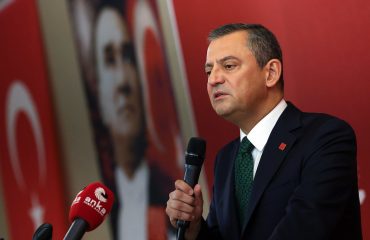
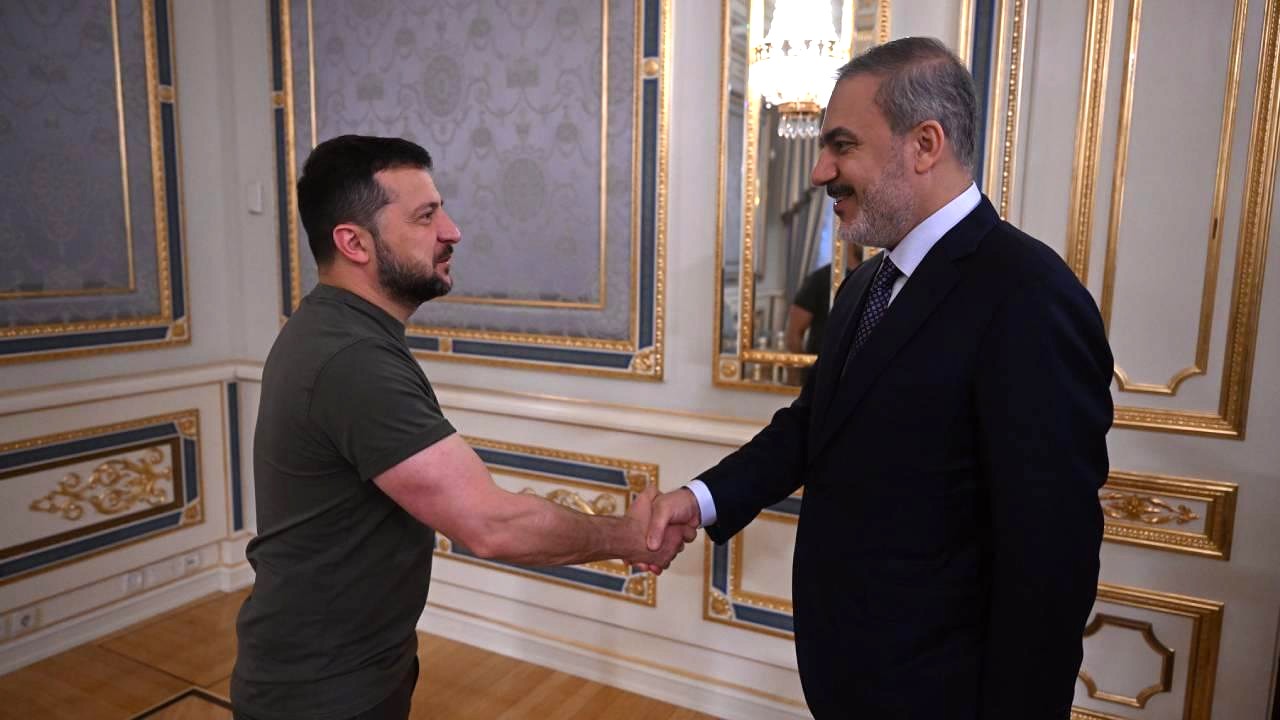
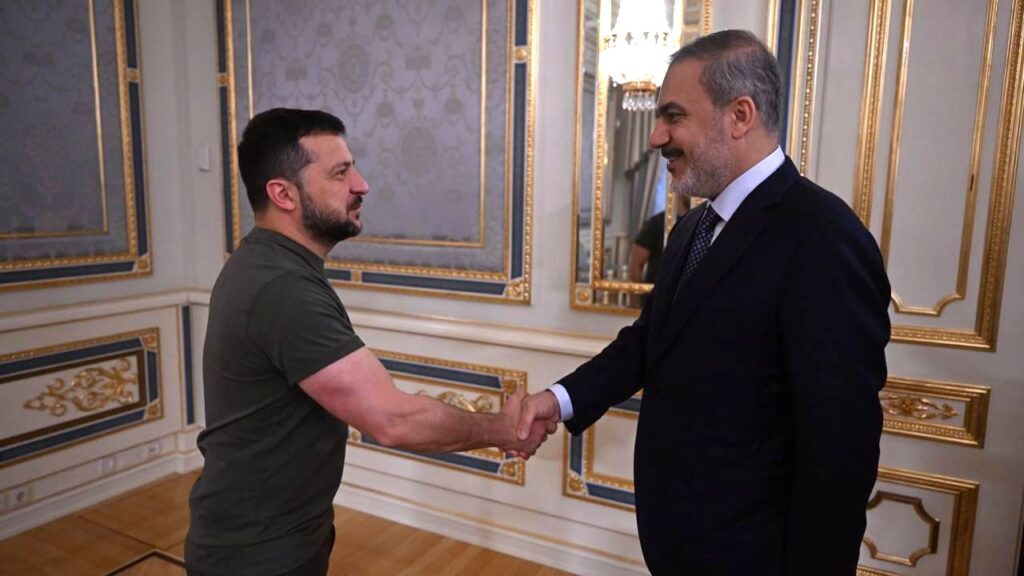
Following the NATO Ankara Summit, Foreign Minister Hakan Fidan visits Ukraine after Russia urged Türkiye to respond over Black Sea security. The archive photo is from one of Fidan’s previous meetings with Ukrainian President Volodymyr Zelensky
Russian Ambassador to Ankara Sergey Vershinin, will host an intriguing event on 16 July. In fact, it is a joint initiative with China’s Ambassador to Ankara Jiang Xuebin , though the venue has been set as the Russian Embassy. A conference will mark the 25th anniversary of the Treaty of Good-Neighborliness, Friendship and Cooperation between Russia and China.
The same program is being held in capitals around the world. In Australia, for example, the venue is the Chinese Embassy in Canberra. In some countries the conferences are hosted by Russian embassies, in others by Chinese missions.
Speaking at the conference held at the Russian Embassy in Beijing, Chinese Vice Foreign Minister Liu Bin said that Russia and China regard each other as “foreign policy priorities” and “support one another on core interests.”
As NATO was gathering in Ankara on 7–8 July, calling for greater unity against Russia’s war in Ukraine, China was simultaneously delivering a message from capitals across the globe: “We stand with Russia.”
Russia’s Expectations and Lavrov’s Warning
At the NATO Ankara Summit, allies agreed to provide additional military assistance to Ukraine and strengthen freedom of navigation in the Black Sea—which, in practice, also means securing commercial shipping.
Both decisions:
- serve Türkiye’s interests by helping prevent attacks on cargo vessels, including in areas partly within Türkiye’s Exclusive Economic Zone;
- enhance Türkiye’s role within NATO by making the Alliance a stakeholder in Black Sea security, while inevitably increasing Russia’s unease.
On 7 July, the day NATO convened in Ankara, Russia accused Ukraine of carrying out a drone attack on a pumping station of the Blue Stream natural gas pipeline linking Russia and Türkiye.
A week later, on 14 July, the same day Ukraine announced it had struck nearly 100 vessels in the Sea of Azov off the Russian-annexed Crimean Peninsula, Russian Foreign Minister Sergey Lavrov issued what amounted to a warning directed at Türkiye.
“We hope our Turkish colleagues will publicly assess these incidents and deliver a firm and unequivocal message of dissatisfaction to the Kyiv authorities.”
It was evident that diplomatic notes had already been exchanged between the two foreign ministries.
Fidan’s Visit to Kyiv
Following Lavrov’s remarks, Ankara’s internal assessment led to the decision for Foreign Minister Hakan Fidan to travel to Kyiv carrying a message from President Recep Tayyip Erdoğan to President Volodymyr Zelensky.
Fidan’s 15–16 July program includes meetings not only with Zelensky but also with senior Ukrainian officials and representatives of the Crimean Tatar community.
His agenda includes Türkiye’s proposal to resume the Russia-Ukraine negotiations that previously began in Istanbul but later stalled. It also carries the message that if Ukraine genuinely supports Black Sea security, it should halt attacks on civilian ships and port infrastructure.
This position illustrates Türkiye’s unique standing within NATO.
For example, U.S. Senator Lindsey Graham, who attended the Ankara Summit on Ukraine before returning to Kyiv—where he reportedly died after suffering cardiac arrest—had advocated much tougher military and economic measures against Russia. He said he and U.S. President Donald Trump were aligned on that approach.
Türkiye, by contrast, continues to stand with Kyiv against the occupation of Ukraine while preserving its political and economic ties with Russia and insisting that peace negotiations remain alive.
Looking at Washington, the expectation appears to be that Moscow is on the verge of strategic decline.
Beijing, however, is sending a different message: “We stand with you.”
That makes the renewed emphasis on the Russia-China treaty particularly noteworthy.
Ukraine’s Strategic Mistake and Russia
The Russia-China treaty is not merely an intergovernmental agreement but a treaty between two states. It was signed in 2001 by Vladimir Putin, who remains in office today, and the then Chinese leader Jiang Zemin, predecessor to Xi Jinping.
That same year, Ukraine relinquished the nuclear weapons it had inherited from the Soviet Union, transferring them to Russia under United Nations supervision, largely under the influence of the United States and the United Kingdom.
It is possible to regard that decision as Ukraine’s greatest strategic mistake.
Many international affairs commentators, with the benefit of hindsight, argue that had Ukraine become a NATO member, Russia might never have annexed Crimea in 2014 or launched its full-scale invasion in 2022.
Far fewer ask the preceding question: had Ukraine retained its nuclear arsenal, might Russia have been deterred from military aggression in the first place?
It is also worth recalling that, in his interview with YetkinReport before the NATO Ankara Summit, Ambassador Sergey Vershinin warned that NATO should adapt to the realities of a changing world.
If one of those realities is the balance of nuclear deterrence, another is undoubtedly the Russia-China cooperation treaty—which also carries implications for U.S.-China strategic competition in the Pacific.
It is a development that deserves close attention.