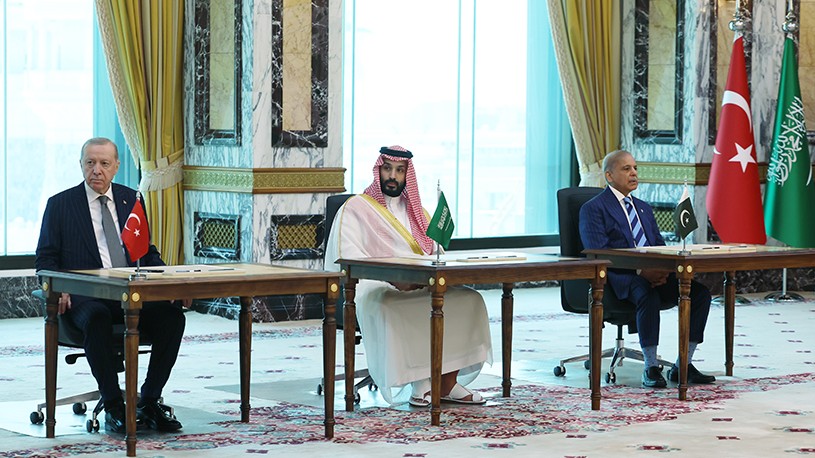
The government should provide clear and satisfactory answers to the public’s legitimate questions about the Mecca Agreement with Saudi Arabia and Pakistan. From left to right, President Erdoğan, Saudi Crown Prince Mohammed bin Salman, and Pakistani Prime Minister Shehbaz Sharif. (Photo: Turkish Presidency)
The full text of the Defense Agreement signed between Türkiye, Saudi Arabia and Pakistan in Mecca on August 7 has not yet been made public. To see the full text, we will have to wait for the agreement to come before the Foreign Affairs Committee of the Grand National Assembly of Türkiye (TBMM) for approval by the General Assembly, unless it is announced earlier. However, there are questions in the public mind about the Mecca Agreement, and these questions have not been fully dispelled by the statements made by Foreign Minister Hakan Fidan to Anadolu Agency on August 8.
Before getting into that, it appears that the development that triggered this agreement was Israel’s policies of annihilating the Palestinians in Gaza, launched following Hamas’s October 7, 2023 attack on Israel and still continuing, as well as the overt support given to Israel by the United States and Western Europe. In those days, Türkiye was busy making Sweden accept the PKK condition in exchange for its desire to join NATO out of fear of the Russia-Ukraine war, and repairing its relations with Egypt through Qatar. Both Türkiye and Pakistan were uncomfortable with the India-Saudi Arabia-Israel-Greece transportation corridor. The Saudi leadership’s unease, meanwhile, was exposed by the Israeli and U.S. attack on Iran, and before the trilateral agreement, it signed a defense agreement with nuclear-armed Pakistan.
“The same” as the NATO Treaty
Questions remain because the agreement stipulates that an attack on one of the countries will be considered an attack on the others as well, and because Fidan said this was “technically the same” as Article 5 of the NATO Treaty concerning collective defense. For example:
- Iran is carrying out armed attacks against Saudi Arabia, particularly against U.S. bases and facilities there. Will Türkiye therefore go to war with Iran?
- India and Pakistan frequently clash. Will Türkiye therefore declare war on India?
- Iran-backed Houthis in Yemen are at war with Saudi Arabia. Will Türkiye become involved in this war?
- Will NATO take sides in these wars through Türkiye? Does this agreement not contradict the additional responsibilities undertaken in the Black Sea, Mediterranean and Middle East just one month ago at the NATO Ankara Summit?
It can already be seen that these and similar questions, including much more agitated ones, will come up during the parliamentary debates on the Mecca Agreement, against a background of the deep scars left in Türkiye’s collective memory by the First World War, into which Türkiye was dragged roughly a century ago by the Committee of Union and Progress government on Germany’s side.
Concern about entering someone else’s war
The objection that the Mecca Agreement contradicts NATO is not particularly strong. More recently, NATO member Greece signed a mutual defense agreement with Southern Cyprus, which seeks to block Türkiye in the Eastern Mediterranean and which, together with Israel, has openly stated that “Türkiye is their next target,” while blocking Türkiye at every platform within the EU.
But the perception that NATO’s Article 5, which says “all for one,” would automatically come into force raises the question of whether we will enter “someone else’s war.”
Fidan said there was no question of automatically going to war, that NATO’s Article 5 is put to a vote only upon the request of the member country, and that it has been used only in the cases of Afghanistan and Kosovo since the alliance was founded. Admittedly, in the 1999 Kosovo case, it was not the “collective defense” article that was invoked, but the “humanitarian intervention” principle, just as the implementation of the Dayton Agreement in the Bosnian War in 1995 and the justification of “protecting civilians” in Libya in 2011 were invoked. In other words, the only actual example is NATO’s decision to intervene in Afghanistan following the September 11, 2001 attacks by al-Qaeda.
The Foreign Minister is trying to ease concerns by saying, “No country that does not attack us is our target,” but more is needed.
The NATO model for the Mecca Agreement
Fidan explains the three main objectives of the Mecca Agreement as:
- Deterrence,
- Non-aggression, and
- Cooperation.
In other words, if anyone now wants to attack one of these three countries, they are expected to think twice, just as in NATO. Meanwhile, cooperation is envisaged in which the geographical positions and different means and capabilities of all three countries will make 1+1+1 worth more than 3. Particular importance appears to be attached to the defense industry here.
It appears that, drawing on Türkiye’s NATO experience, Türkiye ensured that the NATO model was taken as the basis for the Mecca Agreement:
- There will be a General Secretariat,
- As in NATO, a “political and military committee” consisting of the foreign and defense ministries and the chiefs of general staff will be established,
- Just as in NATO, the harmonization of working methods, particularly in military matters, namely interoperability, will be targeted.
This means that the Saudi and Pakistani armies will also become NATO-compatible through the Turkish Armed Forces, which are already “interoperable,” or capable of working together, with NATO. Let us recall that a similar process between Türkiye and Azerbaijan is nearing completion.
From one perspective, Türkiye is extending NATO’s accessibility capabilities to the Caucasus and the Middle East.
The U.S., Israel, Iran
It is possible to say that the Mecca Agreement is a product of the U.S. Middle East policy coming almost entirely under Israeli influence. Arms purchases from the United States, which was expected to provide the guarantee against the fears of Iran whipped up among the Arab monarchies—whether you call it “protection money” in mafia language or, more politely, an “insurance premium”—failed to provide the expected guarantee. This is of course not the only reason, but Fidan also speaks of the tendency of regional countries to secure their own security and protect their economic stability and prosperity.
Within this framework, the “Terror-Free Türkiye” process, which also means removing the PKK as an armed threat and gradually incorporating it into democratic politics, has a place in the Mecca Agreement.
The joint text of the agreement said, “It is not against anyone,” but it can be said that this agreement will have a restraining effect on both Iran and Israel; the strongest reactions came from these two countries.
It would be naïve to say that this agreement was made against the United States, but it would also be naïve to say that the United States ordered it and Türkiye carried it out: it would be more accurate to say that it was approved by the United States and influential NATO countries.
The questions in the public mind about the Mecca Agreement are not empty questions. What the government needs to do is to persuade the public, beyond simply saying “Trust us,” why the agreement was needed and that Türkiye’s interests will not be harmed.