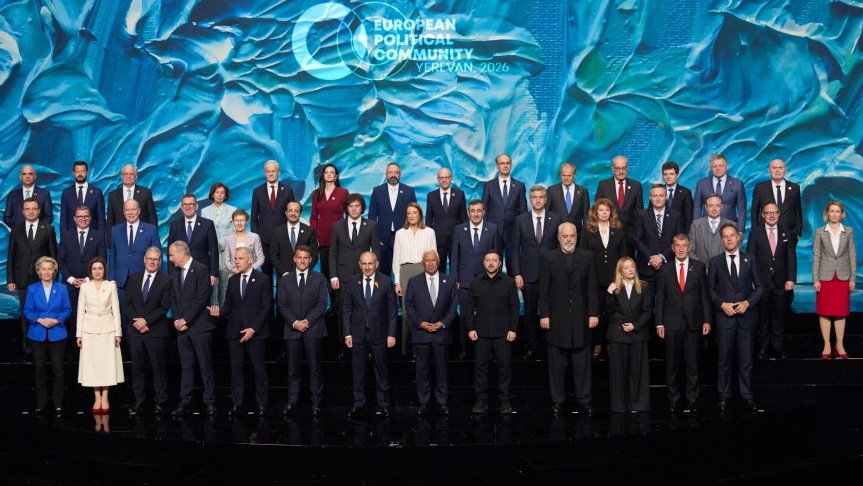
Ankara says “we can win together” to those delivering preemptive blows to Türkiye–EU relations, seeing that Türkiye will emerge stronger in the post-war period. The photo is from the May 4 European Political Community Summit, where Türkiye was represented by Vice President Cevdet Yılmaz. (Photo: AA)
The fact that Vice President Cevdet Yılmaz signed the agreement in Yerevan on May 4 with Armenian Prime Minister Nikol Pashinyan for the restoration of the historic Ani Bridge coinciding with President Tayyip Erdoğan’s renewed remarks on Türkiye–European Union relations was no coincidence. Ankara assesses that the tension in Türkiye–EU relations—no longer possible to conceal—has entered a new phase and is signaling its desire to overcome it with a concrete step.
The following were the key points from Erdoğan’s remarks on Türkiye–EU relations after the Cabinet meeting:
- “Today, Europe’s need for Türkiye is greater than Türkiye’s need for Europe. Tomorrow, this need will increase even further.”
- “Europe is at a crossroads. Either it will see Türkiye’s growing power and global weight as an opportunity to overcome its bottleneck, or it will allow exclusionary rhetoric to darken Europe’s future.”
- “Our hope is that decision-makers in Europe will abandon their political and historical prejudices and focus on developing sincere, genuine, and equal-level relations with Türkiye. Such a relationship will benefit the European continent, of which Türkiye is an inseparable part.”
Questions on Tense Türkiye–EU Relations
The media highlighted Erdoğan’s “greater need” statement, which he has voiced before and which is also used by the Turkish business community.
However, Erdoğan’s remarks should be read together with the message delivered by European Commission President Ursula von der Leyen—who spoke at the opening of the European Political Community summit in Yerevan (and who no longer feels the need to conceal her aversion to Türkiye)—and which she also shared on her X account on the morning of May 4. She said:
- “We are here in Armenia to show that Europe is one large and united family. Bound by the same interests and facing the same challenges. Today, we will work on the pillars of Europe’s independence:
- Energy
- Defense
- And Connectivity.”
Ankara naturally asks the following question: Does the President of the European Commission consider Armenia or Ukraine part of this “united family” because they are Christian? And does she regard Türkiye—despite being a candidate country—as an unwanted neighbor, whose door is only knocked on when its military power is needed, because it is Muslim?
Expressions in Erdoğan’s speech such as “political and historical prejudices” and “genuine and equal-level relations” point to this concern.
What Was Actually Meant?
Given Türkiye’s geography and geopolitical potential, the EU’s ambition to strengthen itself in “energy and connectivity” by viewing Türkiye merely as a military power in the Eastern Mediterranean, the Middle East, the Black Sea, the Caucasus, and beyond appears somewhat unrealistic.
Between the lines of Erdoğan’s remarks, the following assessments emerge:
- Israel and Greece share concerns that Türkiye, by staying out of both the Ukraine war and a potential Iran conflict, will strengthen its position in the post-war period. The trilateral alignment in Jerusalem in December 2025, ahead of Southern Cyprus assuming the EU presidency in January 2026, was seen as a preemptive move against Türkiye.
- France, already uneasy about Türkiye’s rapprochement with Spain and Italy, has become the patron of this alignment and has taken on the role of supporting the militarization of Cyprus and the Aegean islands in violation of the Lausanne Treaty. Ankara also links French President Emmanuel Macron’s show in Armenia to this context. (Recall the Ani Bridge.)
- Ankara argues that by reducing Türkiye–EU relations to a military dimension, the EU cannot strengthen itself in political influence or in trade routes, including energy. In effect, it is saying: “You may try to undermine me, but you won’t achieve your goals either.”
NATO, the EU, and Türkiye
The consequences of the Israel–Greece alliance, supported by Greek Cypriots, were most recently seen when the SUMUD flotilla carrying humanitarian aid to Gaza was intercepted by Israeli commandos off the coast of Crete. The UN Special Rapporteur on Palestine, Italian jurist Francesca Albanese, described Greece allowing Israel to exploit its fear of Türkiye as a “strategic mistake,” calling it part of an effort to “Israelize” Europe.
Meanwhile, a striking contradiction among Israel, Greece, and France was exposed when missiles launched from Iran toward Türkiye were intercepted through NATO’s collective defense. Israeli Prime Minister Benjamin Netanyahu, noting that Türkiye did not retaliate, went as far as calling on the Turkish public to rise up against Erdoğan—only to receive a “take it elsewhere” response from the opposition.
July Will Be a Critical Threshold
After July, it will become more difficult for those seeking to deliver preemptive blows in Türkiye–EU relations. Southern Cyprus’s EU presidency ends on June 30. From July 1, Ireland—an EU member that has taken a more principled stance on Gaza and Iran, like Spain and Sweden—will assume the presidency.
On July 2, Treasury and Finance Minister Mehmet Şimşek will meet with EU Enlargement Commissioner Marta Kos in Istanbul as part of the High-Level Economic Dialogue.
From July 5–7, a NATO summit will be held in Ankara.
It is not yet clear whether Trump will attend, but the countdown toward the November 2026 U.S. midterm elections will have begun.
By keeping the possibility of closer cooperation with the United States and the United Kingdom open, Ankara is telling the “let’s do it without Türkiye” lobby in Brussels: “We can do it together.”
What Türkiye Needs to Do
On the other hand, there has been virtually no progress by the Erdoğan administration on reforms necessary not only to improve Türkiye–EU relations but also to raise its own economic and democratic standards.
Foreign Minister Hakan Fidan recently implied that Türkiye would implement such reforms if there were a clear signal from the EU that membership would follow.
However, compliance with Constitutional Court rulings, implementation of European Court of Human Rights decisions under Article 90 of the Constitution, and refraining from replacing elected mayors with state-appointed officials should not be made conditional on EU requirements.
Even Justice Minister Akın Gürlek—who has been at the center of political-judicial debates due to the İmamoğlu case—recently stated at a MÜSİAD meeting that the economic package announced by Erdoğan to attract foreign investment would not be sufficient, and that the guarantee of an independent judiciary is necessary.
Ultimately, both improving Türkiye–EU relations and raising Türkiye’s economic and democratic standards depend on establishing a judiciary capable of delivering justice. If President Erdoğan recognizes this and decides to act accordingly, there is no problem. Otherwise, both Türkiye and the EU will lose—who loses more will be a matter of detail.