Photo: TUR Presidency
For Turkey, there are effectively two summits taking place in Ankara. One is the NATO summit, where the Alliance is expected to enter what many describe as its new “3.0 era.” The other is the bilateral meeting between President Recep Tayyip Erdoğan and U.S. President Donald Trump.
Only about ten days ago, Trump told NATO Secretary General Mark Rutte to his face at the White House that he might not even have attended the summit had Erdoğan not invited him.
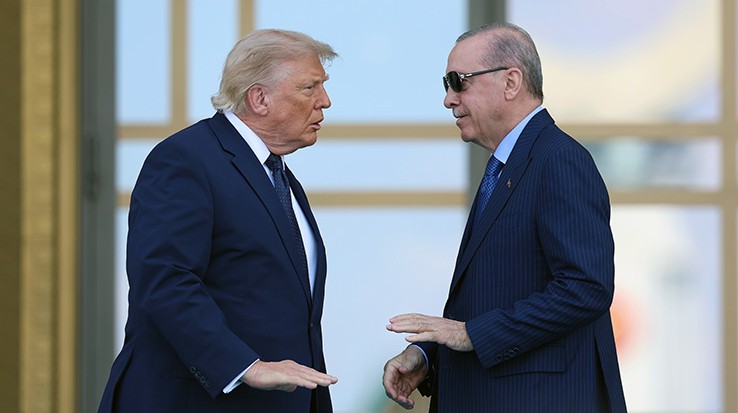
Erdoğan did not leave the gesture unanswered. On the afternoon of July 7, he personally went to welcome Trump at the airport in Etimesgut, recently renamed Ankara Airport following its expansion. Before their bilateral meeting, Trump repeated his compliment at the joint press appearance: had the summit not been held in Turkey, he might not have come. Erdoğan, for his part, made sure not to be outdone; standing alongside Trump projected strength.
Whenever one leader showers another with such praise—particularly when one head of state does so toward another—it usually reflects high expectations.
Expectations, Promises and Reality
Erdoğan has made no effort to hide his expectations. He says his main expectation from the NATO summit is that, if Europe expects greater contributions from Turkey to its defense, then the European Union should stop excluding Turkey—and the Turkish defense industry—and instead accelerate economic integration. He underlined this point by addressing the EU directly in his opening speech at the summit.
Yesterday, amid the exchange of compliments, Erdoğan also stated another expectation openly. He reminded Trump that the U.S. president had previously promised to deliver the five F-35 fighter jets that Turkey had already paid for. Erdoğan said he was “confident” Trump would keep his word. Trump replied with a characteristically open-ended answer: “Why not?”
It is worth recalling that Turkey was expelled from the F-35 program—despite being one of its manufacturing partners—during Trump’s first term after purchasing Russian S-400 missile systems. Ankara had turned to Moscow after Washington attached conditions to the sale of Patriot missile systems. The aircraft that Turkey had already paid for were withheld, and Congress imposed CAATSA sanctions on Turkey.
When asked about the F110 jet engines needed for Turkey’s indigenous KAAN fighter aircraft, Trump interrupted, saying he did not want to “tire Erdoğan,” before declaring that he intended to lift all sanctions on Turkey.
It was an attractive promise. The question was how he intended to overcome congressional opposition.
Trump: Meetings with Fidan and Kalın
One important detail largely escaped attention.
Even before Trump landed in Ankara, a delegation of senior members of the U.S. Senate Foreign Relations Committee was meeting Foreign Minister Hakan Fidan. U.S. Ambassador to Turkey Tom Barrack also attended. Besides what Trump later described as the “big gift” he intended to offer Erdoğan during the summit—lifting or easing the CAATSA sanctions—the agenda included Ukraine and Syria. In other words, diplomacy was proceeding through two channels—or three, if Defense Minister Yaşar Güler is also counted.
Another noteworthy detail came just before the summit officially began. Before everyone had taken their seats, Erdoğan and Trump held a brief standing discussion with Foreign Minister Fidan and National Intelligence Organization (MIT) Director İbrahim Kalın. After receiving a briefing, Trump was seen nodding in approval before taking his seat.
So the question arises once again: how could Trump overcome Congress in order to deliver at least five F-35s to Turkey—or approve the sale of 80 F110 engines worth $700 million?
One possible avenue would be for Trump to issue an executive order that would take effect unless Congress objected within a specified period.
Why not?
Could the Senate delegation, despite strong objections from Israeli Prime Minister Benjamin Netanyahu, remind Washington’s pro-Israel lobby that its influence also has limits?
S-400s and F-35s
The S-400 missile systems also offer a possible path toward lifting—or at least easing—the CAATSA sanctions. Around the NATO summit, numerous speculations have circulated, none of which can yet be verified.
Turkey’s agreement with Russia prevents the S-400 systems from being sold to another country.
But could they be transferred to a third country—perhaps a Gulf state—with Moscow’s approval?
That would depend on what Russia received in return.
Or could the S-400 batteries simply be kept—perhaps without ever being unpacked—at Incirlik Air Base, which serves both the Turkish Armed Forces and as a NATO facility? Would such an arrangement enable Trump to fulfill his promise?
Could all this allow Turkey to move closer to the United States without damaging its relationship with Russia?
What we are witnessing is diplomacy of an exceptionally high and complex order.
And another question naturally follows: why is Trump doing all this? Because he likes Erdoğan personally? Because he has a special affection for Turkey?
The Iran-Israel Factor
Yesterday, Trump added another compliment, saying that under Erdoğan’s leadership Turkey had become a reliable ally.
His explanation was more explicit than it had been ten days earlier.
According to Trump, he had asked Erdoğan to keep Turkey out of the war that the United States and Israel launched against Iran. Despite its longstanding disputes with Israel, Turkey had refrained from siding with Tehran and had stayed out of the conflict.
There was never much public perception of such a possibility inside Turkey, but apparently the U.S. administration had genuine concerns.
For example, were American officials worried that Turkey might halt the flow of Azerbaijani oil delivered to Israel through the Baku-Tbilisi-Ceyhan pipeline, which reportedly supplies nearly half of Israel’s oil needs?
When I asked a senior Turkish official about this yesterday, the answer was: “Much more than that.” Trump, the official implied, understood the broader picture.
Trump’s expectations from NATO 3.0 are different. He wants European allies to shoulder greater responsibility for Russia and the Middle East so Washington can concentrate more effectively on its strategic competition with China in the Pacific. He also hopes to reduce the U.S. military footprint in the Middle East, despite Israel’s tendency to generate recurring crises that complicate such plans.
Trump Is in a “Let’s Wait and See” Mood
Trump’s remark that he might not have attended the NATO summit had it not been for Erdoğan—or for Turkey—should be taken seriously.
Despite Rutte’s assurance that this would be a “summit where promises are kept,” Trump is far from convinced that NATO’s European members will actually follow through. He has reason for skepticism. Many EU governments still appear to hope Trump will leave office after the next election and that relations will return to the familiar patterns of Democratic administrations, even though they increasingly recognize that the United States has entered a new Cold War mindset.
In many ways, Trump came to the Ankara summit to give NATO’s European members—and the European Union, with which he has had a difficult relationship—one more opportunity.
Trump expects the Europeans to keep their promises.
Erdoğan expects Trump to keep his.
And he also expects EU countries to set aside, at least in economic terms, what he sees as their persistent reluctance toward Turkey.
The summit may yet produce unexpected side effects.