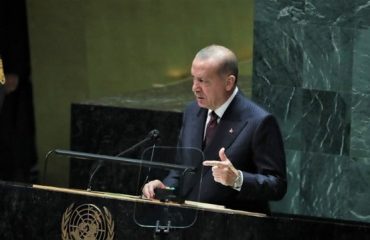
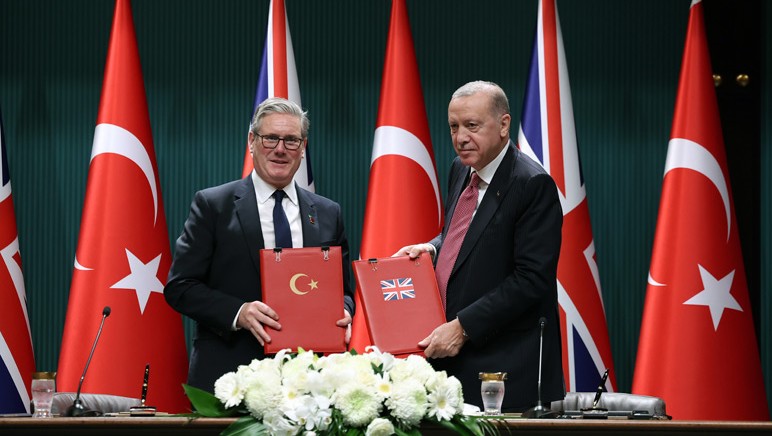
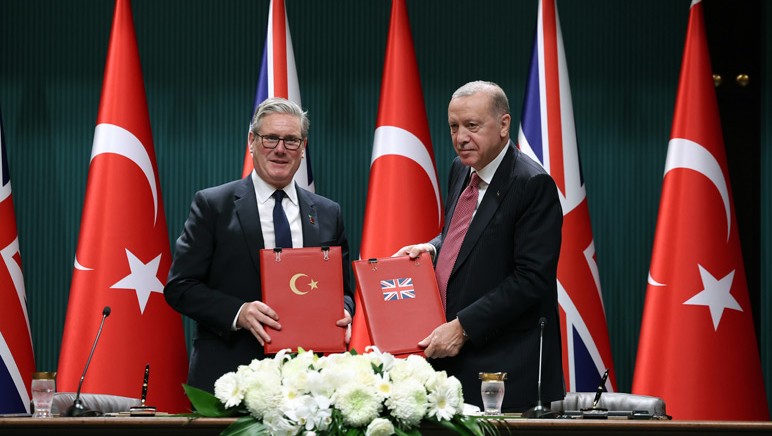
Turkish President Erdoğan, who hosted British Prime Minister Starmer at the beginning of the week, is set to receive German Chancellor Merz midweek. (Photo: Turkish Presidency)
About ten years ago, caricatures of “Sultan Erdoğan” were popular in the Western European press. President Tayyip Erdoğan, who was trying to pull the Turkish Republic into the orbit of Russia and Iran with a neo-Ottoman and political Islamist policy, was seen as the antithesis of the West. The antipathy was so strong that, during the failed coup attempt of July 15, 2016, Türkiye received virtually no genuine support from the West. Whenever Erdoğan tried to emphasize Türkiye’s importance for European security, Western leaders would steer the conversation toward democracy and human rights.
At that time, Erdoğan was not being invited to European capitals, and Western leaders were not eager to visit Türkiye either.
From Turkish Democracy to Security
On October 27, UK Prime Minister Keir Starmer was in Ankara. For several years, Britain has been working to fill the gap in Türkiye’s air force that arose after the U.S. removed Türkiye from the F-35 program over its purchase of Russian S-400 systems—by selling Eurofighter jets. Qatar and Oman have supported the effort with second-hand aircraft.
German Chancellor Friedrich Merz is coming to Ankara on October 29, with his meeting with Erdoğan scheduled for October 30. Germany wants Türkiye to join the new European security architecture (SAFE). The previous government, led by the Greens, had blocked approval for Eurofighter sales on democracy and human rights grounds, but under Merz—who seeks to strengthen NATO’s southern flank against Russia—the approval went through. Now, he is trying to overcome the French-backed vetoes of Greece and the Greek Cypriot government.
Türkiye’s demand is for visa facilitation with the EU—but on that front, the obstacles of democracy and human rights remain.
Both with the UK and Germany, energy and mining are also on the table. Ever since Erdoğan’s meeting with former U.S. President Donald Trump, Türkiye’s rare earth element (REE) deposits have drawn significant attention.
What Has Changed?
What has changed in Turkish democracy, rights, and freedoms in the last decade?
Osman Kavala, Selahattin Demirtaş, and Figen Yüksekdağ—who were imprisoned during the era when Erdoğan was portrayed as a “ruthless sultan”—are still behind bars. There are still journalists in prison.
Istanbul Mayor Ekrem İmamoğlu, who became the CHP’s presidential candidate, has been facing a string of lawsuits—from corruption to espionage—since shortly after his candidacy was announced. Several other CHP mayors have also been detained and await trial.
Türkiye has dropped 38 places in the rule of law index over the past decade, ranking 118th.
Respected economic institutions consider a “fair and efficient judiciary” a prerequisite for attracting investment.
Media freedom faces new restrictions and penalties.
In short, there has been little progress on democracy and rights in Türkiye.
So, how has Europe’s view of Türkiye shifted from one of democracy to one of security?
Why are Western leaders—who, a decade ago, avoided being seen with Erdoğan due to domestic political pressure—now eager to maintain good relations with him and with Türkiye?
Seven Key Reasons
First, Erdoğan is still in power. His victory in the 2023 elections—despite the economic crisis—changed the mood in the West.
Second, on the very first day of the Russia–Ukraine war, Erdoğan invoked the 1936 Montreux Convention to close the Straits—something whose value had previously been underestimated—altering the course of the war, while maintaining dialogue with both Moscow and Kyiv.
Third, following the U.S. F-35 decision, which triggered an acceleration in the Turkish defense industry, has altered the balance of regional power. The deployment of the Bayraktar TB-2 drone in Libya, Ukraine, Syria, and Azerbaijan has boosted the visibility of other Turkish defense systems as well.
Fourth, Trump’s push for NATO’s European members to increase defense spending against Russia has also elevated Türkiye’s role.
Fifth, Türkiye’s involvement in shaping the power transition in Syria.
Sixth, with the rise of nationalist right-wing movements in Europe, voices advocating democracy and human rights have grown weaker and less influential in Western politics.
And seventh, the growing U.S.–EU strategic competition with the China–Russia axis has transformed from being about democracy and rights into one centered on trade and economic rivalry.
To truly understand what’s happening, we must start by digesting the reasons behind this shift in perspective.