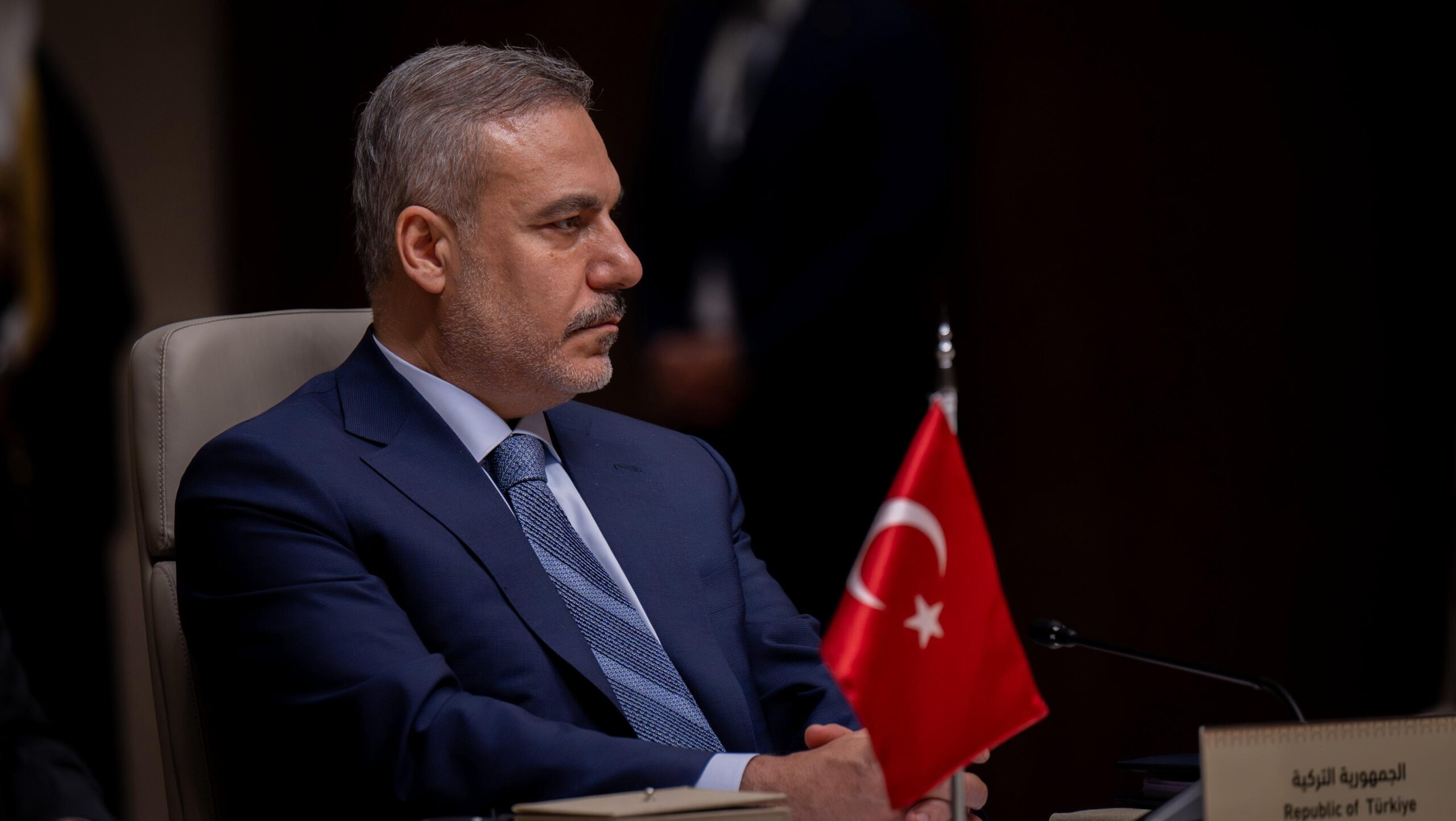
Turkish FM Fidan’s discomfort was evident. At the Riyadh meeting, the reaction of the oil-rich Arab monarchies, fearful of Israel, was directed at Iran. Israel was condemned only for its attacks on Lebanon—and that too at Türkiye’s insistence. The U.S. was not even mentioned. (Photo: X/MoF)
The joint statement issued by the foreign ministers of “regional countries,” who convened in Riyadh, Saudi Arabia, on March 18 to discuss developments in the Iran war, is the kind that may one day be remembered as a victory for Israel. The only sentence in the statement that mentions Israel is the one condemning its attacks on Lebanon—and that, reportedly, was included at Türkiye’s insistence.
This sentence does not suffice to justify the presence of Foreign Minister Hakan Fidan’s signature on behalf of Türkiye. Nor does his subsequent remark in Qatar—where he traveled after Saudi Arabia—that “Israel is the primary cause of the war” change the situation. He did add, “Regardless of the justification, Iran’s attacks on regional countries are unacceptable.” It would have been better if he had not signed the statement or had at least added a reservation. The statement condemns Iran from beginning to end, while the United States is not even mentioned.
It is as if it was not the United States and Israel that initiated the attack on Iran on February 28. I am not saying Iran is right, but it is as if Iran suddenly began launching missiles at the oil-rich Arab emirates of the Gulf from US bases in the region without provocation.
A bloody and hypocritical game is being played in plain sight of the world.
“At Least Don’t Bomb During the Meeting”
Foreign Minister Fidan shared an anecdote during a press conference in Qatar. As he was about to enter the meeting in Riyadh, at around 22:30, Iranian Foreign Minister Abbas Araghchi called him. Fidan reportedly said, “You’re calling us now,” adding, “Missiles are also coming from above. At least don’t send missiles to Riyadh while the meeting is taking place.” This is another dimension of the situation. While Iranian President Masoud Pezeshkian was telling President Tayyip Erdoğan, “We did not launch them,” a third missile reportedly arrived. However, Ankara has information indicating that all three missiles were launched from Revolutionary Guard headquarters.
Meanwhile, CHP’s Murat Emir raised the question: “Doesn’t Iran have the right to defend itself?” He criticized Fidan by asking, “If missiles are launched at Iran from İncirlik, don’t you foresee that Iran would also strike Türkiye?”
Fidan had traveled to Qatar for a solidarity visit following Iran’s attack on the country. Iran’s motive for the attack was retaliation for Israel’s strikes on the South Pars oil and gas field and related refineries, which it jointly operates with Qatar. As a result of the attacks, oil and natural gas prices rose in an atmosphere where the possible closure of the Strait of Hormuz was already being discussed.
We Can’t Stop Israel, So Let’s Stop Iran
Every increase in global oil prices places an additional burden on the Turkish economy.
As US President Donald Trump’s administration seeks to end the war quickly and prepare for midterm elections with what it sees as a victory momentum, Israeli Prime Minister Benjamin Netanyahu’s insistence on continuing the war has reinforced this stance. US Secretary of Defense Pete Hegseth announced that the heaviest strike, which they claim will finish the job, would take place on the night of March 19.
After Trump played the NATO card, the United Kingdom, Germany, France, Italy, Japan, and the Netherlands responded to the US call and began pressuring Iran to keep the Strait of Hormuz open.
The oil-rich monarchies of the Persian Gulf—whose knees are trembling with fear of Israel—are both opening their territories to US bases and trying to broaden the front against Iran.
As long as Israel stands backed by the formidable war machine and financial power of the United States, no one seems capable of stopping it. Nearly everyone is instead trying to prevent Iran from defending itself to avoid drawing Trump’s anger. Russia and China—which for the first time are showing military interest in the Middle East through the Iran war—are closely monitoring developments.
Türkiye has so far pursued the right policy by staying out of the war and refraining from supporting either the United States or Iran. However, the Riyadh meeting presented an image that contradicts this stance. Türkiye should not be drawn into taking sides in the war and should continue its policy of active neutrality.