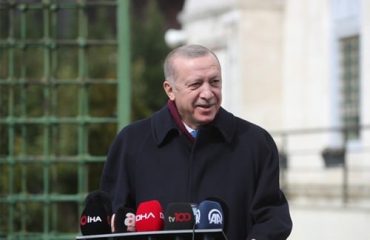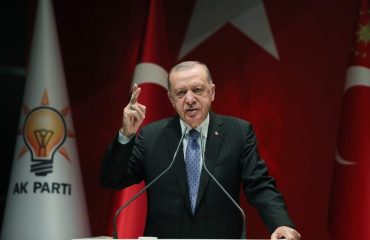
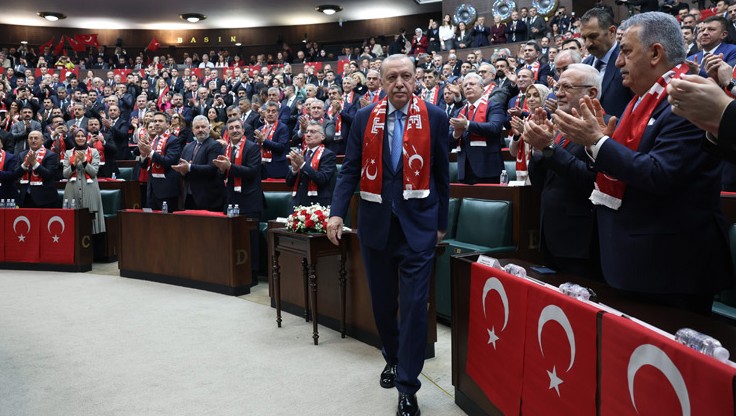
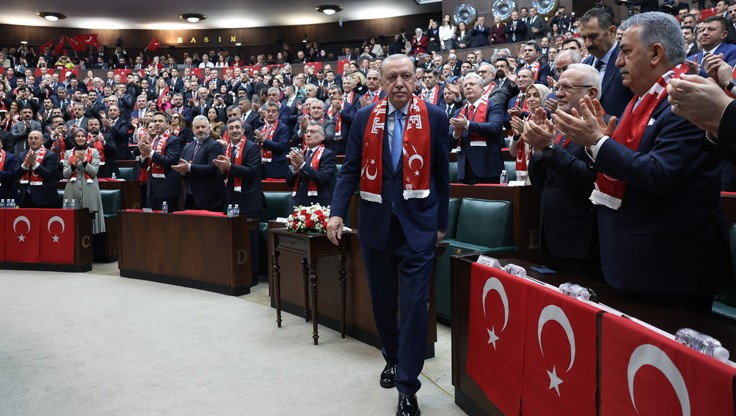
President Recep Tayyip Erdoğan’s latest speech reflects Türkiye’s concern that the Iran war could drag on and evolve into a Sunni–Shia conflict. The Turkish flags and scarves at the AK Party group meeting were to celebrate the national football team’s qualification for the World Cup after defeating Kosovo. (Photo: Presidency)
When the war of words with CHP leader Özgür Özel is stripped out of President Recep Tayyip Erdoğan’s April 1 address to the AK Party parliamentary group, what remains is in fact an important message aimed at external audiences. Reading between the lines, the message highlights concern that the Iran war—launched by the United States and Israel—could evolve into a Sunni–Shia conflict with regional and global repercussions. After reiterating that Türkiye will not enter the war and is doing its utmost to promote de-escalation, Erdoğan said:
- “However, among the dangers awaiting our region is not only the prolongation of the war but also the risk of it turning into a regional internal conflict. Retaliatory strikes targeting energy, transportation, and civilian infrastructure unfortunately increase this likelihood. (…) Any development that would prolong the war by opening new fronts will serve Israel’s bloody strategy and will cost our region dearly.”
Concern Over a Sunni–Shia Conflict
Now, taking the derivative of Erdoğan’s words:
- Türkiye currently sees the greatest danger as the war dragging on and turning into a “regional internal conflict.”
- There is already a war in the region. Both Israel and Iran—both are theocratic states—are regional actors. So too are the Arab monarchies caught between the U.S.-Israel offensive against Iran and Iran’s retaliation. The U.S.-Israel attack on Iran is not, in itself, a civil war.
- Therefore, by “regional internal conflict,” Erdoğan is referring to a conflict among Muslim countries. He clearly alludes to the danger of a Sunni–Shia confrontation, which he had explicitly mentioned in his March 11 speech, though this time he avoids stating it outright, likely to avoid further escalation.
- His warning about “retaliation against energy, transportation, and civilian infrastructure” is directed at Iran’s Shia clerical regime.
- His warning about “opening new fronts” is aimed at the Sunni Arab monarchies of the Gulf—primarily Saudi Arabia, but also the UAE, Qatar, Kuwait, and Bahrain.
- In sum, Erdoğan is signaling that a sectarian war among Muslim governments in the Middle East would be the most serious regional threat, with global ramifications.
Israel and Trump’s NATO Bluff
Without explicitly naming the United States, Erdoğan appears to believe that Israel is provoking Sunni–Shia tensions by pushing Gulf monarchies to enter the war against Iran.
Israel’s worshipping restrictions (both Muslim and christian) in Jerusalem, followed by a parliamentary move to introduce a special death penalty for Palestinian prisoners, reinforces this perception of deliberate provocation.
Such developments are followed by Italian Prime Minister Giorgia Meloni to declare that “Israel has crossed a red line” and to deny U.S. bombers access to Italian airbases. French President Emmanuel Macron reportedly took a similar decision.
It was in this context that former U.S. President Donald Trump issued a “withdrawal from NATO” bluff toward European allies. The bluff failed—most notably, UK Prime Minister Keir Starmer pushed back, effectively saying “that’s not going to happen.”
Without NATO’s geographic advantages, it would be extremely difficult for the U.S. to operate east of Gibraltar, challenge a Russia increasingly aligned with China, or continue offering Israel the kind of unconditional support it currently enjoys.
In fact, Trump’s remark in his April 1 address—“I did what no one else could in Iran”—sounded almost like a petition to Washington’s pro-Israel lobby ro give a message to Israeli Prime Minister Benjamin Netanyahu, to tell him that it’s time to give and end to wrap this war.
Sunni–Shia Fault Lines
The prospect of a Sunni–Shia conflict would mean the war Trump wants to end could instead spiral into Muslim societies turning against one another—allowing Israel to “kill two birds with one stone.”
The countries most vulnerable to such provocation include:
- Saudi Arabia, which sees itself as the leader of Sunni Islam due to Mecca
- The United Arab Emirates, across the Strait of Hormuz, which may be tempted by promises that it could gain control of the strategically important Abu Musa and Greater and Lesser Tunb islands if it retaliates against Iran
But such a scenario raises broader questions about the impact on Shia populations across the Middle East and South Asia, and their links to Western countries:
- In Saudi Arabia, an estimated 10–15 percent Shia population lives in oil-rich eastern regions near Iraq and Kuwait, including around Dhahran—home to ARAMCO and a U.S. base—as well as in the south near Yemen’s Houthi-controlled areas.
- Iraq (excluding the Kurdistan Regional Government, which cooperates with the U.S.) is trying to stay out of the war, but 65–70 percebt of its population is Shia and concentrated in key oil-producing regions bordering Kuwait and Saudi Arabia.
Potential Regional and Global Impacts
- Pakistan, after Iran and Iraq, is one of the countries where Shia populations are most influential. It is already in conflict with the Taliban in Afghanistan, which is supported by India—an ally of Israel.
- In Bahrain, roughly 60 percent of the population is Shia, but the ruling elite is Sunni and backed by Saudi Arabia.
- If Sunni–Shia tensions escalate, there is a real possibility that Lebanon could effectively cease to exist as a state and be absorbed by Israel.
- In Iran, there is also a Sunni minority—Kurds, Baloch, and some Turkmen—who are excluded from holding top political office. Israel’s plan to have the U.S. use Kurdish and Baloch armed groups in Iran and Iraq as ground forces has, for now, failed. However, preventing a Sunni–Shia conflict may become increasingly difficult even for countries like Türkiye, Egypt, and Pakistan.
Türkiye’s Position
Shia population in Türkiye are estimated to make up around 1 percent of the population, living mainly in eastern provinces Iğdır, Kars, Ardahan, and—due to internal migration—in Istanbul. While there may be emotional sensitivities, there is no major threat to domestic peace.
However, if Iran were attacked by Gulf states, there is a risk that militant factions among Türkiye’s Alevi population—as well as militant Sunni groups—could be provoked against each other. Preventing this would require political responsibility not only from the government but also from the opposition.
Ultimately, Ankara’s primary strategic concern is that a prolonged Iran war could fuel Sunni–Shia conflict, weakening Muslim societies and states through internal strife—thereby enabling Israel to expand its regional influence.