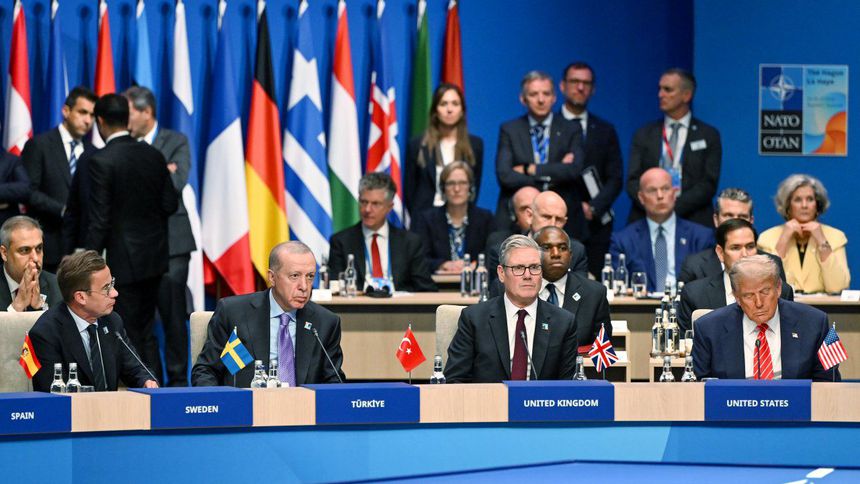
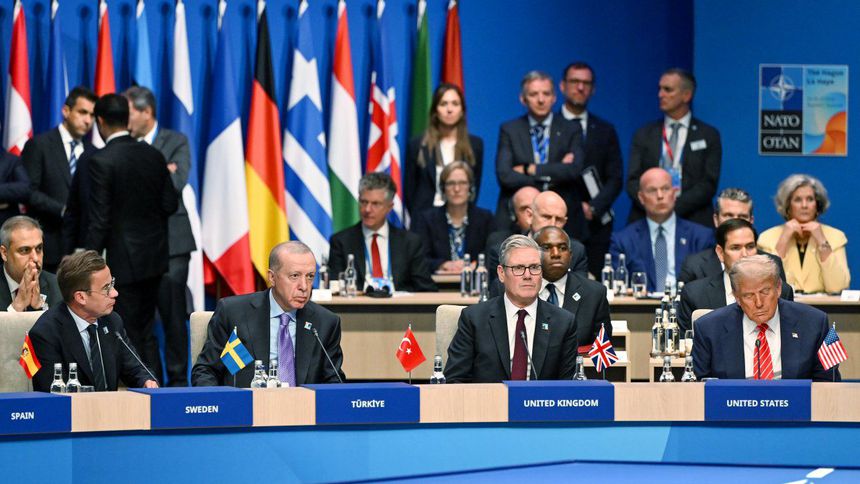
NATO’s EU members will face a moment of decision at the Ankara Summit. France represents one extreme by rigidly equating being “European” with being an EU member. Germany, by contrast, does not appear to share the same level of rigidity. After all, three strategically important military powers on NATO’s European side — the United Kingdom, Norway, and Türkiye — are not EU members. (Photo: 2025 NATO Summit-The Hague/ Netherlands)
There was an interesting meeting at the British Embassy in Ankara on the evening of May 12. In a rather unusual arrangement, the invitation-only gathering — organized with the support of the French and German embassies as well — focused on the NATO leaders’ summit to be held in Ankara on July 7–8. Under the rules of the meeting, titled “A NATO Dialogue,” I cannot disclose who attended or who said what. However, I can relay the topics discussed, as well as note that alongside representatives of the three countries, there was also a speaker from the Turkish Foreign Ministry.
Four Major Topics
First of all, it is worth noting that NATO — which only a few years ago was being described as “on the verge of collapse,” and even declared “brain dead” by French President Emmanuel Macron — will use the Ankara Summit to discuss how to expand its influence into neighboring regions.
The agenda can broadly be summarized under four headings:
- Commitment and Solidarity: NATO’s principle that members come to the aid of an ally facing threats or attack was recently tested in Türkiye’s case. Four missiles launched from Iran were intercepted through NATO’s air defense system. Discussions will focus on strengthening this capability with more advanced command-and-control systems.
- Defense Cooperation and Expanding Production: Efforts are expected to continue to revive the defense industry through greater cooperation, largely under pressure from the United States on NATO’s European members.
- Security and Energy Cooperation with the Middle East: The Iran war initiated by the United States and Israel, along with the resulting Strait of Hormuz crisis, has once again highlighted the Middle East’s importance for Europe. The “North Atlantic” alliance is now expected to engage more closely with Middle Eastern affairs.
- The Black Sea and NATO’s Eastern Flank: Russia’s war in Ukraine demonstrated that Black Sea security is a crucial element linking NATO’s Eastern and Southern flanks.
NATO and Türkiye
All these issues require Türkiye’s role in expanding NATO’s regional influence against Russia and, increasingly, China.
For example, the need to strengthen Türkiye’s air defense capabilities — including its fighter fleet — became more evident in light of the Iranian missile incidents.
There are expectations that the summit will pave the way for new bilateral and multilateral agreements reflecting the progress Türkiye has made in its defense industry over the past decade.
Ankara is reportedly seeking to invite four Gulf countries — Qatar, the United Arab Emirates, Kuwait, and Bahrain — as observer participants to the summit hosted by President Recep Tayyip Erdoğan.
In the Black Sea, Türkiye already has special agreements with fellow NATO and EU members Romania and Bulgaria, particularly on mine-clearing operations. Ankara’s red line remains the Montreux Convention, with the aim of avoiding new tensions with Russia.
Emphasizing that NATO is an international alliance operating by consensus rather than a supranational structure, Ankara is not opposed to the idea of a “more European” NATO. What Türkiye opposes is the notion that, because it is not an EU member, it should be excluded from decision-making processes.
Europe at a Turning Point
NATO’s EU members will face a moment of decision at the Ankara Summit. France represents one extreme by rigidly equating being “European” with being an EU member. Germany, by contrast, does not appear to share the same level of rigidity.
After all, three strategically important military powers on NATO’s European side — the United Kingdom, Norway, and Türkiye — are not EU members.
At the same time, it is neither realistic nor meaningful to speak of increasing NATO’s influence in the Middle East, the Eastern Mediterranean, and the Black Sea while attempting to sideline Türkiye, the key actor in that geography. Such an approach seems driven more by historical and ideological obsessions.
Moreover, EU countries face two major obstacles in fulfilling their commitments to NATO (and the United States):
- Structural challenges, including weapons and ammunition procurement problems and differing strategic priorities,
- The rise of far-right populism in Europe, accompanied by growing anti-American sentiment and sympathy toward Russia.
Ankara’s Biggest Test
The Turkish capital has never before hosted an organization of this scale. Between July 7–8, Ankara is expected to accommodate 5,000 to 6,000 visitors.
Until now, Türkiye has hosted international gatherings of this magnitude either in Istanbul or Antalya. Both cities are major tourism centers capable of receiving large numbers of guests while continuing daily life relatively uninterrupted.
In that sense, the NATO Summit will also be a test for Türkiye. Success could open the door for Ankara itself to host more global-scale events in the future.
Meanwhile, diplomatic circles from guest countries are reportedly complaining about rising hotel prices during the summit, largely because Ankara’s hotel capacity is more limited compared to Istanbul or Antalya.
Most NATO member states enjoy living standards above Türkiye’s average. And considering the visa fees imposed on Turkish citizens, perhaps they can simply reach into their pockets and pay up.