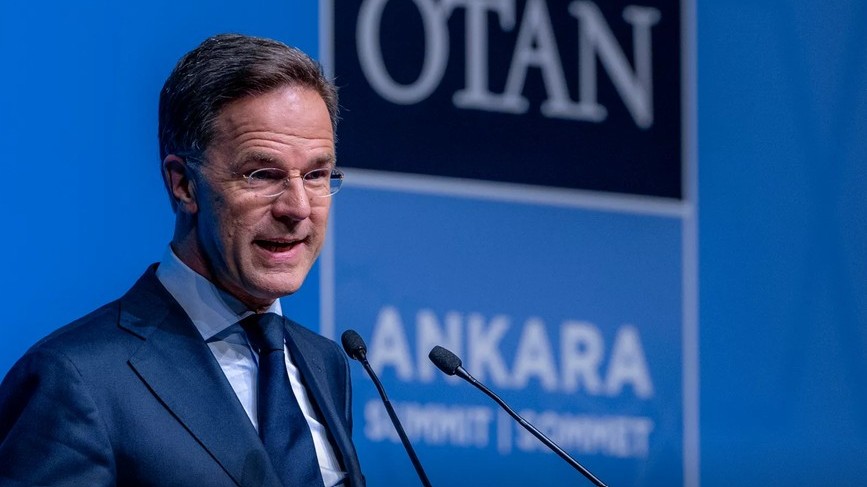
The Ankara Summit is widely regarded as the beginning of NATO 3.0—the alliance’s third era. In reality, it marks the formal emergence of a new Cold War. Secretary General Mark Rutte’s definition of NATO 3.0 does not fully capture its broader geopolitical implications. (Photo: NATO)
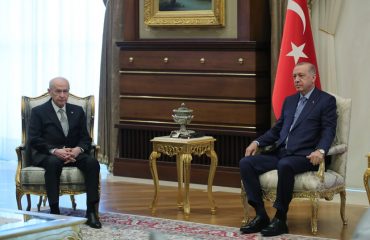
If you view NATO’s July 7–8 Ankara Summit as the founding meeting of the “New Cold War” NATO, then the legal cases against Turkey’s main opposition Republican People’s Party (CHP) and Istanbul Mayor Ekrem İmamoğlu no longer appear contradictory. It also fits with U.S. President Donald Trump’s renewed warnings about the “communist threat” during his speech marking the 250th anniversary of American independence. Likewise, there is no contradiction in seeing NATO Secretary General Mark Rutte criticize Turkey by saying, “Democracy is not only about free elections,” while also stressing the importance of press freedom at his Ankara press conference, only to be seen walking hand in hand with President Recep Tayyip Erdoğan. Under the logic of a new Cold War, political and military priorities inevitably outweigh rights and freedoms everywhere.
What Does NATO 3.0 Mean?
Ever since NATO’s July 7–8 Ankara Summit began to be described as the alliance’s third historic turning point, Rutte has sought to cement the label “NATO 3.0” in public discourse.
According to this framework:
NATO 1.0 was the Cold War alliance. Established in 1949, it was primarily designed to contain Soviet influence in Europe after World War II. Turkey and Greece were admitted together in 1952 despite having no geographic connection to the North Atlantic, largely to block Moscow’s access to the Mediterranean and the Persian Gulf.
NATO 2.0 emerged after the Cold War. The collapse of the Soviet Union in late 1991 was, in many ways, viewed as a victory for the U.S.-led alliance. The doctrines of deterrence and containment seemed obsolete. Liberal theories arguing that NATO itself had become unnecessary, however, underestimated Russia’s recovery and China’s rise.
So what exactly is NATO 3.0?
The Alliance of the New Cold War
Rutte offered his clearest definition on June 25, one day after meeting Trump at the White House, during a speech at the Atlantic Council:
“NATO 3.0 means spending more on defense. It means a stronger Europe within a stronger NATO.”
That definition, however, is both incomplete and somewhat misleading.
A “stronger Europe” essentially means European NATO members allocating larger military budgets against Russia—and using much of those funds to purchase more American weapons. During both NATO 1.0 and NATO 2.0, the United States assumed primary responsibility for Europe’s defense. Trump’s repeated criticism—that Europeans outsourced their defense to America while spending their resources on prosperity and democratic welfare—stems directly from this reality.
European NATO members are now expected to increase defense spending from 2 percent of GDP to 3.5 percent by 2029 and to 5 percent by 2035. Achieving those targets will require politically painful spending cuts that voters are unlikely to welcome—precisely the kind of sacrifice associated with Cold War thinking. We are already beginning to see the consequences, as protests across European Union countries are increasingly being dispersed with levels of force not unlike those witnessed in Turkey.
The Middle East, the Black Sea and the Caucasus
Higher defense spending is not intended solely to deter Russia—and, by extension, its potential partner China. It is also designed to expand NATO’s strategic reach beyond Eastern Europe into the Black Sea, the Caucasus, and the Middle East.
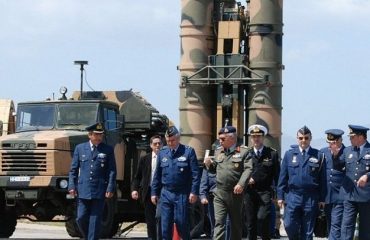
It should also be acknowledged that military sanctions imposed by several NATO members, particularly the United States, accelerated the development of Turkey’s own defense industry, reinforcing Ankara’s pursuit of strategic autonomy.
Within this new strategic landscape, Turkey has effectively moved from being viewed as a “peripheral country” to becoming a central country—not geographically, but in political and military terms. In that context, the establishment of a second rapid reaction corps near the Syrian border and the strategically vital Incirlik Air Base carries considerable significance.
Taken together, NATO 3.0 represents the return of NATO 1.0’s doctrines of deterrence and containment, now adapted to a geopolitical triangle involving Russia, Iran and China, while taking into account the widespread proliferation of ballistic missiles, cross-border terrorism and cyber warfare. That, in essence, is what this new Cold War is about.
Those Who Declared “NATO Is Dead”
These developments also suggest that speculation about the United States gradually withdrawing and handing over the management of NATO 3.0 to Europeans rests on shaky ground.
Washington wants Europe to assume greater responsibility for its own defense for two principal reasons.
First, it seeks to resolve Europe’s contradiction of fearing Russia while simultaneously trying to avoid confronting it. Russia’s war against Ukraine has become the defining factor here, particularly for Germany, which has paid a heavy economic price.
Second, the United States wants Europeans to shoulder more of the security burden—including threats originating from the Middle East—so Washington can focus on strategic competition with China in the Pacific, where Beijing enjoys growing support from Russia and North Korea. The biggest obstacle to that strategy is likely to remain Israel, whose recurring regional crises make American disengagement difficult.
For these reasons, it would be naïve to assume that the United States will loosen its grip on NATO under version 3.0, downgrade Europe’s importance in its competition with China, or allow America’s record-breaking defense industry to be overshadowed by ideological preferences.
At the same time, the concept of strategic autonomy, which Turkey has increasingly pursued in its relations with both the United States and NATO over recent years, appears likely to be embraced by other alliance members in pursuit of their own national interests.
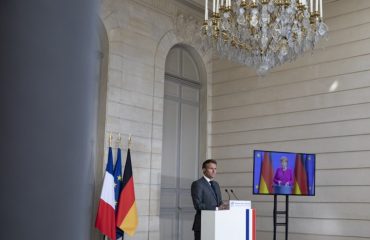
Only a few years ago, French President Emmanuel Macron famously declared that NATO was experiencing “brain death.” Today, his competition with Germany and Britain to shape NATO 3.0 is itself enough to demonstrate that the United States has no intention of relinquishing control.
Winners and Losers
From a national perspective, NATO 3.0 appears set to strengthen Norway on the alliance’s northern flank, Poland on its eastern flank, and Turkey on its southern flank.
Against this backdrop, President Erdoğan’s efforts to leverage Turkey’s military capabilities and defense industry to secure a closer relationship with the European Union—even if not full membership because of democratic concerns, then at least deeper economic integration—deserve attention.
From a broader economic perspective, however, one conclusion stands out: defense manufacturers are likely to become among the biggest winners worldwide.
Unfortunately, another conclusion is equally apparent. In this New Cold War, democratic forces working to expand rights and freedoms are likely to become the primary targets of political pressure across many countries.
The Ankara Summit may therefore be remembered not only as the beginning of NATO 3.0, but also as the moment when a new global political and economic era officially began.